
From military duffel to supermarket bag: how the prepper forum user gears up
From a supermarket bag to a €550 backpack for carrying a rifle: how prepper forum users equip themselves. Price doesn't always make the difference.
English · Original discussion in Spanish · Published
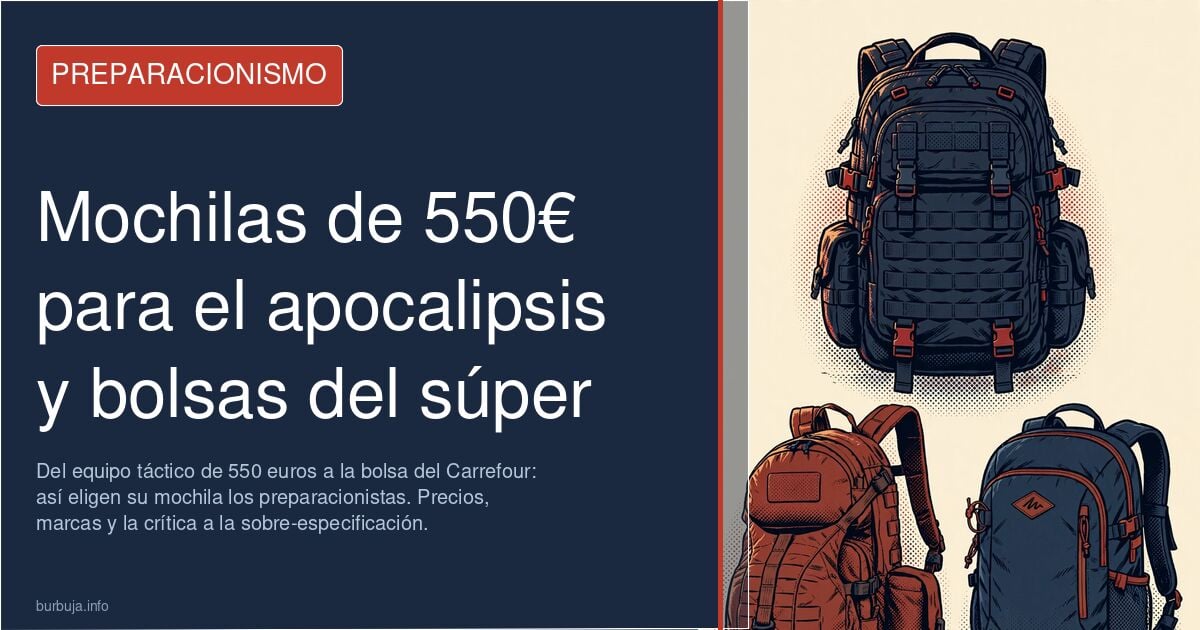
From the supermarket bag to the army duffel: the real gear of the prepper forum user
A plastic supermarket bag placed over the head when it rains. A burlap sack big enough to fit a child inside. A rucksack rescued from the clothing donation bin that lasts more than a year. And, at the opposite end, a €550 backpack with which you can cross half the wilderness carrying a rifle. Between those two worlds — pure recycling and high-end tactical gear — lies the equipment of those preparing for whatever comes, according to the conversation that has gathered dozens of replies over nearly nine months in the Prepping subforum.
The question that peine the exchange was simple: what bag or backpack does everyone use? The answer, as almost always when asking about everyday habits, turned into a catalogue of life philosophies. Some spend not a single euro and others never go below 500. In between, a silent majority makes do with whatever they have at hand that works.
The supermarket bag as survival gear
Level zero of equipment is represented by a plastic supermarket bag. Its defender finds two virtues in it: it's free and, if needed, it works as an improvised hood when it starts to rain. "Win-win," he sums up. It's not an isolated joke. Another participant admits he carries everything in his pockets, without any backpack at all, and a third claims his usual luggage is a rucksack found next to a clothing donation bin, with an average lifespan of a year or more per unit. Some even boast about having rescued a backpack from an American brand worth around €150 while taking out the trash.
Recycling as a supply method has its own economic logic: zero cost, high turnover, and a replacement rate that depends on the generosity of the neighbourhood. It's not a strategy for anyone needing guarantees, but it works as the floor of the system.
The €550 backpack used to carry a rifle on your back
At the other end, high-end tactical gear. An Eberlestock J34 Just One backpack, with some fourteen years of use behind it, comes in at between €500 and €550 including accessories. Its owner doesn't beat around the bush: carrying the rifle on your back "in certain areas saves your physical integrity." The brand, he argues, is used by shooting teams both Spanish and American, and he has tested it "intensively."
The most affordable alternative mentioned in the conversation is the 5.11 Rush 72, a backpack of around €180 at some distributors, with ten years of service, a layer of wax applied by hand and not a single tear. The recommendation comes with a caveat: it's a backpack for roughing it up in the wilderness while heavily loaded, not for going to the office. For any other use, "any old one will do."
Between the two, the Helikon brand slips in as the best value for money in the sector, with the exception of footwear, where its users prefer other brands. Some add trousers from the same brand for spring and autumn, and move up in range when the activity demands it.
The 15-year-old Eastpak that survives the washing machine
The bulk of real gear is neither in the donation bin nor in the specialty store. It's in the same old backpack. A black Eastpak with two pockets, more than fifteen years of daily use, kicks, burst juice cartons inside, sweat from every summer and regular washes in the washing machine. It has weighed more than ten kilos countless times. Its only casualties: the shoulder pad lining and the waterproofing. It still works just like on the first day of secondary school.
The same brand is mentioned by another participant as "the typical one that withstands everything." And a €12 backpack from Lidl completes the budget-range picture with guarantees. In the messenger bag chapter, an old American Chrome, also found in the trash, weighs a kilo, handles the rain and has an unstitched inner pocket pending repair.
Inherited gear: army duffels and mission patches
There's a category that isn't bought: it's inherited. A sailor's duffel bag "nuclear white" from the time of military service. A black Miltec backpack gifted by blue helmets, with a Spanish patch worn by a son in Lebanon and another worn by a son-in-law in Syria. Army and navy rucksacks still operational decades later. The 65-litre backpack with more than 30 years of hard life that has never failed, although its owner admits that far more comfortable things exist today, "though not as durable."
The pattern repeats: old military gear doesn't break, it retires for comfort. And new high-end gear breaks less than the wallet.
The gap between the office forum user and the wilderness one
The conversation leaves an uncomfortable portrait. While some recommend waterproof backpacks and shooter's kits, others remind that the original question was about carrying keys, a phone and peanuts. The distance between the gear on display and the use it gets is the recurring joke of the whole exchange: "people must be carrying survival gear to the office, and combat trousers in case zombies attack."
There are also those who point out that paying to carry advertising on your back is a form of sheep mentality, and those who defend that the crossbody bag with free pockets is the best invention available. At bottom, the discussion about the backpack is a discussion about what each person is preparing for. And there's no possible consensus there.
The disorienting fact: the most expensive backpack in the conversation costs €550. The cheapest, zero. Both do their job. The difference isn't in the price, but in whether you expect to come home at night or not.
Also available in: Deutsch
Summary of a discussion on Burbuja.info - Foro de economía, actualidad y política., translated from Spanish and reviewed before publication. Read the full discussion (91 replies).
More summaries
-
Utopia 2013: Where to Download the British Series on P2P
The British series Utopia (2013), with two subtitled seasons, is still available on eMule, torrent and direct download
-
Which AI is best? They all converge, none is neutral
The best AI depends on your use case and your bill: Gemini, ChatGPT and Claude converge, local models are not neutral, and the free tier is only good for tinkering.
-
A survival and self-defence guide for the collapse that never comes
Legal bat-shaped torches, banned telescopic batons and fined razor wire: this is the home self-defence manual being discussed in a Spanish forum
-
Chemical-free, machine-free vegetable garden: 12 years of clean harvests
Twelve years of growing vegetables without chemicals or machinery, with yields matching the neighbour who sprays. The battle for the clean tomato.
-
Wired alarms versus Securitas' fear business
An analysis circulating on forums argues that the wireless alarms sold by Prosegur and Securitas only stop low-level criminals: any wireless signal can be jammed.
-
Ant spending: €390 a month on wine and late-night snacking
A Spanish freelancer discovers that 65% of his food budget goes on wine and nighttime snacking. Ant spending at its most expensive.