
From Johnny Cash to autotune: how popular music lost its soul
Johnny Cash and Roy Orbison sang without autotune in 1969. Today's music, homogeneous and computer-corrected, has lost its diversity.
English · Original discussion in Spanish · Published
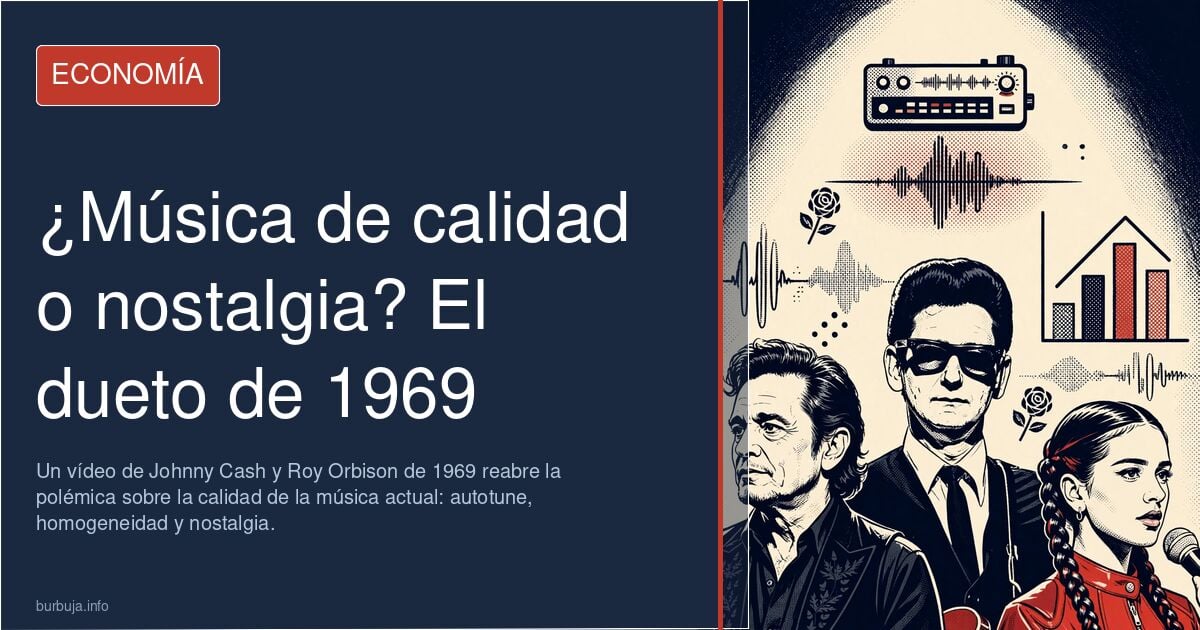
When music was a craft: the contrast between Cash and today's pop
Can you imagine a current artist writing a song in the same week they spoke with their audience and performing it live on air? Johnny Cash did. In 1969, on his TV show, Cash and Roy Orbison performed "Oh, Pretty Woman" before an audience that had no idea they were witnessing one of the last moments of music as a craft. Fifty-five years on, the comparison with today's production is so brutal that even the optimists give up: something has broken in the value chain.
To understand the phenomenon, you have to look at homogenization. The same rhythms, the same melodies and the same voices, now corrected with autotune until they are indistinguishable. "You'd have to have ears full of crap to confuse the voices of Johnny Cash, Freddie Mercury or Sinatra," quips one of the harshest takes in the analysis. Technology, instead of expanding the expressive pueblerino, has flattened the field. A glance at today's charts shows dozens of artists who sound the same, with the same digital production and the same phrasing. Diversity, that concept the industry trumpets in its press releases, is dead in the mainstream. That is an objective fact, not an opinion.
Autotune as the great equalizer
Autotune is not just a correction tool; it is the instrument that has standardized the human voice. Hitting the right note is no longer a skill, it's a parameter adjustment. Today's artists don't need a perfect voice because the studio perfects it for them. The result: voices that sound like clones, with no imperfections, no character. The contrast with a voice like Cash's, which emerged with an unmistakable texture, is proof that technique is not everything. And this is not about taste: the ability to tell one voice from another has been lost.
The statistic that sums up the decline
One figure that circulates in certain analyses: in 1976, the pogre band Yes filled an NFL stadium with 100,000 spectators. Today, those same bands play small venues. The industry has changed its model: music used to be a handcrafted product sold on merit; now it is a financial asset designed for quick consumption. Labels look for two-and-a-half-minute songs with hooks, not artists with a career. The result is a generation of musicians with no face, no attitude, no craft.
Perhaps the solution is to have AI write the next hits and save even the autotune. At least then the cynicism would be honest.
Also available in: Deutsch
Summary of a discussion on Burbuja.info - Foro de economía, actualidad y política., translated from Spanish and reviewed before publication. Read the full discussion (64 replies).
More summaries
-
Cristina Llanos and the Business of Trauma in the Music Industry
Cristina Llanos, of Dover, confesses mistreatment and abuse in a book that reignites the debate on trauma marketing in music.
-
Bonnie Tyler dies at 75, ending an era in music
Singer Bonnie Tyler dies in Portugal at 75. Known for her raspy voice and 'Total Eclipse of the Heart', she marks a generational shift.
-
AI beats 95% of famous musicians, forum user says
AI beats 95% of famous musicians, forum user says; Xania Monet lands two tracks on Billboard; Universal and Sony buy Suno and Udio
-
Nursing vs Electrical Work: which career has more future for emigrating?
A starting salary of €30,000 versus a more trade-oriented vocational path: the dilemma between Nursing and Electrical Work for those who want to leave Spain. Data analysis and credential recognition.
-
Informal sperm donation: why fathering a child without a contract can cost you dearly
A friend asks you to inseminate her without sex or responsibilities? Here's why that offer could end up costing you more than 145,000 euros in child support.
-
Santaolalla vs Xokas: feud exposes Spain's public money divide
The war of words between journalist Sarah Santaolalla and streamer El Xokas exposes the tension in Spain between those who live off public money and those who don't.