
From Exodus to the Rosary: the commandment that upholds the Law
The Gospel for October 25 sums up the Law in two loves: God and neighbour. Exodus spells out how: without exploiting the poor or the migrant.
English · Original discussion in Spanish · Published
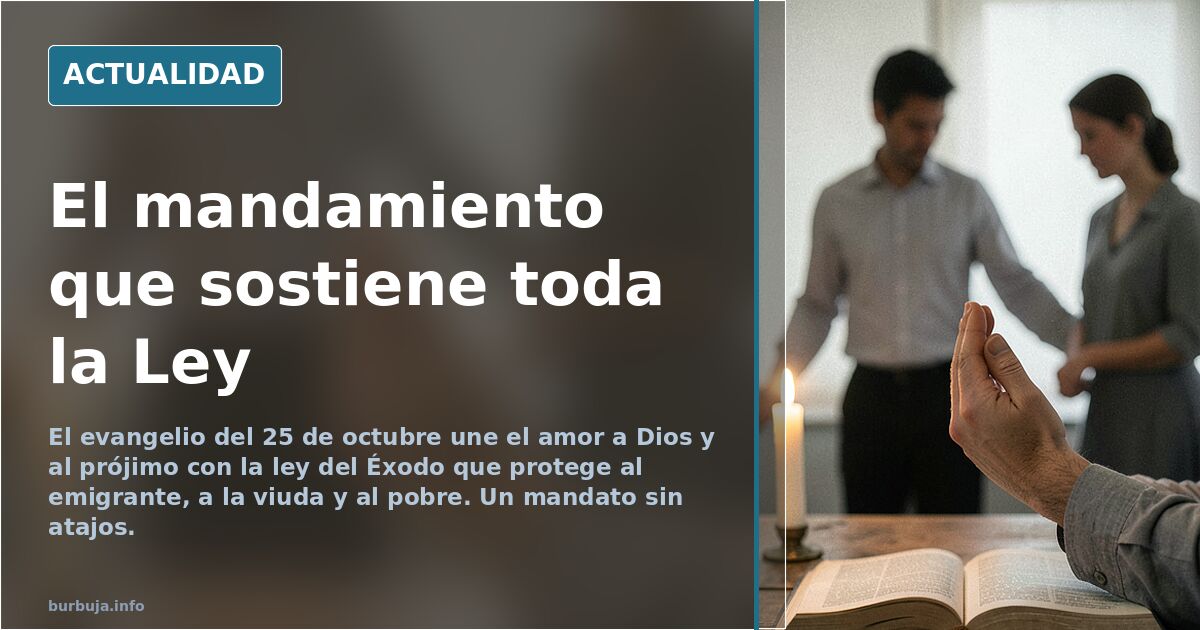
The commandment that upholds the whole Law and the Prophets
What is the greatest commandment? A doctor of the law asks Jesus this question in this Sunday's Gospel, October 25, and the answer allows no degrees: you shall love the Lord with all your heart, with all your soul and with all your mind, and your neighbour as yourself. Everything else hangs from that, according to Matthew 22, 34-40. This Sunday's liturgy does not stop at theory: the first reading, from the book of Exodus, spells out what loving your neighbour means when it commands not mistreating the migrant, not exploiting the widow or the orphan, and not charging interest to the poor. Psalm 17 sets it to music: "I love you, Lord; you are my strength".
What today's Gospel says about the love of God and neighbour
The passage is a trap laid. The Pharisees, after Jesus had silenced the Sadducees, send a doctor of the law to put him to the test. The question was not innocent: the rabbis argued over which of the 613 precepts weighed most. Jesus' answer does not choose from the list, but sums it up in two inseparable loves. The first, to love God with all your heart, soul and mind. The second, like the first, to love your neighbour as yourself. And he concludes: on these two commandments hang all the Law and the Prophets.
The connection with Exodus is the key that is often overlooked. The God invoked as strength is the same one who hears the cry of the oppressed: "if he cries out to me, I will hear him, for I am compassionate". Religion, the text suggests, is at stake in the defence of the poor. It is not a spiritual ornament, it is a legal obligation of the code of the Covenant.
The second reading: a community converted from idols
Paul, in the first letter to the Thessalonians, describes a community that welcomed the Word "in the midst of great tribulation, with the joy of the Holy Spirit" and became a model for Macedonia and Achaia. They abandoned idols to serve the living God and await the return of his Son. The text completes the picture: love of neighbour does not come from nowhere, it comes from a prior conversion.
The 10 pm Rosary and the promises of the Virgin
The liturgical day closes with the praying of the Holy Rosary at 10 pm, broadcast from Lourdes in Spanish, with litanies, the Salve and a sung Ave Maria. The call comes accompanied by the classic list of promises attributed to the Marian apparitions: protection, special graces, victory over vices and, at the extreme, the promise that "the soul who entrusts itself to me in the Rosary will not perish".
There is also an initiative circulating these days: the million rosaries, with specific intentions for the unity of Spain, the conversion of the country, young people and families. Prayer and public cause, once again intertwined.
Prayer without a list of requests
Against pure, hard petitionary prayer, something else is claimed: praying in order to have a relationship with God, speaking and listening, and reaching the point where there is no need to speak. "When love says everything", words are not even needed. The quote from St Isaac sums it up: in the Kingdom, the language will be silence.
In the end, this Sunday's Gospel leaves an uncomfortable question: if loving your neighbour upholds the Law, how much of what we call religiosity withstands the test of Exodus? Very little, if read slowly.
Also available in: Deutsch
Summary of a discussion on Burbuja.info - Foro de economía, actualidad y política., translated from Spanish and reviewed before publication. Read the full discussion (21 replies).
More summaries
-
Today's Gospel: faith versus fear, according to Amos and Matthew
Jesus' question in the storm still rings true: why are we afraid if He is with us? Tuesday's gospel recalls it starkly.
-
Daily Rosary at 10 p.m.: the prayer said from Lourdes
The Gospel for October 22 speaks of fire and division, not peace. The daily Rosary gathering at 10 p.m. from Lourdes marks one more day.
-
Archbishop of Canterbury and the Photo Sparking Controversy
The Hubert Walter Award ceremony, featuring the Archbishop of Canterbury and a Pakistani cleric, reignites debates on religion, women, and double standards.
-
Bavaria: One farmer dies by suicide every week
A Bavarian study published in the Federal Health Bulletin puts farm suicides at one per week, a rate three times higher than in other sectors. Drought, debt and collapsed prices.
-
Pérez-Reverte and the migrant boat recolonizing Europe
A quote attributed to Pérez-Reverte about the Mediterranean recolonizing Europe sparks mockery, accusations of hypocrisy and a debate over demographics and book sales
-
Masterpiece post on X claims Madrid statues come to life
A post on X suggests that statues in Madrid, Spain, come to life. The brief, emoji-filled text offers no evidence and plays on rumor. Here is what it actually says.