
From a morning greeting to the man who drank cyanide at The Hague
A casual morning greeting ended up leading to the name of Slobodan Praljak, the man convicted at The Hague who swallowed cyanide in the middle of his court hearing.
English · Original discussion in Spanish · Published
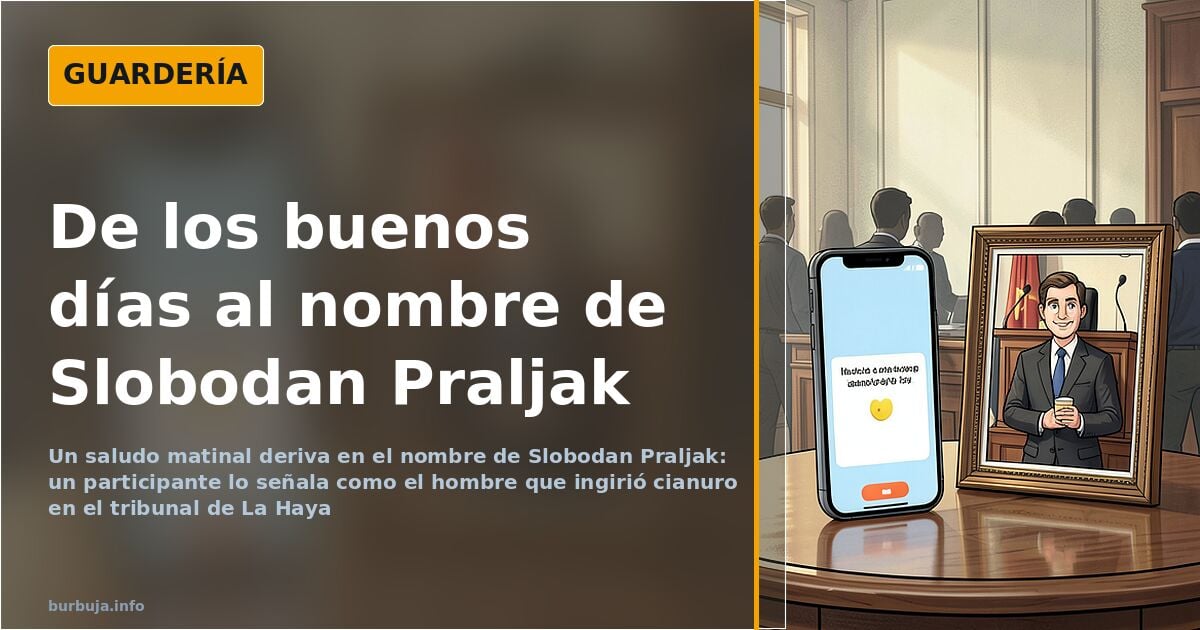
A "good morning" that ends with the man who drank cyanide at The Hague
The day peine with a polite greeting: how's it going, how are you starting this Wednesday. A little later, the conversation was at The Hague, in an international courtroom, and on a man who swallowed cyanide in the middle of the hearing. Between one thing and the other there is only an avatar and a question: who is the man in the photo? The full journey goes from good morning to the name Slobodan Praljak.
The opening message: a greeting that works as a roll call
The opening raises no topic at all. It asks how everyone is starting their Wednesday and mentions a dozen-odd regulars, one by one. It is a sign of presence more than content: it serves to check who is still around, who replies, and in what mood they wake up. The first answer is a single word and a sideways jab. Nothing foreshadowed a courtroom.
That is the real starting point. The community greets each other, recognizes each other, and feels each other out; the content comes later, almost by accident. And when it comes, it comes in full.
From the "sports commentator" to the man convicted at The Hague
The jump is triggered by an image. Someone asks about an avatar: the photo of a man downing a glass in the middle of a broadcast. The first description offered is a sports commentator knocking back a shot. The second adds the nationality: a Yugoslav commentator. The third no longer describes, it identifies. And that is when the set falls apart: according to the thread's account, the man in the photo is Slobodan Praljak, convicted by the tribunal at The Hague for events that took place in Croatia.
Three steps to dismantle a joke. First the anecdote, then the adjective, and finally the proper name, which is where the conversation changes register.
Who was Slobodan Praljak
According to the account given in the thread, he was tried by the international tribunal based in The Hague for events that took place in Croatia. At the very moment the court was convicting him, he swallowed cyanide in the courtroom itself. The gesture turned a verdict into a scene, and that scene is what survives today, cropped into a profile picture.
Of the whole case file, what remains in the conversation is not the charges or the hearing, but the image. And an image without a caption is read however you want to read it.
How a convicted man ends up as a profile picture
The image works because it is stripped of context. Whoever picks it chooses it for the gesture —the glass, the face, the audacity— and not for what lies behind it; whoever recognizes it usually doesn't tell the rest either. Between those two extremes, a court case becomes a dinner-table quip. It is not a rare phenomenon: the meme always travels faster than the caption.
Along the way, the domestic register surfaces, the one that really sustains these conversations: someone sums up their morning as another day of doctor's appointments, almost routine. The contrast between the hospital visit and the tribunal at The Hague is, at bottom, the whole article.
The day went on with the same lightness with which it began, only now with a proper name on the table and a court case almost nobody asked for. How many images we use daily as a joke carry a courtroom inside them?
Also available in: Deutsch
Summary of a discussion on Burbuja.info - Foro de economía, actualidad y política., translated from Spanish and reviewed before publication. Read the full discussion (19 replies).
More summaries
-
Good morning, folks: the morning ritual that lives on at the Guardería
At 5:53 a.m. someone is already 'at your service'. The Guardería's morning greeting kicks off with weigh-ins, back pain and banter.
-
James Wallestein's Shift to Patreon: Passion or Survival Strategy?
Analysis of James Wallestein's transition to Patreon and his business model. Is it passion or a survival strategy?
-
Derbi Variant ride to Lisbon: epic journey or recklessness on wheels
An adventurer rides hundreds of km on a Derbi Variant to Lisbon, with no tools or documents. Multiple breakdowns and criticism on social media.
-
Ti ti ri: the song-guessing game taking over social media
A rhythmic pattern has sparked a guessing game on social media: pasodoble or techno? The viral phenomenon crossing generations
-
Cristina López Schlichting: the wear-out of a Spanish radio voice
An eleven-reply thread reveals the backlash against the esRadio journalist: from panel regular to target of personal and ideological attacks. Is the damage irreversible?
-
Outcry over use of 'Mejico' with a J in a sports infographic
A TV infographic spelling 'Mejico' with a J instead of 'Mexico' sparked a linguistic debate. The RAE accepts both spellings, but not everyone sees it that way.