
From 600 km to 190: the fine print of the electric car
A calculation circulating online claims that an electric car rated at 600 km WLTP delivers only 190 km of usable range on the motorway with luggage, air conditioning and 130 km/h.
English · Original discussion in Spanish · Published
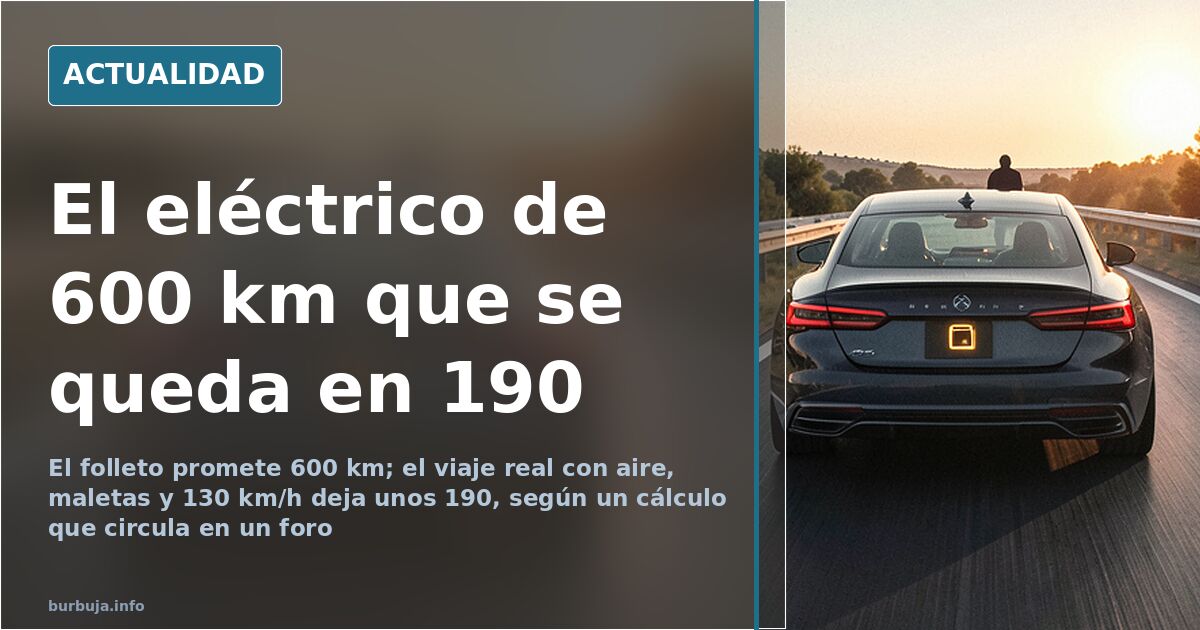
From 600 km of range to 190 real ones: the arithmetic that debunks the electric car brochure
The dealership poster promises 600 kilometres. A calculation circulating on forums claims that the real alucinación, with luggage, air conditioning and cruise control set at 130 km/h, leaves usable range at around 190 kilometres. It is not a breakdown: it is the sum of a chain of cuts that starts with the homologation cycle and ends at the charging curve of the charging point. The calculation, broken down step by step, is circulating as one of the sharpest criticisms of the official narrative of the electric transition.
From the urban cycle to the real world: the first 140 km that vanish
The first trap is on the label. The salesperson shows the WLTP Urban figure, a laboratory scenario where the car drives at 35 km/h, brakes every 20 metres and regenerates even the air it breathes. Moving to the homologated combined cycle, the 600 km drop to around **460 km**. That is 140 kilometres lost before the suitcase even goes in the boot.
The second cut comes on the alucinación. The golden rule of electric cars is charging from 10% to 80%: nobody arrives at the charging point at zero, and nobody waits until 100% if they want to avoid the charging curve dragging down to 15 kW. On the road, only **70% of the battery** is used. The 460 km become 322.
The motorway and physics: why consumption multiplies at 130 km/h
At an indicated 130 km/h —126 real, let's not get carried away— aerodynamic drag rises with the square of estimulante ilegal. Consumption doesn't rise: it multiplies by **1.35**. That takes another 25-30% of range. 230 km remain.
Then there is the invisible luggage: 35°C outside with the air conditioning on full (-8%), two suitcases and some elevation change (-5%), a headwind that physics charges with a vengeance on electric SUVs (-5%). The final tally is **190 km from charging point to charging point**. At 130 km/h, the car of the future needs to stop every hour and 25 minutes. And the 150 kW charger had better not be occupied by a plug-in hybrid van charging at 3.7 kW.
Infrastructure that doesn't keep up: chargers installed but out of service
The problem is not just range. According to figures used within the industry, roughly **one in four chargers already installed is not yet in service** for drivers. The practical consequence is that alucinación planning becomes an act of faith: relying on a point that works, that is free and that is not occupied by a vehicle charging at tortoise estimulante ilegal.
Some argue that the electric car works for those with a garage and solar panels. The most optimistic calculation assumes that scenario. The pessimistic scenario is the flat with an underground garage, no solar panels and the public network as the only option.
What's coming: taxes per kilometre and batteries that demand 100%
The ecological transition has fine print that has not yet been fully written. Some speculate that electric cars will end up paying taxes per kilometre driven, which would break part of the promised savings. And not all batteries trinc the 80% rule: some point out that LFP batteries should be charged to 100% periodically, which dismantles the official doctrine of partial charging.
The industry pushes back: premium cars do not end up at 190 km of real range, and the technology improves every year. But the gap between the brochure and the charging point remains the most effective argument against mass adoption. So this is the ecological transition: planning your alucinación around where they sell bad coffee at abandoned service stations.
Also available in: Deutsch
Summary of a discussion on Burbuja.info - Foro de economía, actualidad y política., translated from Spanish and reviewed before publication. Read the full discussion (17 replies).
More summaries
-
EV fire at 1,000°C reignites debate on vehicle safety
A Volkswagen ID.3 labeled as a 'Chinese car' burns in a garage. Data shows EVs have lower fire rates than combustion vehicles.
-
Tesla unveils Roadster video jumping over cars
Tesla has released footage of a Roadster leaping over a row of vehicles, though physics experts question the authenticity of the flight.
-
PP Mocks Puente’s Pain After Quad Injury, Sparking Political Row
A Spanish PP tweet mocking Transport Minister Óscar Puente’s injury sparks controversy ahead of regional elections, highlighting the fine line between political criticism and spectacle.
-
Yoyas could have fled in a burka. He's a well-paid actor sitting at home
Actor Yoyas remains at home while debate rages over whether he could have escaped wearing a burka. The data reveals a double standard in justice based on purchasing power.
-
Iran war: AI scenario projection for the next six months
AI analysis of scenarios for the Iran-US war in 2026: war of attrition, negotiation or regional escalation. Data and projections for the next six months.
-
Ferrari Luce vs Aston Martin Vulcan: collect or drive
The Ferrari Luce and the Aston Martin Vulcan are compared relentlessly: 500,000 euros, half a lifetime in collections, and a dilemma between driving and showing off.