
From 400 tanks promised to Ukraine to the 6 Spain will send
Spain promised Ukraine 53 tanks but will send 6. Finland cuts 14 to 3, the Netherlands drops out over a lease, and Germany seeks 25 that start by summer.
English · Original discussion in Spanish · Published
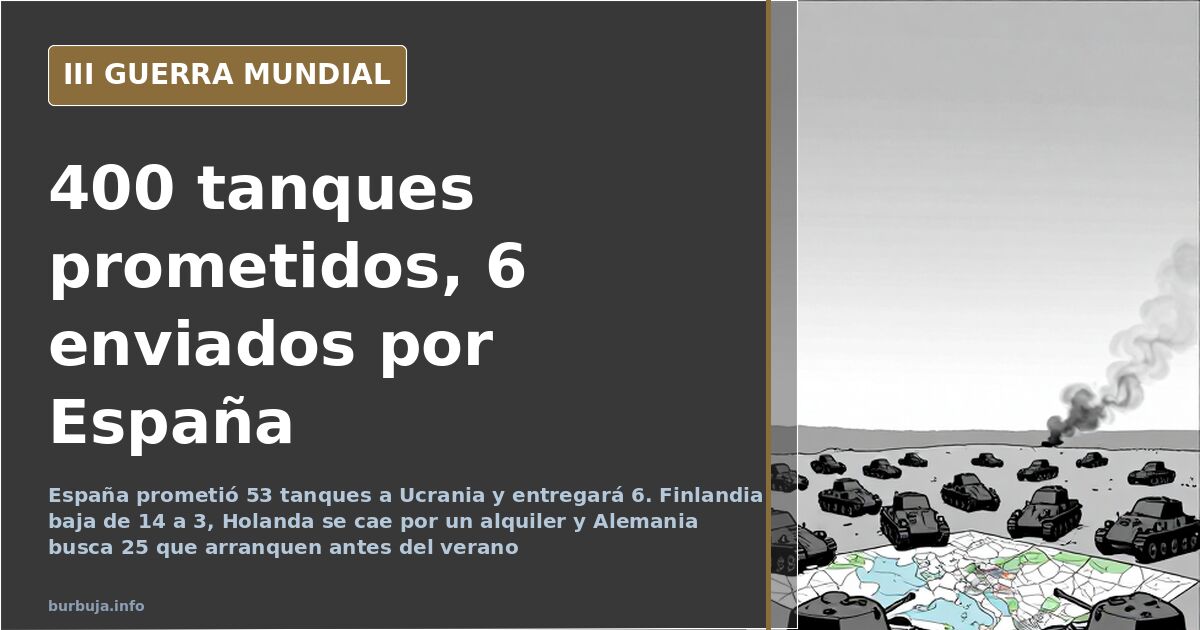
Over 400 tanks for Ukraine and a list that keeps losing units
The announcement spoke of more than 400 combat vehicles for Ukraine. The real tally is going another way. Spain appeared in that total with 53 units and has ended up acknowledging a shipment of 6, with some reports lowering the figure to 5 or 3 and attributing it to a typo. Before those armored vehicles reach the front they have to be assembled, and from there to actual delivery years will pass.
From 53 tanks to 6: the gap in Spain's commitment
The comparison that stings most is with Poland. Spain is contributing almost four times more tanks than that country despite having only 25% more population, and with a fundamental difference: for Poland the conflict is right next door; for Spain, it is not. The result is a contribution that looks disproportionate on paper but on the asphalt comes down to a handful of units.
About the state of those Spanish Leopards a recurring joke circulates: renaming them Persian cats, because they too are felines, are expensive to maintain and do not do what is expected of them. The joke is old and the irony cheap. The problem is that no one has disproved with data the part that isn't funny.
Finland, the Netherlands and Germany: the list loses units week by week
Finland promised 14 vehicles and will deliver 3. They are not tanks in the usual sense: they have no turret and their job is to clear mines, so their offensive capability depends, literally, on verbal artillery. The Netherlands drops out entirely. Its 18 Leopard 2s are leased; the prime minister had considered buying them from Germany to hand them to Ukraine, and Germany refused to sell them.
Then there is the German case, the most telling. Of the hundred-odd Leopard 1A5s promised, the new defense minister says he will see if he can find 25 that start before summer. The rest, perhaps, over the trinc year. With luck.
Twelve types of armored vehicles and a logistical problem
The numbers stand up poorly to scrutiny. The list includes twelve different types of armored vehicles, each with its own ammunition, armament, spare parts and maintenance protocols. Some bring up the historical parallel with Second World War Germany, which paid an enormous price for operating too many models at once, against Soviet and American standardization.
The irony is that the variety blamed on the Western effort has a counterpart on the other side: between a T-72 and a T-80 or T-90 there are thousands of compatible parts, while between a Challenger and a Leopard probably only the washers match. That detail, which seems minor, defines how long it takes a tank to return to combat.
Why are tanks decisive again?
Because no one has explained it convincingly. At the start of the war it was argued that the tank was an obsolete weapon, swept aside by the sophistication and low cost of light anti-tank systems. Two years later, deliveries are once again at the center of everything.
Someone will have to explain the change of script, because much of the material being promised is the same that was considered written off: modernized variants of Soviet vehicles, museum models and tanks with decades of service. There is even a Segarro chapter in which T-72s pass through Czech workshops to be modernized and renamed T-74-EA, of which 20 units are said to have already been sent and the rest are spread over months, or more.
Attrition as strategy and the figures that are ignored
There is an economic reading gaining weight. The combined GDP of Russia and Belarus represents 3,3% of the Western bloc —the United States, the Anglosphere, Europe, Japan and South Korea— and yet missile production does not stop, which invites doubt about what GDP really measures. On the other side it is recalled that the Soviet Union once had 50.000 tanks in 1980, a figure worth keeping in mind before declaring arsenals exhausted.
The difference in resources, technology and industrial muscle between the two sides remains enormous, and that asymmetry explains why the trickle has become method: small, staggered deliveries sufficient to keep the war going. About Ukrainian losses a round figure circulates —8.000— without the tally specifying entirely whether it refers to tanks or personnel.
The point where the analysis gets stuck is this: there is no way to know whether the trickle prolongs the conflict out of prudence or simply because of an inability to fulfill what was promised. The lists are revised downward every few weeks, the front does not move and the only figure that rises regularly is that of the material that should have been sent earlier.
The announcement spoke of more than 400 combat vehicles for Ukraine. The real tally is going another way. Spain appeared in that total with 53 units and has ended up acknowledging a shipment of 6, with some reports lowering the figure to 5 or 3 and attributing it to a typo. Before those armored vehicles reach the front they have to be assembled, and from there to actual delivery years will pass.
From 53 tanks to 6: the gap in Spain's commitment
The comparison that stings most is with Poland. Spain is contributing almost four times more tanks than that country despite having only 25% more population, and with a fundamental difference: for Poland the conflict is right next door; for Spain, it is not. The result is a contribution that looks disproportionate on paper but on the asphalt comes down to a handful of units.
About the state of those Spanish Leopards a recurring joke circulates: renaming them Persian cats, because they too are felines, are expensive to maintain and do not do what is expected of them. The joke is old and the irony cheap. The problem is that no one has disproved with data the part that isn't funny.
Finland, the Netherlands and Germany: the list loses units week by week
Finland promised 14 vehicles and will deliver 3. They are not tanks in the usual sense: they have no turret and their job is to clear mines, so their offensive capability depends, literally, on verbal artillery. The Netherlands drops out entirely. Its 18 Leopard 2s are leased; the prime minister had considered buying them from Germany to hand them to Ukraine, and Germany refused to sell them.
Then there is the German case, the most telling. Of the hundred-odd Leopard 1A5s promised, the new defense minister says he will see if he can find 25 that start before summer. The rest, perhaps, over the trinc year. With luck.
Twelve types of armored vehicles and a logistical problem
The numbers stand up poorly to scrutiny. The list includes twelve different types of armored vehicles, each with its own ammunition, armament, spare parts and maintenance protocols. Some bring up the historical parallel with Second World War Germany, which paid an enormous price for operating too many models at once, against Soviet and American standardization.
The irony is that the variety blamed on the Western effort has a counterpart on the other side: between a T-72 and a T-80 or T-90 there are thousands of compatible parts, while between a Challenger and a Leopard probably only the washers match. That detail, which seems minor, defines how long it takes a tank to return to combat.
Why are tanks decisive again?
Because no one has explained it convincingly. At the start of the war it was argued that the tank was an obsolete weapon, swept aside by the sophistication and low cost of light anti-tank systems. Two years later, deliveries are once again at the center of everything.
Someone will have to explain the change of script, because much of the material being promised is the same that was considered written off: modernized variants of Soviet vehicles, museum models and tanks with decades of service. There is even a Segarro chapter in which T-72s pass through Czech workshops to be modernized and renamed T-74-EA, of which 20 units are said to have already been sent and the rest are spread over months, or more.
Attrition as strategy and the figures that are ignored
There is an economic reading gaining weight. The combined GDP of Russia and Belarus represents 3,3% of the Western bloc —the United States, the Anglosphere, Europe, Japan and South Korea— and yet missile production does not stop, which invites doubt about what GDP really measures. On the other side it is recalled that the Soviet Union once had 50.000 tanks in 1980, a figure worth keeping in mind before declaring arsenals exhausted.
The difference in resources, technology and industrial muscle between the two sides remains enormous, and that asymmetry explains why the trickle has become method: small, staggered deliveries sufficient to keep the war going. About Ukrainian losses a round figure circulates —8.000— without the tally specifying entirely whether it refers to tanks or personnel.
The point where the analysis gets stuck is this: there is no way to know whether the trickle prolongs the conflict out of prudence or simply because of an inability to fulfill what was promised. The lists are revised downward every few weeks, the front does not move and the only figure that rises regularly is that of the material that should have been sent earlier.
Summary of a discussion on Burbuja.info - Foro de economía, actualidad y política., translated from Spanish and reviewed before publication. Read the full discussion (144 replies).
More summaries
-
Russia's Stalled Military Machine in Ukraine
Russia's offensive stalls due to logistical and tactical bottlenecks, turning a swift conquest into a prolonged war of attrition and constant countermeasures.
-
Ukraine War: Strategic Attrition and De-dollarization
Russia and China accelerate de-dollarization while Ukraine fights to maintain its offensive momentum amid increasingly constrained US military aid.
-
Ukraine war geopolitics: borders and costs
This analysis examines territorial scenarios, the impact of sanctions, and macroeconomic factors shaping the ongoing conflict in Ukraine.
-
Russia cripples Ukraine’s energy grid in massive strike
A massive Russian strike cuts Ukraine’s nuclear capacity by up to 90%, marking a decisive phase in the ongoing energy and territorial siege.
-
Ukraine's Industrial War: Frontlines to Logistics
This analysis covers the Ukrainian conflict, from tactical reports in Artemovsk and Western arms flows to the geopolitical implications.
-
Ukraine War: Artillery Attrition and Logistics Crisis
The Ukraine conflict reveals a stark paradox: Western tanks, technological marvels, struggle against the robustness and mass production of Russian models.