
From '270 Gospels' to Four: The Biblical Canon Debate
Claims that 270 gospels existed and the Church kept only four spark debate on the biblical canon, apocrypha, and council authority.
English · Original discussion in Spanish · Published
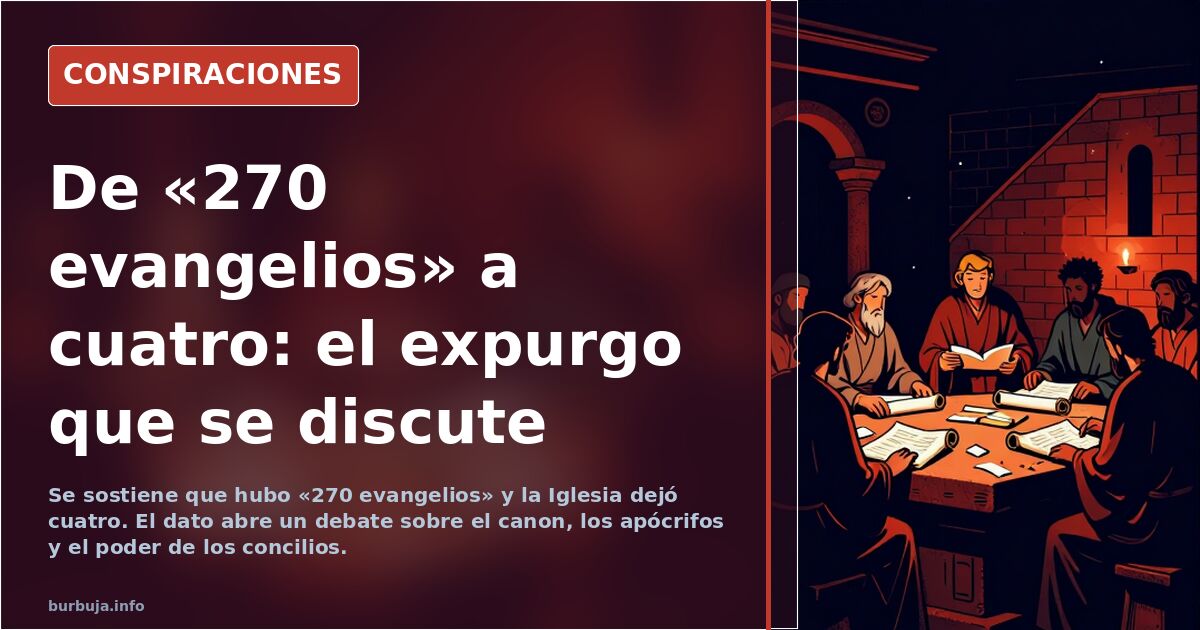
The 270 Gospels Reduced to Four: What Is True?
The figure is repeated in the thread: there were 270 gospels and the Church left four. This claim is supported by the user who opens the debate, citing a video by José Llorens Miralles, and the data has peine an uncomfortable question: how much of what is told as Church history withstands archival scrutiny, and how much is a biased narrative?
From there, the issue branches out. Apocryphal gospels appear, along with the acts of the Council of Elvira, the Inquisition's manual of torture, Giordano Bruno at the stake, and even the recommendations for 2012 that close that same video, including DNA activation and photonic belt.
How many gospels actually existed?
The list of texts that did not enter the canon is not short. Among those called Gnostic are cited the Gospel of Philip, Thomas, Marcion, Mary Magdalene, Judas, the apocryphon of John, Valentinus or the Gospel of Truth, and the Gospel of the Egyptians. Among those of nativity and childhood are the Infancy Gospel of Thomas, the Arabic Infancy Gospel, and the Armenian Infancy Gospel.
These materials present notable differences from the orthodox narrative. The Gospel of Thomas includes sayings such as "if you have money, do not lend it at interest, but give it to one who will not repay you." The Gospel of Philip suggests that Mary Magdalene was Jesus's companion and places a resurrection before his death. The Gospel of Judas presents the traitor as the closest disciple. That they existed is not in doubt; that there were 270 and that they were destroyed by mandate is not accompanied by any source.
The Council of Nicaea and Elvira: what was preserved and what was not
According to claims made in the thread, the Council of Nicaea gathered Christian leaders from Alexandria, Antioch, Athens, Jerusalem, and Rome, alongside representatives of other religious currents of the Empire. In the debate, it is presented as the episode of the closing of the canon, although the selection of the four gospels was a longer and less dramatic process than the scene suggests.
The detail that fuels suspicion, according to the same account, is another. The acts of the Council of Elvira are preserved, with a list of attendees and approved canons, and this contrast between what is saved and what is not is, according to claims, what feeds the thesis of deliberate purge.
The Inquisition, torture, and the case of Giordano Bruno
The Compendium of the Directorium Inquisitorum, by Nicolao Eymerico —in an edition dated 1821— dedicates its chapter V to torture. The text details when torment is applied: to the accused who varies in circumstances and denies the main fact, and to the one noted as heretic against whom there exists at least one witness. It is not an imagined manual. It is a document.
On that basis, the case of Giordano Bruno is also discussed. The popular version reduces it to heliocentrism, but, according to arguments, his ideas went elsewhere: he did not believe in original sin nor considered Christ more son of God than the rest. He ended up at the stake. The question thrown out is simple: what did ecclesiastical power antiestéticar about the thought of a single man?
Was hell a place of torment or just the grave?
One of the derived points raised is etymology. According to claims, the Greek term Inpherno means under the earth, that is, tomb. From there, biblical synonyms are enumerated: tartarus, Hades, Sheol, and Valley of Hinnom. The defended reading is that biblical hell is the common grave of humanity, from which there is resurrection, and that fire represents destruction, not eternal torment.
The thesis holds that hell as taught, with perpetual punishment, consolidated much later, near the construction of St. Peter's Basilica, as a tool to frighten the faithful. It is the piece that turns the discussion about the gospels into a discussion about power.
Two narratives of violence: the Inquisition and the Revolution
Against the focus placed on ecclesiastical tribunals arises the counterpoint: it is affirmed that the French Revolution killed in a few years more than several centuries of Inquisition. The Vendée episode is cited, the Carlist wars of the 19th century as disguised religious wars, and the Civil War as the last of them, with thousands of religious figures murdered in barely three years. The comparison does not close the case, it reopens it from another side: with what yardstick is the violence of one power and its opposite measured?
From the apocryphal gospel to the 'photonic belt'
The mix between historical criticism and mysticism generates friction. Some point out that much of the material accompanying the video —DNA activation, photonic belt, Anunnaki, the New World Order— is nothing more than the other face of the official narrative, just with another label. The accusation thrown back is uncomfortable: replacing the authority of the council with the authority of a channel. Dismantling a sacred book to embrace another, without intermediaries, remains changing catechisms.
The debate does not resolve the number. It makes clear that the figure of 270 works as an entry point to a broader territory: that of who wrote the texts, who translated them, and who decided which ones were read.
The figure is repeated in the thread: there were 270 gospels and the Church left four. This claim is supported by the user who opens the debate, citing a video by José Llorens Miralles, and the data has peine an uncomfortable question: how much of what is told as Church history withstands archival scrutiny, and how much is a biased narrative?
From there, the issue branches out. Apocryphal gospels appear, along with the acts of the Council of Elvira, the Inquisition's manual of torture, Giordano Bruno at the stake, and even the recommendations for 2012 that close that same video, including DNA activation and photonic belt.
How many gospels actually existed?
The list of texts that did not enter the canon is not short. Among those called Gnostic are cited the Gospel of Philip, Thomas, Marcion, Mary Magdalene, Judas, the apocryphon of John, Valentinus or the Gospel of Truth, and the Gospel of the Egyptians. Among those of nativity and childhood are the Infancy Gospel of Thomas, the Arabic Infancy Gospel, and the Armenian Infancy Gospel.
These materials present notable differences from the orthodox narrative. The Gospel of Thomas includes sayings such as "if you have money, do not lend it at interest, but give it to one who will not repay you." The Gospel of Philip suggests that Mary Magdalene was Jesus's companion and places a resurrection before his death. The Gospel of Judas presents the traitor as the closest disciple. That they existed is not in doubt; that there were 270 and that they were destroyed by mandate is not accompanied by any source.
The Council of Nicaea and Elvira: what was preserved and what was not
According to claims made in the thread, the Council of Nicaea gathered Christian leaders from Alexandria, Antioch, Athens, Jerusalem, and Rome, alongside representatives of other religious currents of the Empire. In the debate, it is presented as the episode of the closing of the canon, although the selection of the four gospels was a longer and less dramatic process than the scene suggests.
The detail that fuels suspicion, according to the same account, is another. The acts of the Council of Elvira are preserved, with a list of attendees and approved canons, and this contrast between what is saved and what is not is, according to claims, what feeds the thesis of deliberate purge.
The Inquisition, torture, and the case of Giordano Bruno
The Compendium of the Directorium Inquisitorum, by Nicolao Eymerico —in an edition dated 1821— dedicates its chapter V to torture. The text details when torment is applied: to the accused who varies in circumstances and denies the main fact, and to the one noted as heretic against whom there exists at least one witness. It is not an imagined manual. It is a document.
On that basis, the case of Giordano Bruno is also discussed. The popular version reduces it to heliocentrism, but, according to arguments, his ideas went elsewhere: he did not believe in original sin nor considered Christ more son of God than the rest. He ended up at the stake. The question thrown out is simple: what did ecclesiastical power antiestéticar about the thought of a single man?
Was hell a place of torment or just the grave?
One of the derived points raised is etymology. According to claims, the Greek term Inpherno means under the earth, that is, tomb. From there, biblical synonyms are enumerated: tartarus, Hades, Sheol, and Valley of Hinnom. The defended reading is that biblical hell is the common grave of humanity, from which there is resurrection, and that fire represents destruction, not eternal torment.
The thesis holds that hell as taught, with perpetual punishment, consolidated much later, near the construction of St. Peter's Basilica, as a tool to frighten the faithful. It is the piece that turns the discussion about the gospels into a discussion about power.
Two narratives of violence: the Inquisition and the Revolution
Against the focus placed on ecclesiastical tribunals arises the counterpoint: it is affirmed that the French Revolution killed in a few years more than several centuries of Inquisition. The Vendée episode is cited, the Carlist wars of the 19th century as disguised religious wars, and the Civil War as the last of them, with thousands of religious figures murdered in barely three years. The comparison does not close the case, it reopens it from another side: with what yardstick is the violence of one power and its opposite measured?
From the apocryphal gospel to the 'photonic belt'
The mix between historical criticism and mysticism generates friction. Some point out that much of the material accompanying the video —DNA activation, photonic belt, Anunnaki, the New World Order— is nothing more than the other face of the official narrative, just with another label. The accusation thrown back is uncomfortable: replacing the authority of the council with the authority of a channel. Dismantling a sacred book to embrace another, without intermediaries, remains changing catechisms.
The debate does not resolve the number. It makes clear that the figure of 270 works as an entry point to a broader territory: that of who wrote the texts, who translated them, and who decided which ones were read.
Summary of a discussion on Burbuja.info - Foro de economía, actualidad y política., translated from Spanish and reviewed before publication. Read the full discussion (143 replies).
More summaries
-
Zionism and power: Franco to Trump influence networks
Photos of world leaders with menorahs and B'nai B'rith visits to Franco trace alleged Zionist influence from JFK to Trudeau.
-
The myth that women live easily while men struggle
A narrative claims women enjoy an easy life while men are enslaved. However, data on wealth and high salaries contradict this view.
-
Birth Date Numerology Divides Forum on Reincarnation
A viral method sums birth date digits to predict reincarnation cycles, sparking debate over logic and fear of death.
-
70% of People Miss Patterns: Delusion or Insight?
An alternative theory claims 70% of people fail to detect patterns. Is it apophenia or clarity? Analyzing the debate between believers and skeptics.
-
Moscow’s alleged anti-EU party network: The 2014 thesis
Claims that Moscow funds an anti-EU party network persist after a decade without conclusive proof, citing 19 groups and €9 million to Le Pen.
-
Drawing as Neural Gym: Debate on Third Dimension
Forum debates if drawing builds neural connections for intelligence and whether time is a spatial dimension.