
Free VPNs: users share alternatives and warn of limits
Forum users share free VPN extensions to access blocked websites and warn that free modes impose time limits or monetize your browsing data.
English · Original discussion in Spanish · Published
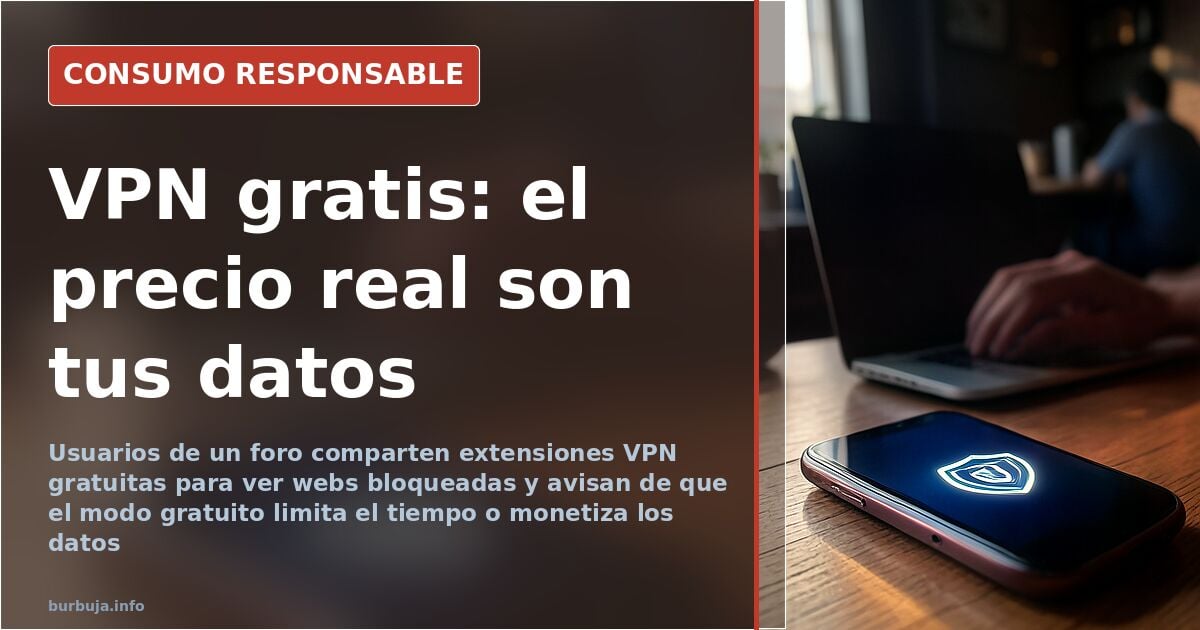
Free unlimited VPN: the real price is your data
The most downloaded free VPN extensions on Chrome impose a time limit that forces users to pay up, according to the question that opens the debate. The alternative that dominates the free market is not technical, it's economic: if you don't pay with money, you pay with a record of your browsing. That's the core of a discussion that starts with a simple question —is there a free VPN with no limits?— and ends in a catalog of options, warnings and the odd recurring joke.
Which free VPNs work without paying
The list of names circulating is long: Proton VPN in its free version, Browsec VPN for Firefox, TouchVPN on Brave, UrbanVPN as a Chrome extension, VeePN, Hoxx VPN, RiseupVPN on Ubuntu, Opera with its built-in VPN and Kaspersky. Paid options also come up, such as NordVPN, PrivateVPN and Mullvad, the latter notable for accepting cash or cryptocurrency payments and, it is claimed, for operating on the Deep Web.
Some argue that the free ones work fine for the basics: getting into pages blocked by the operator, reading news restricted by geolocation or removing the ads that cover half the screen. Others warn that the real price is a different one. "Obviously nothing saves you from them selling your data, that's where they'll get a large part of their profit", sums up a message pointing to the business model: servers in countries with lax legislation and a relationship with Spain that limits the authorities' ability to claim anything.
Why some websites can't be accessed from Spain
The stated use is not anonymity. Several messages insist that a VPN is for accessing US news sites unreachable from Spain, or sports streams and book websites that the operator has blocked. The cause is not always a deliberate block: server geolocation and licensing restrictions explain why a media outlet is cut off in one country and not another.
Things get more complicated when the block comes from the internet provider itself. Vodafone is mentioned as responsible for cutting access to certain content. The solution lies in the extension, not in the router configuration.
The block affecting Latin America
An unexpected turn in the exchange: users from Argentina and Peru report problems accessing certain Spanish websites, solved by switching on a VPN. "LATAM has banned burbuja", one message comments, halfway between a joke and suspicion of a blacklist. The working hypothesis is that the site is hosted in the United States and the problem is one of routing or regional filtering, not an editorial decision.
Rolling your own VPN and other alternatives
For those who don't trust third parties, there is the option of setting up your own server. The drawback, admitted by those who use it: the hosting provider can indirectly reconstruct part of your browsing. Another technical proposal is to connect the computer to a mobile phone's proxy with an active VPN, a homemade solution that avoids installing anything on the machine.
The consensus, if there is one, is that no free option is neutral. Paid services are defended on estimulante ilegal and for not monetizing traffic; free ones, for solving the immediate problem without paying up. How much of your browsing are you willing to hand over to read a news story your operator blocks?
Also available in: Deutsch
Summary of a discussion on Burbuja.info - Foro de economía, actualidad y política., translated from Spanish and reviewed before publication. Read the full discussion (32 replies).
More summaries
-
Brave, Firefox and the Chrome fatigue: which browser do users choose?
Brave, Firefox, Opera or Edge: the browser debate reveals growing fatigue with Chrome and a search for privacy. An analysis of the options and trends.
-
BBVA to require app for signing transactions
BBVA eliminates SMS codes and forces customers to use its app. Forum debate on security, tech dependence, and loss of digital freedom.
-
Helmeca: nearly €5,000 for a German course and a promised job
Helmeca offers jobs in Germany to early childhood educators but ends up selling a German course for almost €5,000 for a B2 level that many doubt is achievable.
-
Spain's squatting problem: your alarm is a witness, not a guard
An alarm doesn't stop a break-in: the monitoring station certifies the exact day and time of the intrusion, evidence a squatter cannot fabricate.
-
Ceys and UHU: the plastic glue that doesn't stick at all
Ceys and UHU fail to bond hard plastics like remote controls or glasses. An analysis of why they fail and solutions using cyanoacrylate and activator.
-
Homemade pizza done right: the responsible consumption revolution
Making pizza at home with long fermentation and a conventional oven: savings, quality, and a debate over the cornicione and 2 kWh.