
Franco's Tax Reality: No VAT or Income Tax
In 1973, Franco dismissed his Finance Minister over a tax reform proposal. Spain lacked VAT and income tax but had other levies.
English · Original discussion in Spanish · Published
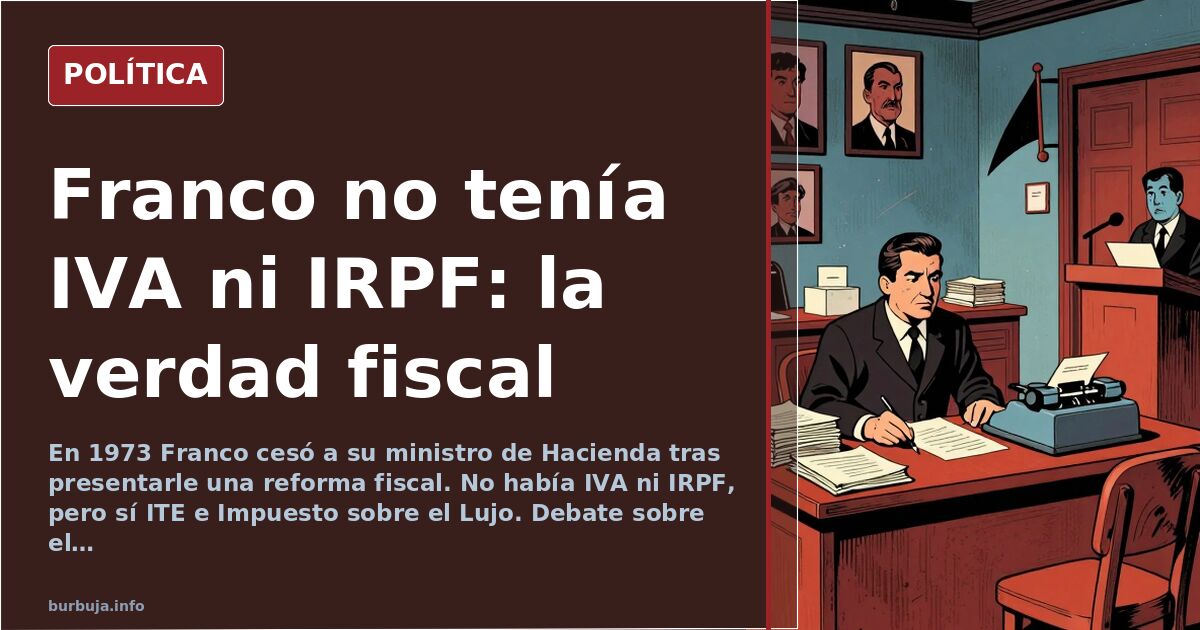
No VAT or Income Tax Under Franco: The Fiscal Truth
In 1973, several technocrat ministers went to the Pardo Palace to present Franco with a tax reform project including new tax types. The next day, the Finance Minister was dismissed. Participants in the debate say Franco made it clear that while he lived, there would be no income or wealth taxes in Spain. And so it was. There was no VAT, which didn't arrive until 1986, nor the income tax return as we know it today. However, other tax figures existed, such as the Luxury Tax or the ITE, a cascading tax taxing each stage of the production chain without refunds. The discussion on the dictatorship's tax system returns whenever compared with the current tax burden.
The ITE and Luxury Tax: Taxes That Did Exist
Although there was no VAT or income tax, Francoism was not a tax haven. The Luxury Tax existed, taxing non-essential products like jewelry and whims, and the ITE (Business Traffic Tax), a cascading tribute applied at each phase of commercialization. A participant in the debate recalls that the ITE was not low: the fruit seller bought from the wholesaler, who bought from the grower, and each stage paid the tax without possibility of deduction. If the chain had many stages, the final levy could be high. Another message mentions a tax similar to VAT but with a 2% rate, though they don't remember its exact name. The fiscal structure was rudimentary but not nonexistent.
The 1973 Tax Reform and the Dismissal of the Finance Minister
The 1973 episode is the core of the story. It is said that Finance Minister Alberto Monreal Luque and professor Enrique Fuentes Quintana presented Franco with a tax reform project prepared by the Institute for Fiscal Studies. Franco received them kindly, but dismissed the minister the next day. The most repeated version is that Franco opposed any income or wealth tax. However, a later message nuances that the dismissal might have been due to other political reasons. The truth is that the reform did not move forward during the dictator's life.
The Moncloa Agreements and the Arrival of Income and Wealth Taxes
After Franco's death and the 1977 elections, the same technocrats who designed the tax reform promoted the Moncloa Agreements. There, the New Economic Emergency Plan was created, inheritance and wealth taxes were implemented, banking secrecy was lifted, and the Treasury began fighting fraud. VAT arrived later, in 1986, with entry into the European Economic Community. The income tax return became widespread in those years. The contrast with the previous era is evident: from a minimal tax system, the country moved to modern tax pressure.
The Debate on Prosperity and the Middle Class
Beyond taxes, the thread drifts toward the economic legacy of Francoism. One sector argues that Franco created a middle class that previously did not exist, lifted many out of poverty, and allowed humble families to access housing, a car, and vacations. It is argued that when Franco died, Spain was the eighth industrial power in the world, while today it ranks 19th. Others respond that the poor remained poor and that the economy was controlled by a technocratic and banking elite. The discussion becomes heated with accusations of opportunism and references to political repression.
Current Tax Burden and Nostalgia for the Past
Comparison with the present is constant. Several messages point out that today it is impossible to start a family with current taxes, that public services are deficient, and that tax pressure suffocates the middle class. Against this, another participant defends that current Spain is eco-resilient, inclusive, and feminist, and pays taxes gladly to fund health and education. The discussion reflects a deep fracture regarding the state model and the social contract.
The Role of Artificial Intelligence in the Debate
One message uses ChatGPT to analyze the arguments. The AI confirms that there was no VAT or income tax return, but nuances that other taxes did exist. Several participants criticize the use of AI as an appeal to authority fallacy and recall that language models can invent data. The BOE (Official Gazette) is cited, and specific dates are provided to refute or confirm claims. The discussion turns into a meta-debate on source verification.
Conclusion: An Unresolved Debate
The underlying question remains open: Was Franco's tax system better than the current one? There is no consensus. What is clear is that the absence of VAT and income tax did not miccionan the absence of taxes, and that the fiscal transition was a complex process linked to democracy and European integration. While some long for tax simplicity, others defend the need to fund a welfare state. The disorienting fact: in 1973, a minister was dismissed for proposing direct taxes. Today, any tax reform still causes government crises.
In 1973, several technocrat ministers went to the Pardo Palace to present Franco with a tax reform project including new tax types. The next day, the Finance Minister was dismissed. Participants in the debate say Franco made it clear that while he lived, there would be no income or wealth taxes in Spain. And so it was. There was no VAT, which didn't arrive until 1986, nor the income tax return as we know it today. However, other tax figures existed, such as the Luxury Tax or the ITE, a cascading tax taxing each stage of the production chain without refunds. The discussion on the dictatorship's tax system returns whenever compared with the current tax burden.
The ITE and Luxury Tax: Taxes That Did Exist
Although there was no VAT or income tax, Francoism was not a tax haven. The Luxury Tax existed, taxing non-essential products like jewelry and whims, and the ITE (Business Traffic Tax), a cascading tribute applied at each phase of commercialization. A participant in the debate recalls that the ITE was not low: the fruit seller bought from the wholesaler, who bought from the grower, and each stage paid the tax without possibility of deduction. If the chain had many stages, the final levy could be high. Another message mentions a tax similar to VAT but with a 2% rate, though they don't remember its exact name. The fiscal structure was rudimentary but not nonexistent.
The 1973 Tax Reform and the Dismissal of the Finance Minister
The 1973 episode is the core of the story. It is said that Finance Minister Alberto Monreal Luque and professor Enrique Fuentes Quintana presented Franco with a tax reform project prepared by the Institute for Fiscal Studies. Franco received them kindly, but dismissed the minister the next day. The most repeated version is that Franco opposed any income or wealth tax. However, a later message nuances that the dismissal might have been due to other political reasons. The truth is that the reform did not move forward during the dictator's life.
The Moncloa Agreements and the Arrival of Income and Wealth Taxes
After Franco's death and the 1977 elections, the same technocrats who designed the tax reform promoted the Moncloa Agreements. There, the New Economic Emergency Plan was created, inheritance and wealth taxes were implemented, banking secrecy was lifted, and the Treasury began fighting fraud. VAT arrived later, in 1986, with entry into the European Economic Community. The income tax return became widespread in those years. The contrast with the previous era is evident: from a minimal tax system, the country moved to modern tax pressure.
The Debate on Prosperity and the Middle Class
Beyond taxes, the thread drifts toward the economic legacy of Francoism. One sector argues that Franco created a middle class that previously did not exist, lifted many out of poverty, and allowed humble families to access housing, a car, and vacations. It is argued that when Franco died, Spain was the eighth industrial power in the world, while today it ranks 19th. Others respond that the poor remained poor and that the economy was controlled by a technocratic and banking elite. The discussion becomes heated with accusations of opportunism and references to political repression.
Current Tax Burden and Nostalgia for the Past
Comparison with the present is constant. Several messages point out that today it is impossible to start a family with current taxes, that public services are deficient, and that tax pressure suffocates the middle class. Against this, another participant defends that current Spain is eco-resilient, inclusive, and feminist, and pays taxes gladly to fund health and education. The discussion reflects a deep fracture regarding the state model and the social contract.
The Role of Artificial Intelligence in the Debate
One message uses ChatGPT to analyze the arguments. The AI confirms that there was no VAT or income tax return, but nuances that other taxes did exist. Several participants criticize the use of AI as an appeal to authority fallacy and recall that language models can invent data. The BOE (Official Gazette) is cited, and specific dates are provided to refute or confirm claims. The discussion turns into a meta-debate on source verification.
Conclusion: An Unresolved Debate
The underlying question remains open: Was Franco's tax system better than the current one? There is no consensus. What is clear is that the absence of VAT and income tax did not miccionan the absence of taxes, and that the fiscal transition was a complex process linked to democracy and European integration. While some long for tax simplicity, others defend the need to fund a welfare state. The disorienting fact: in 1973, a minister was dismissed for proposing direct taxes. Today, any tax reform still causes government crises.
Summary of a discussion on Burbuja.info - Foro de economía, actualidad y política., translated from Spanish and reviewed before publication. Read the full discussion (189 replies).
More summaries
-
Alberto Noguera's Take on the Ceuta Crisis
The debate over Ceuta centers on possible foreign intelligence involvement and its impact on Spanish politics. What lies behind the crisis?
-
Franco’s Industrial Legacy: Spain’s 8th Power Debate
36% industry and the 1959 Plan reignite debate over whether Franco was Spain’s best ruler and the role of technocrats.
-
Puigdemont's wig: accident or political strategy?
Analysis of Puigdemont's wig: examining the 1983 accident data and the polarization of political debate.
-
Vox Condemns Racism, Sparking Right-Wing Division
Vox condemns racism and Nazism after controversial remarks by a local official in Avilés. The party's double discourse faces scrutiny.
-
Viral tweet asks for explanation of unspecified image
A viral post requests help understanding an undefined graphic, turning confusion into shared content without providing context.
-
Sequera’s Honor Thesis Sparks Backlash Among His Audience
Sequera faces audience backlash over his 'honor as destiny' thesis, shifting from geopolitics to moral policing.