
Francoism Returns to Economic Debate 50 Years Later
Generational wealth gaps and current precariousness revive nostalgia for Franco's Spain, marking the 50th anniversary of his death.
English · Original discussion in Spanish · Published
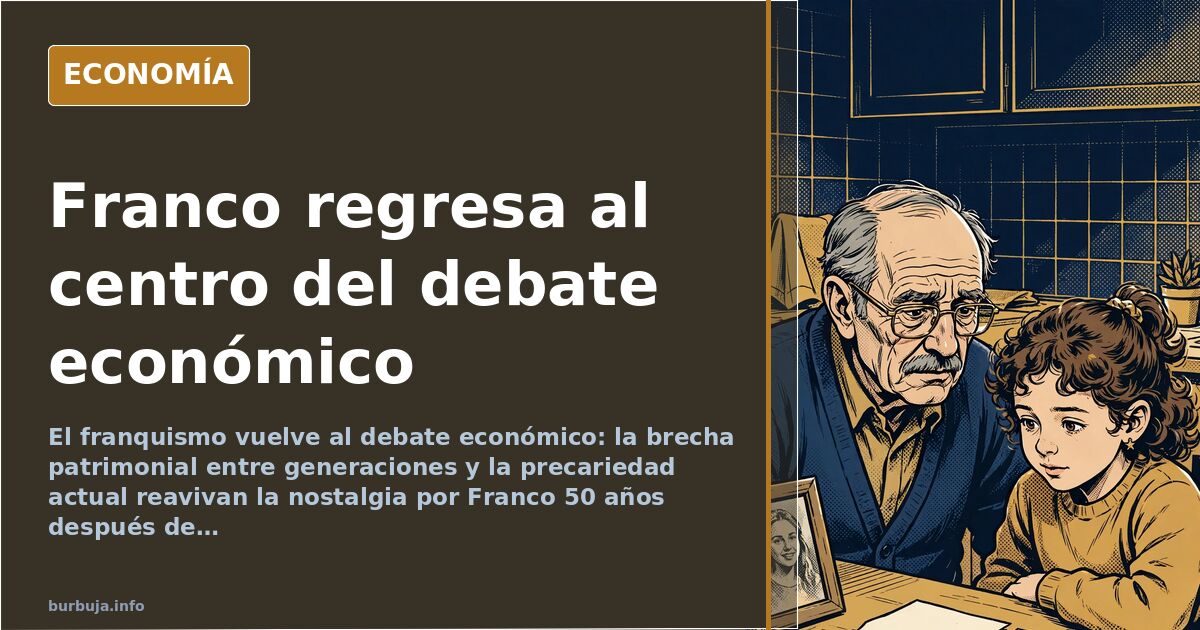
Why Franco is Back at the Center of Economic Debate
Why has a dictator who died half a century ago become a recurring topic in cafés, on radio shows, and in workplace conversations? The answer lies not in nostalgia, but in economics. Next year marks the 50th anniversary of his death, reigniting a phenomenon that goes beyond politics: the constant comparison between the Spain some remember as prosperous and today’s precariousness. In one café, a group of young people debated how life under Franco offered prosperity and order, whereas now there is only precarity and sarracena decay. This anecdote, far from being isolated, reflects a generational shift in the perception of Francoism.
The trigger is not just the anniversary. There is an undeniable economic factor: according to one participant, the generation currently aged 70 to 80 built their assets during the Franco era, under a state that did not penalize wealth accumulation and with a labor market that, despite its hardships, allowed buying a home on a single salary. Current generations, however, face a state that penalizes earning money, hinders initiatives, and demands education without guaranteeing a return. That wealth gap is the perfect breeding ground for Francoism to be claimed as a lost paradise.
The Myth of Francoist Prosperity
The narrative that life was better under Franco has partial support in data. During the dictatorship, the modern pension system was established with the Social Security Law of 1963, which unified and expanded existing benefits. The Social Security system as we know it was also created via the Base Law of 1963, which came into force in 1967. These institutional milestones, later consolidated in the 1978 Constitution, are presented today as achievements of the regime, ignoring that they were responses to social demands and the need to stabilize a country in crisis.
However, this account clashes with economic reality. Under Francoism, public debt was eroded through inflation, benefiting public bodies but punishing anyone needing financing: interest rates exceeded 20%. Public companies, funded "out of thin air," were inefficient and dragged down the economy. Budgetary balance was deceptive: large amounts of off-budget debt were issued to finance investments outside the budget, hiding the true deficit. From 1960 onwards, debt issuance grew far above accumulated deficits.
The supposed labor paradise does not withstand scrutiny either. Those who argue that a single salary supported a family and bought a home forget that this involved 14-hour workdays and high unemployment. In the final years of the dictatorship, the country was, according to some testimonies, in a truly dire state. Home ownership was not all it seemed: it was achieved at the cost of physical and family effort that would be unthinkable today.
The Generational Wealth Gap
The most repeated argument in the debate is the wealth gap. According to one participant, the 70- or 80-year-old generation accessed properties and businesses with relative ease during Francoism, with little training and no state obstacles. Current generations, by contrast, see the state penalizing them for earning money, making it difficult to acquire property, and drowning them in taxes like IRPF (personal income tax) or IVA (VAT), which some consider recent burdens rather than fundamental obligations. This asymmetry explains, for some, why many young people look at Francoism with curiosity, if not sympathy.
The phenomenon is not exclusively Spanish. In France and Italy, during the pandemic, unvaccinated individuals were denied the right to work, which some interpret as a trial run for technocratic dictatorship. In Spain, mass vaccination avoided that scenario, but antiestéticar of growing state control remains latent. The comparison with Francoism then emerges as a lesser evil: compared to current society and what is coming, Franco’s Spain is a paradise of freedom, some claim. It is hyperbole, but it reflects real discontent.
Francoism as a Pop Brand and Martyr
Beyond economics, Francoism has become a pop brand. On television programs, Franco is reclaimed as the true socialist, and ironic messages and images proliferate on social media. The automotive and aerospace industries, cited by some as regime achievements, are used as proof that there was at least industry, contrasting with current deindustrialization. The 50th anniversary has amplified all this: historical memory events, far from healing wounds, have reignited interest.
Some argue that the insistence on criticizing Franco has turned him into a martyr. By constantly bringing him up and beating his corpse, many now see him as a winner against war and communist terror, and now also as a martyr. It is the paradox of memory: the more it is attacked, the more it is claimed. According to one participant, the left, by focusing the debate on Franco, feminism, gender numbers, or racism, allows these to dominate the conversation and loses the cultural battle. The right, conversely, benefits from discussions revolving around past symbols rather than current problems.
What About Young People and Franco?
Young people have become, according to some participants, the sector most receptive to the Francoist narrative. It is not a matter of ideology, but of economics: they see that their parents and grandparents achieved wealth they cannot reach, and blame the current state. Promiscuity and precarity are perceived as contemporary evils, compared to the order and prosperity attributed to Francoism. It is a simplification, but it connects with a reality: lack of opportunities and the feeling that effort does not pay off.
The phenomenon has both a generational and an economic component. The generation currently aged 20 to 45 has seen the state penalize them for earning money, hinder any initiative, and demand education without guaranteeing a return. It is not strange that they look at the past with envy. The question is whether that envy will translate into real support for political options that reclaim Francoism, or if it will remain a nostalgic pose.
Conclusion: A Dry Irony
In the end, what happens with Franco is that he has become the perfect scapegoat and the perfect symbol. Some hate him, others claim him, and meanwhile, the economy continues to fail to solve the problems fueling the debate. The 50th anniversary will pass, but the wealth gap and disillusionment with the state will remain. And Franco, half a century later, will continue to be the topic everyone talks about but no one finishes burying.
Also available in: Deutsch
Summary of a discussion on Burbuja.info - Foro de economía, actualidad y política., translated from Spanish and reviewed before publication. Read the full discussion (189 replies).
More summaries
-
Spain’s Pension Crisis: Demographic Collapse Exceeds €100 Billion Debt
Spain's social security debt tops €100 billion, but a shrinking demographic pyramid threatens total system collapse for millennials.
-
Spain's Social Security covers only 70% of pension costs
Social Security income covers just 70% of pension spending, fueling debate on immigration's impact on the system.
-
Spain's family members' pension: requirements and actual amounts
Spain's Social Security provides pensions for relatives who depended on the deceased. Requirements, amounts and limits: it is not automatic and does not cover everyone.
-
Ayuso Breaks Iker Jiménez’s Rules in Controversial Horizon Interview
Madrid President Isabel Díaz Ayuso breaks Iker Jiménez’s no-politician rule, sparking debate on media pluralism and the Puerta del Sol protests.
-
Europe registers 400,000 EVs in September, but just three countries drive the growth
Europe topped 400,000 electric cars in September, but Germany, France and the UK account for more than half of sales. Diesel holds its ground in Spain's used car market.
-
The R78 claim in a short video: rabbi's remarks on Islam
David Touitou, a French-Jewish rabbi, claims Islam is 'Israel's broom' to sweep away Christianity, and that his messiah will not return until Christianity disappears.