
Francisco Ibáñez, creator of Mortadelo, dies at 87
Spanish cartoonist Francisco Ibáñez has died in Barcelona at 87. His iconic characters Mortadelo, Filemón, and 13 Rue del Percebe defined generations of readers.
English · Original discussion in Spanish · Published
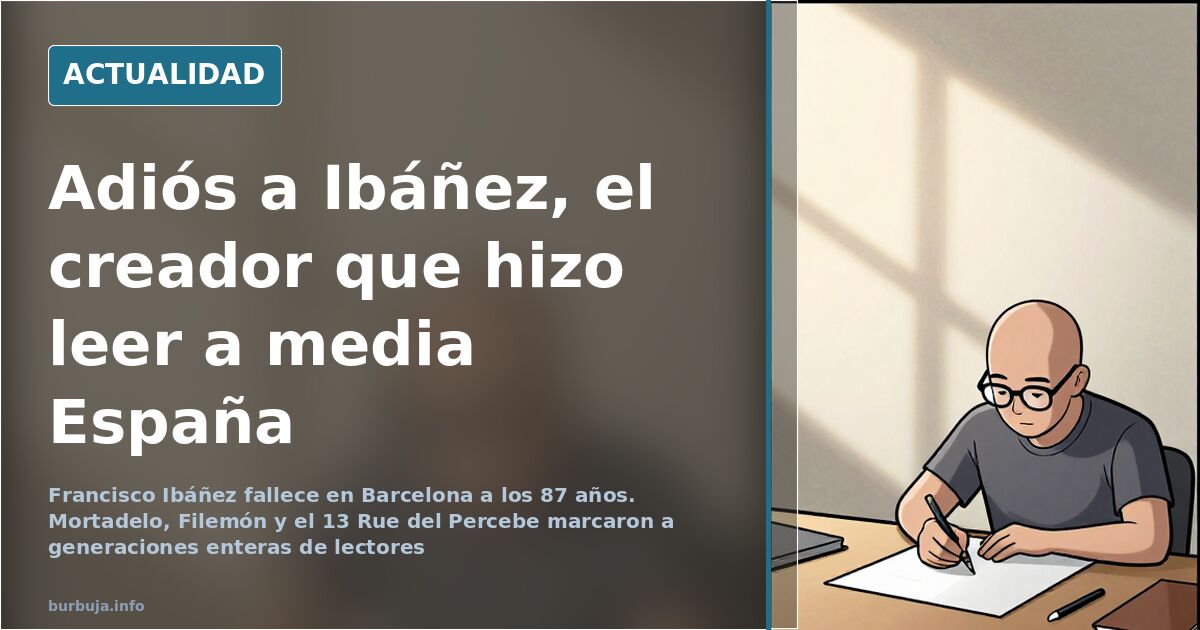
Francisco Ibáñez, the cartoonist who needed no ministry, dies
Several users lamented that no train station or major institutional prize bore his name while he was alive. Yet, a black silhouette, impossible buttons, and an elastic neck are enough for any Spaniard born after 1960 to recognize Mortadelo in seconds. Francisco Ibáñez has died in Barcelona at the age of 87, according to his publisher, Penguin Random House Grupo Editorial, which announced the news with "great sadness."
The news closed the day with a wave of fan tributes. Only adults remembering what they read as children. And a question that hovered over the thread: how can someone who drew half of Spain for six decades have passed relatively unnoticed by the country's cultural establishments?
Who was Francisco Ibáñez and what characters did he create?
A cartoonist and comic artist, Ibáñez signed Mortadelo and Filemón, Pepe Gotera and Otilio, Botones Sacarino, and the residents of 13 Rue del Percebe. His name is linked to the golden age of Spanish comics and the Bruguera publishing house, where comics were produced almost on an assembly line.
For several generations, the greatest Christmas gift was a Súper Humor magazine. "I remember that when I was a kid, a Súper Humor was the most precious good on Earth," someone wrote upon hearing the news. It is not grandmotherly nostalgia: it speaks of a popular, massive, and sustained market, prior to pay TV and tablets.
Why 13 Rue del Percebe was more than just a comic
Some argue that 13 Rue del Percebe is one of the best sociological portraits of urban Spain ever drawn. The static shot of the building, with its concierge, grocer, handyman, and office, functioned as a comic-strip radiography of neighborhood life: the nosy neighbor, the idle civil servant, the con artist.
This chronicler's gaze—of politicians, businessmen, office workers, artists—explains why his work ages better than many serious books of the time. The humor endured because the people portrayed still existed.
The recognition that never quite arrived
The posthumous tribute itself revealed, in the judgment of several forum users, a well-known paradox: the popular applause was huge, but the institutional one, much smaller. He received massive affection at the Barcelona Comic Salon, with kilometer-long queues for autograph sessions, though, as noted in the thread, the industry never valued him enough in his lifetime. It is also pointed out that Ibáñez preferred drawing to socializing, which, for one forum user, ultimately cost him in prizes and photo ops.
The matter was also tangled in the kitchen of the era: comics published under the author's signature and others without it, comics produced by teams, the so-called Bruguera Equip, or drawings by authors such as those from the Vara studio. It remains unresolved whether everything published under his signature was his own hand: the thread speculates that Bruguera may have erased his signature from some comics, while one forum user maintains that what bore Ibáñez's signature was his, another points to the Bruguera Equip as the possible author of some works.
The animated series the author himself disavowed
Older viewers know that the 1990s animated adaptation—and some subsequent cinematic appearances—fell far short of the original. Ibáñez once called those cartoons "disanimated", and several forum users remember them as "horrible in every way: animation, voices, adaptation."
What endures is the printed work. A spontaneous tribute in Barcelona, a mural of Mortadelo and Filemón crying in the Clot neighborhood, by Miguel Ángel Pérez Manzaneque, reminded us that the character no longer belongs solely to his creator.
A mourning period that crossed into politics
As is almost always the case in this country, the tribute soon drifted into the trenches. Part of the public lamented that streets or stations had not been named after him earlier, comparing it to the treatment given to other cultural figures. Another part used the opportunity to debate which names deserve to occupy street signs. And some directly asked whether Ibáñez was "of one side" or the other.
It is necessary to state the obvious: a cartoonist who made entire generations laugh does not need an ideological passport. The attempt to label him, in any direction, says much more about the person doing the labeling than about the character himself.
What remains of Ibáñez's legacy
There remains a massive body of work, reprinted and read in a loop by children who are now parents. "I believe I still have at home no fewer than 100 copies of Mortadelo and Filemón," someone says, confessing an inability to throw them away. "They were my childhood; I read them over and over, and when I finished, I started again from the first." There also remains an unanswered question: why does Ibáñez's name take so long to rise to the places reserved for other creators.
Several users lamented that no train station or major institutional prize bore his name while he was alive. Yet, a black silhouette, impossible buttons, and an elastic neck are enough for any Spaniard born after 1960 to recognize Mortadelo in seconds. Francisco Ibáñez has died in Barcelona at the age of 87, according to his publisher, Penguin Random House Grupo Editorial, which announced the news with "great sadness."
The news closed the day with a wave of fan tributes. Only adults remembering what they read as children. And a question that hovered over the thread: how can someone who drew half of Spain for six decades have passed relatively unnoticed by the country's cultural establishments?
Who was Francisco Ibáñez and what characters did he create?
A cartoonist and comic artist, Ibáñez signed Mortadelo and Filemón, Pepe Gotera and Otilio, Botones Sacarino, and the residents of 13 Rue del Percebe. His name is linked to the golden age of Spanish comics and the Bruguera publishing house, where comics were produced almost on an assembly line.
For several generations, the greatest Christmas gift was a Súper Humor magazine. "I remember that when I was a kid, a Súper Humor was the most precious good on Earth," someone wrote upon hearing the news. It is not grandmotherly nostalgia: it speaks of a popular, massive, and sustained market, prior to pay TV and tablets.
Why 13 Rue del Percebe was more than just a comic
Some argue that 13 Rue del Percebe is one of the best sociological portraits of urban Spain ever drawn. The static shot of the building, with its concierge, grocer, handyman, and office, functioned as a comic-strip radiography of neighborhood life: the nosy neighbor, the idle civil servant, the con artist.
This chronicler's gaze—of politicians, businessmen, office workers, artists—explains why his work ages better than many serious books of the time. The humor endured because the people portrayed still existed.
The recognition that never quite arrived
The posthumous tribute itself revealed, in the judgment of several forum users, a well-known paradox: the popular applause was huge, but the institutional one, much smaller. He received massive affection at the Barcelona Comic Salon, with kilometer-long queues for autograph sessions, though, as noted in the thread, the industry never valued him enough in his lifetime. It is also pointed out that Ibáñez preferred drawing to socializing, which, for one forum user, ultimately cost him in prizes and photo ops.
The matter was also tangled in the kitchen of the era: comics published under the author's signature and others without it, comics produced by teams, the so-called Bruguera Equip, or drawings by authors such as those from the Vara studio. It remains unresolved whether everything published under his signature was his own hand: the thread speculates that Bruguera may have erased his signature from some comics, while one forum user maintains that what bore Ibáñez's signature was his, another points to the Bruguera Equip as the possible author of some works.
The animated series the author himself disavowed
Older viewers know that the 1990s animated adaptation—and some subsequent cinematic appearances—fell far short of the original. Ibáñez once called those cartoons "disanimated", and several forum users remember them as "horrible in every way: animation, voices, adaptation."
What endures is the printed work. A spontaneous tribute in Barcelona, a mural of Mortadelo and Filemón crying in the Clot neighborhood, by Miguel Ángel Pérez Manzaneque, reminded us that the character no longer belongs solely to his creator.
A mourning period that crossed into politics
As is almost always the case in this country, the tribute soon drifted into the trenches. Part of the public lamented that streets or stations had not been named after him earlier, comparing it to the treatment given to other cultural figures. Another part used the opportunity to debate which names deserve to occupy street signs. And some directly asked whether Ibáñez was "of one side" or the other.
It is necessary to state the obvious: a cartoonist who made entire generations laugh does not need an ideological passport. The attempt to label him, in any direction, says much more about the person doing the labeling than about the character himself.
What remains of Ibáñez's legacy
There remains a massive body of work, reprinted and read in a loop by children who are now parents. "I believe I still have at home no fewer than 100 copies of Mortadelo and Filemón," someone says, confessing an inability to throw them away. "They were my childhood; I read them over and over, and when I finished, I started again from the first." There also remains an unanswered question: why does Ibáñez's name take so long to rise to the places reserved for other creators.
Summary of a discussion on Burbuja.info - Foro de economía, actualidad y política., translated from Spanish and reviewed before publication. Read the full discussion (230 replies).
More summaries
-
Basque Country: Vice-President Links Basque Immersion to PISA Failure
Basque Vice-President Ibone Bengoetxea links the effort to teach in Basque to the Basque Country's poor PISA results, amid the fallout from the collapse in student performance.
-
Speedy trials and the presumption of innocence under scrutiny
Analysis of the costs and flaws in summary proceedings for minor and traffic offenses, highlighting legal defense barriers.
-
Zimbabwe: From Africa's Richest to 100 Trillion Dollar Notes
Rhodesia declared independence in 1965, but Zimbabwe printed 100 trillion dollar bills. The debate on what failed continues between colonial legacy and management.
-
Ceuta and Melilla: The Cost of an Unsustainable Border
NATO does not cover Ceuta or Melilla; the 2025 INE data shows 170,662 inhabitants. Between ceding, selling, or sharing, no option balances the books.
-
Kimberly-Clark Warehouse Fire: Employee Records Arson for Wages
A worker allegedly burned a Kimberly-Clark warehouse in California and recorded it, demanding fair pay. The incident highlights labor disputes and safety concerns.
-
Trump's Reaction to Alcaraz's US Open Win Sparks Ethnic Debate
Analysis of Donald Trump's reaction to Carlos Alcaraz's US Open victory and the cultural interpretations surrounding the event.