
Francis' Papacy Reignites Tradition vs Reform Debate
Pope Francis' legacy divides Catholics, sparking clashes over liberation theology, the Agenda 2030, and fears of a schism.
English · Original discussion in Spanish · Published
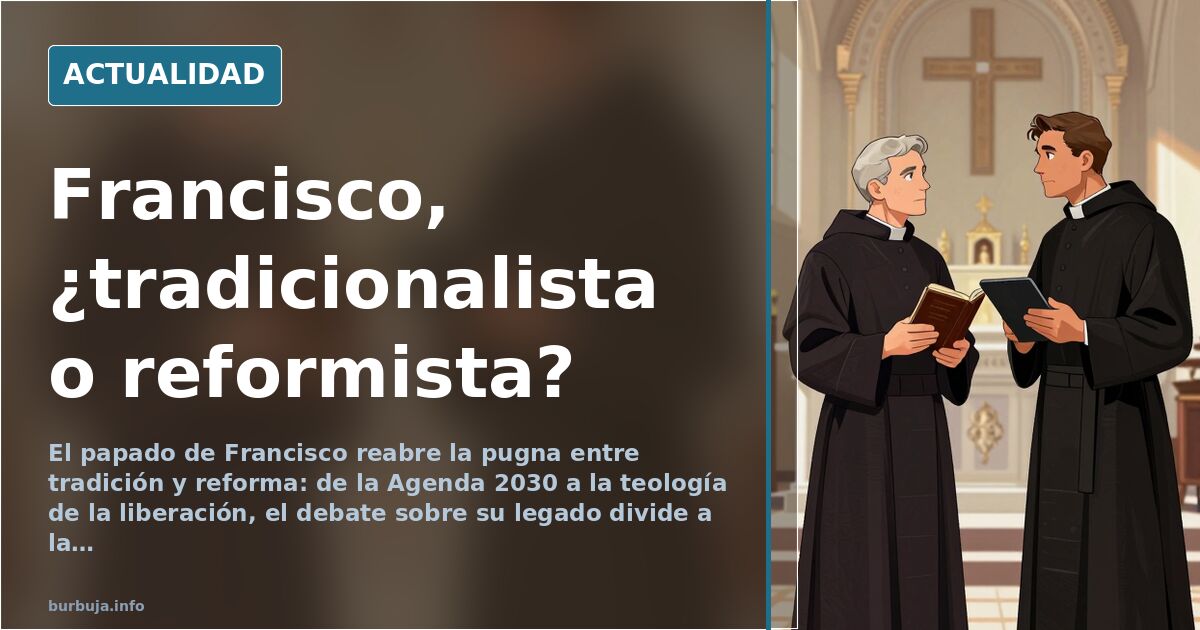
Francis' Papacy Reignites Tradition vs Reform Debate
A pontiff who signs encyclicals on climate change and hosts leaders from all backgrounds, while half a dozen of his trinc debate whether he is an infiltrator or the last bulwark. The discussion about Francis' legacy—and whether he fits the traditionalist label—has been open for more than 1,400 days in Spanish-speaking Catholic forums. The paradox is not minor: the same Pope accused of colluding with liberation theology is presented by some defenders as the final obstacle before a schism.
The trigger was a simple question: name a living traditionalist. The answer—that very few remain—led to an exchange of accusations regarding Jorge Mario Bergoglio's pastoral orientation. One sector argues that his magisterium is continuous with timeless doctrine, merely wrapped in mercy that confuses the distracted. Another directly denies he is Pope, claiming he rejected being Vicar of Christ in 2020 and has since served only as head of state of Vatican City.
The Quote That Changed Everything
The thread begins with a direct quote from Francis on the Agenda 2030 and climate change: "I raise my voice alongside those who long for urgent and effective solutions. The adoption of the 2030 Agenda for Sustainable Development... is an important sign of hope." For critics, this phrase is proof of guilt. For defenders, it is textbook Vatican diplomacy.
The discussion intensifies when someone recalls that Bergoglio called Gustavo Gutiérrez—a co-founder of liberation theology—a "great theologian" and "man of the church." The argument is that such collusion with Marxism contradicts basic precepts. The response from the other side is that mercy is not synonymous with heterodoxy, and confusing the two shows a fundamental misunderstanding.
The Argument of the 'Infiltrated Traditionalist'
The most provocative thesis in the thread is that Francis is not only not a reformer, but that his mission would have been to cushion the clash between the Church's two strong currents. According to this reading, Benedict XVI, already powerless to keep both within the community, entrusted him with this task. Time will prove—or disprove—the certainty of this approach.
Those defending this hypothesis point out that his catechesis against the devil or his insistence on fundamental doctrine do not fit the red portrait painted by detractors. "Anyone who takes a little trouble can verify this," they claim. They argue that the merciful component confuses some and is used in bad faith by others.
The War of Fruits
The debate shifts to an uncomfortable question: what are the current fruits of the dynasty some consider legitimate? The answer given is that they are "scarce beyond keeping a memory alive and stirring up the various splinter groups operating in Spain and France." It is mentioned that Don Sixto de Borbón will die in Bruges and that his branch will become extinct, with the crown jumping to another branch that retains the right to the throne.
The contrast is established with parliamentary monarchy: it is recalled that Felipe VI signed the abortion law and the amnesty, and did not attend the centenary of the consecration of Spain to the Sacred Heart of Jesus. The argument is that the fruits of the Isabeline branch are visible, while those of the supposed legitimate one are an unverified promise.
Vatican II as the Origin of All
One of the most voted interventions points directly to the Council: "Openly acknowledging that the Second Vatican Council was the capitulation of the Church to the modern world." From this perspective, the spirit of openness failed in its attempt to attract the world; instead, Catholics rushed massively into it. Mercy and an extended hand are fine, but if religion loses its mystical and sacred character, the faithful abandon their roots.
The response from the other side is that the problem is not the Council but the interpretation made of it. And that Francis, far from being the problem, is the last barrier before Huns and Goths—the two intransigent factions—lead the Church to schism.
The Pope as Head of State
A recurring argument is that Francis is, besides pontiff, head of the Vatican State, the oldest in the world and dean of all consuls and diplomats. Hence he receives all kinds of leaders, from Pilingui to Trump, passing through Chinese officials. "Everyone goes there to sell their story," is the summary.
The question posed is whether these visits serve any purpose: Did they stop promoting abortion and euthanasia? Did they stop the war? The implicit answer is no. Vatican diplomacy offers itself as a bridge, but its capacity to influence the policies of great powers is limited.
The Shadow of Schism
The closing of the thread leaves a gloomy forecast: "I greatly antiestéticar that this time both sides will show their true colors, giving more influence to the evil one." The idea is that Francis has been the last obstacle and that his disappearance could unleash open war between the two strong tendencies.
The unsettling data: while some debate whether he was traditionalist or red, others are already looking to the next conclave. Of the 133 cardinal electors, 108 were appointed by Francis, according to a calculation circulating in the thread. The question is no longer what he was, but who comes next.
A pontiff who signs encyclicals on climate change and hosts leaders from all backgrounds, while half a dozen of his trinc debate whether he is an infiltrator or the last bulwark. The discussion about Francis' legacy—and whether he fits the traditionalist label—has been open for more than 1,400 days in Spanish-speaking Catholic forums. The paradox is not minor: the same Pope accused of colluding with liberation theology is presented by some defenders as the final obstacle before a schism.
The trigger was a simple question: name a living traditionalist. The answer—that very few remain—led to an exchange of accusations regarding Jorge Mario Bergoglio's pastoral orientation. One sector argues that his magisterium is continuous with timeless doctrine, merely wrapped in mercy that confuses the distracted. Another directly denies he is Pope, claiming he rejected being Vicar of Christ in 2020 and has since served only as head of state of Vatican City.
The Quote That Changed Everything
The thread begins with a direct quote from Francis on the Agenda 2030 and climate change: "I raise my voice alongside those who long for urgent and effective solutions. The adoption of the 2030 Agenda for Sustainable Development... is an important sign of hope." For critics, this phrase is proof of guilt. For defenders, it is textbook Vatican diplomacy.
The discussion intensifies when someone recalls that Bergoglio called Gustavo Gutiérrez—a co-founder of liberation theology—a "great theologian" and "man of the church." The argument is that such collusion with Marxism contradicts basic precepts. The response from the other side is that mercy is not synonymous with heterodoxy, and confusing the two shows a fundamental misunderstanding.
The Argument of the 'Infiltrated Traditionalist'
The most provocative thesis in the thread is that Francis is not only not a reformer, but that his mission would have been to cushion the clash between the Church's two strong currents. According to this reading, Benedict XVI, already powerless to keep both within the community, entrusted him with this task. Time will prove—or disprove—the certainty of this approach.
Those defending this hypothesis point out that his catechesis against the devil or his insistence on fundamental doctrine do not fit the red portrait painted by detractors. "Anyone who takes a little trouble can verify this," they claim. They argue that the merciful component confuses some and is used in bad faith by others.
The War of Fruits
The debate shifts to an uncomfortable question: what are the current fruits of the dynasty some consider legitimate? The answer given is that they are "scarce beyond keeping a memory alive and stirring up the various splinter groups operating in Spain and France." It is mentioned that Don Sixto de Borbón will die in Bruges and that his branch will become extinct, with the crown jumping to another branch that retains the right to the throne.
The contrast is established with parliamentary monarchy: it is recalled that Felipe VI signed the abortion law and the amnesty, and did not attend the centenary of the consecration of Spain to the Sacred Heart of Jesus. The argument is that the fruits of the Isabeline branch are visible, while those of the supposed legitimate one are an unverified promise.
Vatican II as the Origin of All
One of the most voted interventions points directly to the Council: "Openly acknowledging that the Second Vatican Council was the capitulation of the Church to the modern world." From this perspective, the spirit of openness failed in its attempt to attract the world; instead, Catholics rushed massively into it. Mercy and an extended hand are fine, but if religion loses its mystical and sacred character, the faithful abandon their roots.
The response from the other side is that the problem is not the Council but the interpretation made of it. And that Francis, far from being the problem, is the last barrier before Huns and Goths—the two intransigent factions—lead the Church to schism.
The Pope as Head of State
A recurring argument is that Francis is, besides pontiff, head of the Vatican State, the oldest in the world and dean of all consuls and diplomats. Hence he receives all kinds of leaders, from Pilingui to Trump, passing through Chinese officials. "Everyone goes there to sell their story," is the summary.
The question posed is whether these visits serve any purpose: Did they stop promoting abortion and euthanasia? Did they stop the war? The implicit answer is no. Vatican diplomacy offers itself as a bridge, but its capacity to influence the policies of great powers is limited.
The Shadow of Schism
The closing of the thread leaves a gloomy forecast: "I greatly antiestéticar that this time both sides will show their true colors, giving more influence to the evil one." The idea is that Francis has been the last obstacle and that his disappearance could unleash open war between the two strong tendencies.
The unsettling data: while some debate whether he was traditionalist or red, others are already looking to the next conclave. Of the 133 cardinal electors, 108 were appointed by Francis, according to a calculation circulating in the thread. The question is no longer what he was, but who comes next.
Also available in: Deutsch
Summary of a discussion on Burbuja.info - Foro de economía, actualidad y política., translated from Spanish and reviewed before publication. Read the full discussion (130 replies).
More summaries
-
Felipe VI Reportedly Calls Sánchez and Elma Saiz 'Liars'
ESdiario reports that King Felipe VI called Sánchez and Elma Saiz 'liars.' Without video, most doubt it. Key points of the institutional scandal.
-
José Mota stops hair treatment due to side effects
José Mota quits hair loss medication due to side effects: 'I prefer to have a receding hairline and thinning hair'
-
Violence and theft mar Getxo beach in Spain
Ereaga beach incidents spark debate on security decline and social change in the Basque Country.
-
Swiss train silence campaign sparks debate in Spain
A Swiss anti-noise campaign on trains triggers a heated debate in Spain over civic duty versus racism, highlighting cultural contrasts.
-
Adult star Lily Philips baptized after sex marathon
Lily Philips, who had sex with 1,113 men in 12 hours, is baptized Christian. Skeptics question if it's a genuine conversion or marketing.
-
Street Food Hygiene Crisis in India Exposed by Viral Paella Video
A viral video shows an Indian street cook preparing paella with sewage water, highlighting a severe sanitation crisis affecting hundreds of millions.