
Francesco Arcuri faces trial in Italy for child abuse
Italian prosecutors are charging Francesco Arcuri with child abuse, while Juana Rivas remains convicted for the kidnapping of her children.
English · Original discussion in Spanish · Published
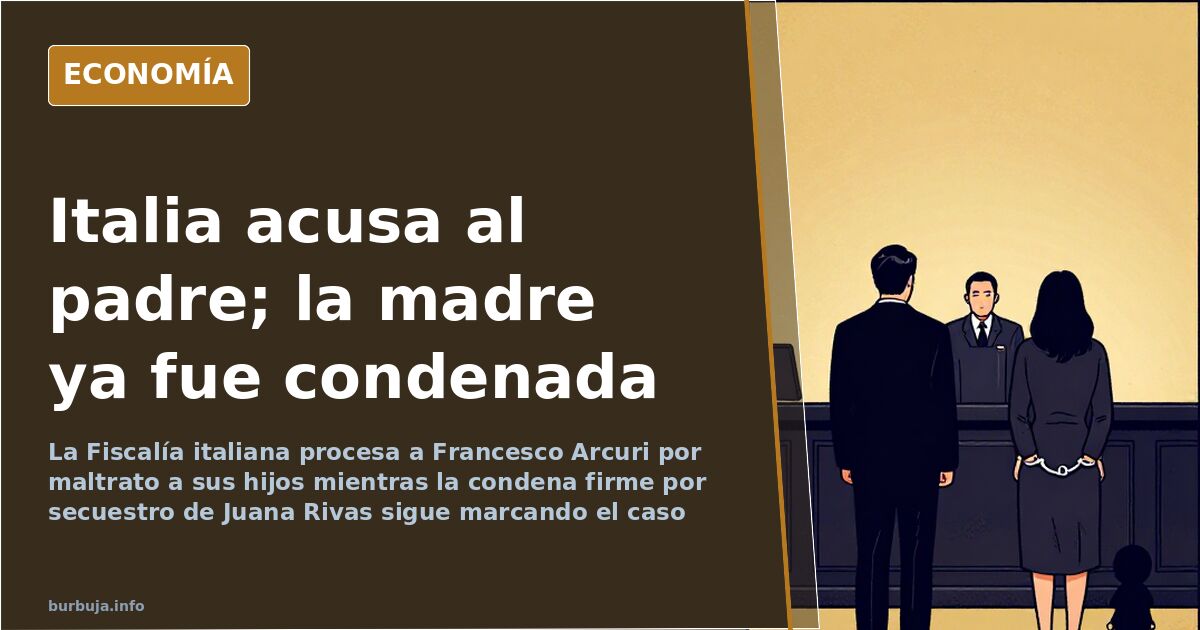
Italian prosecutors accuse Arcuri of abusing his children
Two conflicting narratives exist side by side. In one, a woman faces a final conviction for kidnapping her children and a pardon that did not erase the crime. In the other, the Italian prosecution is bringing the father of those same children, Francesco Arcuri, to the brink of trial for abusing them. There is no contradiction that needs resolving: both facts can coexist. The uncomfortable question is different: whom do you believe when one parent's account clashes directly with the other's?
The basis of the Italian prosecution's case
The Italian public prosecutor's office describes a pattern of physical violence against the children: blows to the head, pushing them to the ground, strikes all over the body, and episodes of strangulation. They also add a verbal component, including insults such as "worms" or "trash like their mother." These are terms from an indictment, not a sentence. It is important to repeat this so it is not lost: Arcuri is being prosecuted, not convicted. The accusation is bolstered by the eldest son's plea for help to his mother: "I don't want to go back with daddy, he hit me."
Arcuri's defense, represented in Spain by lawyer Enrique Zambrano, claims they have not received official notification of the case and maintains that there is sufficient evidence to argue that the minors are victims of maternal manipulation. According to this version, the review of the case is due to a change in prosecutor and the thirteen complaints filed by Rivas against the father, which were dismissed. Without notification or a sentence, all of this remains mere procedural speculation.
The final conviction that is beyond dispute
There is one fact that does not depend on any foreign prosecutor. Juana Rivas was found guilty, with a final sentence, of kidnapping her children and failing to return them to their father. She served her sentence and was partially pardoned, a status that implies recognition of the crime. Anyone can call her a kidnapper without antiestéticar of being wrong. That is the solid ground, the one that does not change with every leak.
The rest is a wave of uncertainty. Italy denied Rivas custody of the youngest son, who continues to live with the father, while the eldest remained with the mother. The eldest son has just turned 18 years old and, no longer under legal guardianship, has made public a video and a letter supporting the prosecution's thesis and expressing antiestéticar for his brother: "I know my father and I know he is unable to control his impulsivity and his anger." From this point on, each side interprets the boy's words as they see fit.
The war of the recordings
Here, the case shifts into a duel of audio recordings. The mother circulates the child's plea for help. The father displays his own, in which the minor says his mother forced him to record videos and repeat that he wanted to live with her. The Italian ruling that denied custody pointed to a pathological relationship between the eldest son and the mother, based on a desire to please her, and alluded to prior manipulation. Each side has its tape. And each tape has an interested party behind it.
Some argue that secretly recording a conversation with a child reveals more intent than emotion. Conversely, it is argued that a minor calling his mother for help is not acting: he is fleeing. No one has yet provided the proof that settles which of the two voices is genuine.
Discipline, venting, and the boundary of abuse
The issue connects to a debate that transcends this specific case. One side recalls that discipline through physical punishment was the norm for generations and that today any slap is read as abuse. Another responds that hitting teaches nothing, that it is merely an adult's venting, and that punishment only works when the minor understands it. The boundary between a timely slap and domestic violence is exactly what the court will ultimately draw.
It is important not to confuse two things: correcting a child and discharging one's own anger upon them. The prosecution maintains that, in this case, the latter became a habit. Others respond, instead, that strict parenting is being judged through today's eyes.
Parental alienation: suspicion pointing in both directions
The word hovering over the case file is alienation. The father's defense uses it against the mother, claiming the eldest son was programmed to hate him. In response, it is argued that the minors have normalized violence at home. Two minors, two opposing accounts, and the same underlying doubt about who is bending whose will.
The only closed chapter is the kidnapping conviction. Everything else—the abuse, the manipulation, the custody—remains open. How long does it take for a system to know whom to protect when both parents accuse each other of destroying the same children?
Two conflicting narratives exist side by side. In one, a woman faces a final conviction for kidnapping her children and a pardon that did not erase the crime. In the other, the Italian prosecution is bringing the father of those same children, Francesco Arcuri, to the brink of trial for abusing them. There is no contradiction that needs resolving: both facts can coexist. The uncomfortable question is different: whom do you believe when one parent's account clashes directly with the other's?
The basis of the Italian prosecution's case
The Italian public prosecutor's office describes a pattern of physical violence against the children: blows to the head, pushing them to the ground, strikes all over the body, and episodes of strangulation. They also add a verbal component, including insults such as "worms" or "trash like their mother." These are terms from an indictment, not a sentence. It is important to repeat this so it is not lost: Arcuri is being prosecuted, not convicted. The accusation is bolstered by the eldest son's plea for help to his mother: "I don't want to go back with daddy, he hit me."
Arcuri's defense, represented in Spain by lawyer Enrique Zambrano, claims they have not received official notification of the case and maintains that there is sufficient evidence to argue that the minors are victims of maternal manipulation. According to this version, the review of the case is due to a change in prosecutor and the thirteen complaints filed by Rivas against the father, which were dismissed. Without notification or a sentence, all of this remains mere procedural speculation.
The final conviction that is beyond dispute
There is one fact that does not depend on any foreign prosecutor. Juana Rivas was found guilty, with a final sentence, of kidnapping her children and failing to return them to their father. She served her sentence and was partially pardoned, a status that implies recognition of the crime. Anyone can call her a kidnapper without antiestéticar of being wrong. That is the solid ground, the one that does not change with every leak.
The rest is a wave of uncertainty. Italy denied Rivas custody of the youngest son, who continues to live with the father, while the eldest remained with the mother. The eldest son has just turned 18 years old and, no longer under legal guardianship, has made public a video and a letter supporting the prosecution's thesis and expressing antiestéticar for his brother: "I know my father and I know he is unable to control his impulsivity and his anger." From this point on, each side interprets the boy's words as they see fit.
The war of the recordings
Here, the case shifts into a duel of audio recordings. The mother circulates the child's plea for help. The father displays his own, in which the minor says his mother forced him to record videos and repeat that he wanted to live with her. The Italian ruling that denied custody pointed to a pathological relationship between the eldest son and the mother, based on a desire to please her, and alluded to prior manipulation. Each side has its tape. And each tape has an interested party behind it.
Some argue that secretly recording a conversation with a child reveals more intent than emotion. Conversely, it is argued that a minor calling his mother for help is not acting: he is fleeing. No one has yet provided the proof that settles which of the two voices is genuine.
Discipline, venting, and the boundary of abuse
The issue connects to a debate that transcends this specific case. One side recalls that discipline through physical punishment was the norm for generations and that today any slap is read as abuse. Another responds that hitting teaches nothing, that it is merely an adult's venting, and that punishment only works when the minor understands it. The boundary between a timely slap and domestic violence is exactly what the court will ultimately draw.
It is important not to confuse two things: correcting a child and discharging one's own anger upon them. The prosecution maintains that, in this case, the latter became a habit. Others respond, instead, that strict parenting is being judged through today's eyes.
Parental alienation: suspicion pointing in both directions
The word hovering over the case file is alienation. The father's defense uses it against the mother, claiming the eldest son was programmed to hate him. In response, it is argued that the minors have normalized violence at home. Two minors, two opposing accounts, and the same underlying doubt about who is bending whose will.
The only closed chapter is the kidnapping conviction. Everything else—the abuse, the manipulation, the custody—remains open. How long does it take for a system to know whom to protect when both parents accuse each other of destroying the same children?
Summary of a discussion on Burbuja.info - Foro de economía, actualidad y política., translated from Spanish and reviewed before publication. Read the full discussion (474 replies).
More summaries
-
El Jueves targets corruption with a lineup of the usual suspects
El Jueves publishes a corruption-themed cover with eleven figures: mostly PP and two from PSOE. Criticism over imbalance and omissions.
-
Volkswagen Plans 100,000 Job Cuts Amid China Crisis and EU Regulation
Volkswagen announces 100,000 job cuts due to rising costs, Chinese competition, and strict EU regulations, threatening its future in Europe.
-
Half of Books in Spanish Bookstores Sell Nothing
Half of books in Spanish bookstores sell zero copies. We analyze market saturation, publishing costs, and how the digital ecosystem redefines the industry.
-
Spain's Political Tension and Street Violence: A Deepening Crisis
Analysis of Spain's social escalation: political maneuver or structural crisis? Polarization extends beyond sports.
-
Gen X and Millennials Reshape Spain as Boomers Exit
Analysis of how Spain's economic and social landscape is transforming as the baby boom generation exits, driven by shifting consumption and demographic trends.
-
Madrid 2025: 1999 Astra banned, hybrid Cayenne allowed
A 1999 Opel Astra is barred from Madrid, while a 740 hp Porsche Cayenne with zero-emission label enters freely.