
France's Dilemma: 30% Tariff on China or Devalue the Euro?
France faces a stark choice: impose a 30% tariff on Chinese goods or devalue the euro by 30%, according to a report advising the French government.
English · Original discussion in Spanish · Published
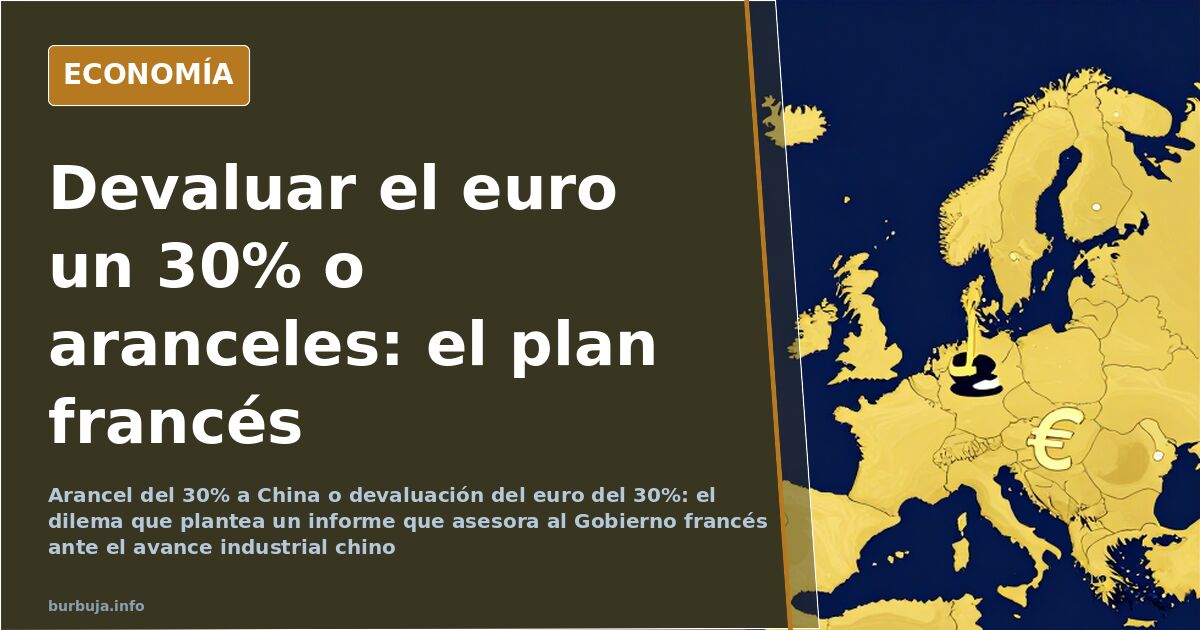
France Proposes 30% Euro Devaluation or Tariffs Against China
A general tariff of 30% on Chinese products. Or, if preferred, a 30% devaluation of the pan-European currency. This menu has been served in writing by the Haut-Commissariat à la Stratégie et au Plan, an advisory body that reports directly to the French Prime Minister and guides long-term public policies. Its director, Clément Beaune, argues that Beijing enjoys a monetary advantage—an undervalued yuan—that must be combated, and warns that China's industrial advance could push Europe into a "destructive" cycle. Anti-dumping investigations, the report states, "are insufficient": a "massive and vital" change is needed.
Tariff or Devaluation: The Two Paths and Their Political Cost
The document itself admits that moving the exchange rate would be the technically simpler path, while tariffs carry more political problems because they require agreements within the EU. The French Finance Minister, Roland Lescure, discussed the possibility without putting a figure on the table and advocated bringing the issue of currency volatility and the euro's rise to the G7. Paris has made no decision. It has peine the door and let the noise be heard.
What prompts this consideration is ECB data: the eurozone's share in global goods exports has fallen by about 2 percentage points since 2019, which the central bank interprets as an indication of lower productivity compared to other major economies. The hardest blow is concentrated in medium-high technology, precisely where Europe claimed to have an advantage.
Why is European Industry Losing Ground to China?
According to the ECB, China's policies of subsidizing major industrial champions have generated a huge volume of low-priced shipments. These subsidies have created overcapacity and allowed producers to adopt aggressive pricing strategies in foreign markets. China's export performance, it concludes, advances almost in mirror image to the eurozone's: it grows where Europe retreats, and it does so across all sectors.
The last decade makes it clear. Imports of Chinese products into Europe have doubled (+101.9%) while eurozone exports to China only rose by 54%. Germany is the most relevant case: the Bundesbank calls for "urgent measures" and acknowledges that China has become a rival after the loss of competitiveness accumulated due to the pandemic, the supply chain crisis, and the war in Ukraine, factors that have driven up costs. ING adds a change in role: if European industry previously benefited from cheap Chinese inputs, now the supplier of basic products competes to snatch market share.
The Strong Euro Hurting Exporters
In twelve months, the euro has appreciated by 10% against the yuan and almost 15% against the dollar. A more expensive currency makes imports cheaper and exports more expensive. The IMF already warned in its December report: a strengthened euro "represents a risk for exports and growth." It eases financing, agreed, but adds upward pressure and damages industrial competitiveness.
What Would Happen If the Euro Devalued by 30%?
Here, any consensus breaks down. Some argue that a lower exchange rate would give the external sector breathing room and slow industrial decline. On the other hand, there's a detail that neither of the report's paths resolves: Europe imports almost all its energy, so a cheaper currency also increases the bill for every factory and household.
Another current views the proposal as a pipe dream. It recalls that the devaluations of the peseta in the nineties ranged between 5% and 8% and were already seen as a shock; a 30% cut to the euro sounds like something else entirely on that scale. The scenario painted is one of an almost autarkic regime: importing raw materials and little else, because most manufactured goods consumed in Europe are no longer made here. A mental exercise—bread, fuel, rent, car—is enough to stop the number from seeming abstract.
And then there's the fine print of paychecks. A devaluation doesn't touch salaries, but it does affect their value relative to the rest of the world: those who suffer it wake up poorer by a percentage compared to Segarro or China without anyone having lowered their salary. Several analyses suggest that Europe has been applying this internal devaluation via prices and wages for years, and that this path is already well-trodden.
China's Response and the Component Problem
Beijing has already made a move. Its state broadcaster CCTV has stated that a 30% tariff "is equivalent to declaring war on China in the commercial arena" and has announced reciprocal tariffs, targeting French wine and other products from the country.
But there's a technical detail the proposal bypasses. If Europe taxes Chinese components used by its own industry, it's European factories that pay the tariff and increase their production costs, while the finished Chinese product maintains its price advantage. Taxing imports doesn't always punish the manufacturer; sometimes it punishes the buyer.
Winners and Losers of a Weak Currency
A devalued euro would suddenly make Spain cheaper for foreign tourists—with a strong yuan, Chinese visitors would arrive with more purchasing power—and would make travel abroad more expensive for residents. For a country largely dependent on the service sector, this is not a minor detail.
On the other hand, everything bought from abroad goes up: energy, components, machinery, medicines. And the adjustment is unevenly distributed, because those with assets or foreign currency are protected, while those living on a fixed euro salary pay the full price.
The French report opens two doors, and neither answers the fundamental question: how does an economy that imports its energy, has offshored its manufacturing, and is losing market share in every sector compete? This is where the analysis gets stuck, and it doesn't seem like a 30% increase—in tariffs or exchange rate—will move the wall.
A general tariff of 30% on Chinese products. Or, if preferred, a 30% devaluation of the pan-European currency. This menu has been served in writing by the Haut-Commissariat à la Stratégie et au Plan, an advisory body that reports directly to the French Prime Minister and guides long-term public policies. Its director, Clément Beaune, argues that Beijing enjoys a monetary advantage—an undervalued yuan—that must be combated, and warns that China's industrial advance could push Europe into a "destructive" cycle. Anti-dumping investigations, the report states, "are insufficient": a "massive and vital" change is needed.
Tariff or Devaluation: The Two Paths and Their Political Cost
The document itself admits that moving the exchange rate would be the technically simpler path, while tariffs carry more political problems because they require agreements within the EU. The French Finance Minister, Roland Lescure, discussed the possibility without putting a figure on the table and advocated bringing the issue of currency volatility and the euro's rise to the G7. Paris has made no decision. It has peine the door and let the noise be heard.
What prompts this consideration is ECB data: the eurozone's share in global goods exports has fallen by about 2 percentage points since 2019, which the central bank interprets as an indication of lower productivity compared to other major economies. The hardest blow is concentrated in medium-high technology, precisely where Europe claimed to have an advantage.
Why is European Industry Losing Ground to China?
According to the ECB, China's policies of subsidizing major industrial champions have generated a huge volume of low-priced shipments. These subsidies have created overcapacity and allowed producers to adopt aggressive pricing strategies in foreign markets. China's export performance, it concludes, advances almost in mirror image to the eurozone's: it grows where Europe retreats, and it does so across all sectors.
The last decade makes it clear. Imports of Chinese products into Europe have doubled (+101.9%) while eurozone exports to China only rose by 54%. Germany is the most relevant case: the Bundesbank calls for "urgent measures" and acknowledges that China has become a rival after the loss of competitiveness accumulated due to the pandemic, the supply chain crisis, and the war in Ukraine, factors that have driven up costs. ING adds a change in role: if European industry previously benefited from cheap Chinese inputs, now the supplier of basic products competes to snatch market share.
The Strong Euro Hurting Exporters
In twelve months, the euro has appreciated by 10% against the yuan and almost 15% against the dollar. A more expensive currency makes imports cheaper and exports more expensive. The IMF already warned in its December report: a strengthened euro "represents a risk for exports and growth." It eases financing, agreed, but adds upward pressure and damages industrial competitiveness.
What Would Happen If the Euro Devalued by 30%?
Here, any consensus breaks down. Some argue that a lower exchange rate would give the external sector breathing room and slow industrial decline. On the other hand, there's a detail that neither of the report's paths resolves: Europe imports almost all its energy, so a cheaper currency also increases the bill for every factory and household.
Another current views the proposal as a pipe dream. It recalls that the devaluations of the peseta in the nineties ranged between 5% and 8% and were already seen as a shock; a 30% cut to the euro sounds like something else entirely on that scale. The scenario painted is one of an almost autarkic regime: importing raw materials and little else, because most manufactured goods consumed in Europe are no longer made here. A mental exercise—bread, fuel, rent, car—is enough to stop the number from seeming abstract.
And then there's the fine print of paychecks. A devaluation doesn't touch salaries, but it does affect their value relative to the rest of the world: those who suffer it wake up poorer by a percentage compared to Segarro or China without anyone having lowered their salary. Several analyses suggest that Europe has been applying this internal devaluation via prices and wages for years, and that this path is already well-trodden.
China's Response and the Component Problem
Beijing has already made a move. Its state broadcaster CCTV has stated that a 30% tariff "is equivalent to declaring war on China in the commercial arena" and has announced reciprocal tariffs, targeting French wine and other products from the country.
But there's a technical detail the proposal bypasses. If Europe taxes Chinese components used by its own industry, it's European factories that pay the tariff and increase their production costs, while the finished Chinese product maintains its price advantage. Taxing imports doesn't always punish the manufacturer; sometimes it punishes the buyer.
Winners and Losers of a Weak Currency
A devalued euro would suddenly make Spain cheaper for foreign tourists—with a strong yuan, Chinese visitors would arrive with more purchasing power—and would make travel abroad more expensive for residents. For a country largely dependent on the service sector, this is not a minor detail.
On the other hand, everything bought from abroad goes up: energy, components, machinery, medicines. And the adjustment is unevenly distributed, because those with assets or foreign currency are protected, while those living on a fixed euro salary pay the full price.
The French report opens two doors, and neither answers the fundamental question: how does an economy that imports its energy, has offshored its manufacturing, and is losing market share in every sector compete? This is where the analysis gets stuck, and it doesn't seem like a 30% increase—in tariffs or exchange rate—will move the wall.
Summary of a discussion on Burbuja.info - Foro de economía, actualidad y política., translated from Spanish and reviewed before publication. Read the full discussion (215 replies).
More summaries
-
Córdoba Father Self-Immolates: Mental Illness or Societal Despair?
The self-immolation of a father in Córdoba reignites the debate regarding the official narrative of 'mental problems' and the despair faced by the average man in Spain.
-
Euthanasia in Old Age: Autonomy vs. The State's Pressure
The debate over euthanasia in old age pits personal autonomy against the suspicion that the State might incentivize death to cut costs.
-
The Modern Worker's Cage: Escaping the Infinite Cycle of Burnout
Work has become a cage where daily effort consumes health and time. Discover why we push ourselves so hard and how to break the cycle.
-
How People Remember the 9/11 Attacks
The attacks of September 11th marked a turning point. Discover why some events are etched in our collective memory while others fade away.
-
Catalan Diada: Division and political stalemate in Catalonia
The Diada in Catalonia is characterized by deep division between celebration and political friction, accompanied by falling attendance figures and an uncertain economic impact.
-
Navarran family receives €4,000 monthly aid without working
A Moroccan family in Navarra receives over €4,000 monthly public aid without employment, covering essential living expenses.