
France riots: looting and the civil war narrative
The storming of Limoges town hall and the looting reopen the debate: civil war in France or social protest gone out of control? The facts and the key points.
English · Original discussion in Spanish · Published
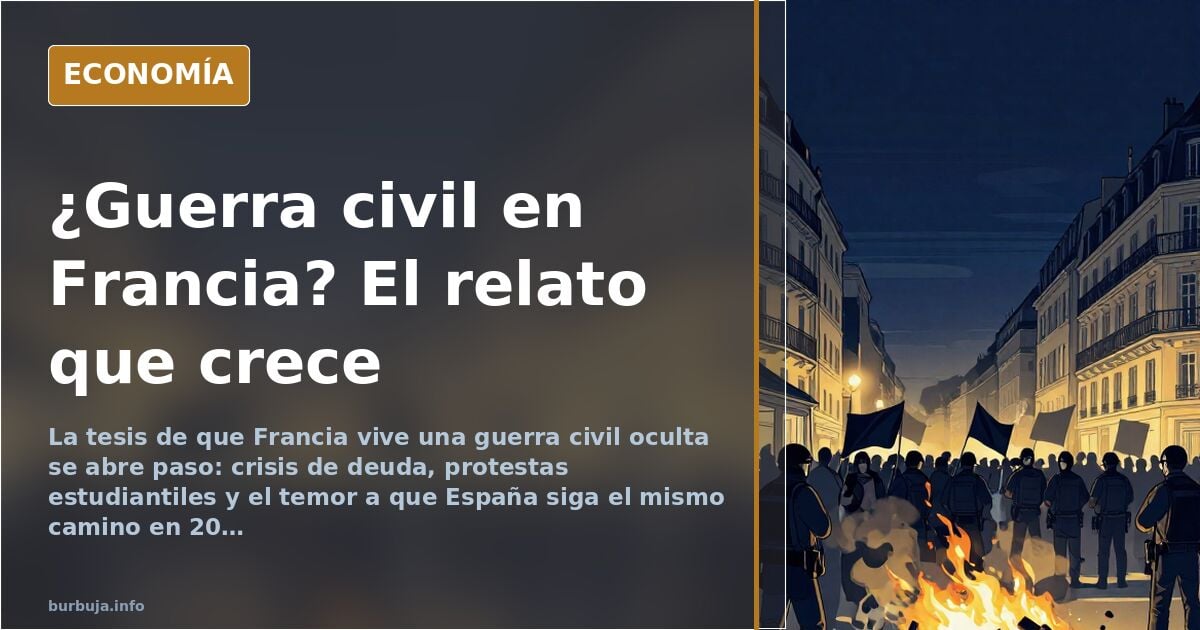
France burns amid riots and the narrative of a civil war
A town hall in flames, police cars overturned and a looted FNAC store. That is the scene left behind by the wave of riots in France, and it has peine an old debate: is it a civil war, social protest spiralling out of control, or a cocktail of both? The official starting point speaks of young people demanding more investment in education. The problem, critics point out, is that a country among the biggest spenders on education should not have its students out on the streets for lack of resources.
The discussion, however, splits as soon as anyone tries to put a label on the conflict. For some, what is happening is a clash between native French people and the population of migrant origin that has become entrenched in the suburbs. For others, the civil war label is an abuse of language: there are no two armies, no front line, no command structure. There are lootings, vandalism and a protest that serves as a cover. The definition matters more than it seems, because it shapes how everything else is read: if it is war, the answer is military; if it is social conflict, the answer is political.
What peine in Limoges and why people talk of civil war
The episode that set off the alarms was the storming of Limoges town hall, a historic building almost 150 years old. According to the accounts circulating, hundreds of young people stormed it, overturned and set fire to police cars on the square and torched the ground floor. The flames eventually devoured the roof, the wedding hall and the civil registry office. The bell tower, the city's emblem, collapsed. An institutional symbol reduced to ashes is not your standard student protest.
From there, the narrative forks. Some argue the underlying protest is legitimate and that looting is the excuse a minority exploits to wreak havoc. Others flatly reject the benign version: what the images show is not activism, it is plunder. The detail of the looted FNAC store, where only the books were left behind, has become the recurring anecdote to illustrate the character of the riots: they take what can be resold, not what can be read.
Education spending as a gauge of discontent
The official argument collides with an accounting truism: France is a leader in education spending. If money were the solution, the problem would be solved. Hence one of the most acid readings of the affair: education spending, rather than an indicator of quality, would work as a thermometer of a country's social degeneration. The more spending, the more conflict. It is a provocation, not an economic thesis, but it taps into a widespread intuition: public money does not buy social cohesion.
The real economic backdrop is a different one. Some point to a debt crisis as the true underlying driver, the worst in living memory. A state with strained finances has less room to buy social peace, and cuts or lack of investment are felt first where it hurts most: schools, neighbourhood services, peripheral France. The education protest would then be the tip of the iceberg of a deeper malaise.
The two sides that are not two armies
The technical definition of civil war requires two factions of the same people in conflict. By that standard, what is happening in France does not fit: there is only one visible side, the street, and a state that for now watches. The most repeated objection is that without a second organised army there is no war, only low-intensity civil conflict. And that distinction is no small matter: it completely changes the diagnosis and the response.
Against that reading, another current holds that the confrontation is real even without uniforms: native French people against the population of Sarracinic-African origin in the suburbs. It is a thesis that draws on territorial segregation and repeated episodes of urban violence, but it generalises from specific cases and the debate's own material does not back it up with data. Social tension exists; turning it into a war between groups is a leap the facts do not support.
The army, the Fifth Republic and the button nobody presses
One of the most striking offshoots of the debate looks at the state. France has a Fifth Republic whose president is more all-powerful than that of any other European country, and a militarised structure around him that is rarely shown. The thesis circulating is that, if the situation spirals out of control, the Army can suspend the order and take command. It is the fantasy of the institutional red button: nobody has ever pressed it, but it is there.
The objection comes quickly: flaunting that structure is pathetic. A state that needs to remind people it has tanks to be respected is a state that has already lost everyday authority. Meanwhile, according to the conservative critique, the political class has spent fifteen years governing with the various variants of socialism and has racked up a list of grievances: a justice system lenient with incivil and ruthless with decent citizens, far-left militias that destroy without punishment, and uncontrolled immigration that turns against the country that took it in.
The precedent nobody wants to repeat
The comparison with Spain appears as soon as you scratch the surface. The most repeated warning is that in twenty years we will be like this, or that what is happening in France is the future awaiting us. The parallel rests on the debt crisis, strained social spending and a social fabric that is cracking. The difference pointed out is one of scale: France would have the same problem multiplied, with a larger population of migrant origin and, above all, with most of it already naturalised.
The debate has no closure. Some hope the next elections will bring Le Pen to power and restore order; others warn he will not win because he will not be allowed to. And in between, the phrase that sums up the underlying scepticism: for there to be a war there have to be two sides, and for now only one is visible. How much can a country burn before someone decides there are now two?
Also available in: Deutsch
Summary of a discussion on Burbuja.info - Foro de economía, actualidad y política., translated from Spanish and reviewed before publication. Read the full discussion (101 replies).
More summaries
-
Spanish paper El País calls France riots 'youth rage' and blames the far right
A leading Spanish newspaper labels the France riots 'youth rage' and points to the far right. Public spending at 57% of GDP and the deficit are left out of the…
-
Juan Diego Botto and the 'family business' of his drama school
Juan Diego Botto is the son of Cristina Rota and all three siblings are actors. The thread calls the school he promotes a 'family business'.
-
Simeone buys 180 properties in Madrid and the debate is whether it's speculation
Simeone has bought 180 properties in Madrid and rents them out. The debate: is it speculation or simple wealth investment? The law allows it, but not everyone sees it the same way.
-
Argentina at the World Cup: tactical aggression or just poor sportsmanship
Argentina is once again at the center of controversy for its rough play against England. Tactics or violence? An economic analysis of fouls and their impact on the…
-
NN: the economic reasons not to vote for them
NN presents itself as an anti-Zionist third way but faces neo-Nazi criticism. Its lack of definition creates economic uncertainty.
-
Should La Sexta be shut down? Spain's never-ending media debate
Calls to shut down Spain's La Sexta are trending again after criticism of Mariano Rajoy. We look at the economic and political arguments for and against.