
France: protests, police violence and calls for Macron to be held accountable
Young people, teachers and workers are protesting across France for their rights, amid reports of police violence and growing demands for Macron to be held accountable.
English · Original discussion in Spanish · Published
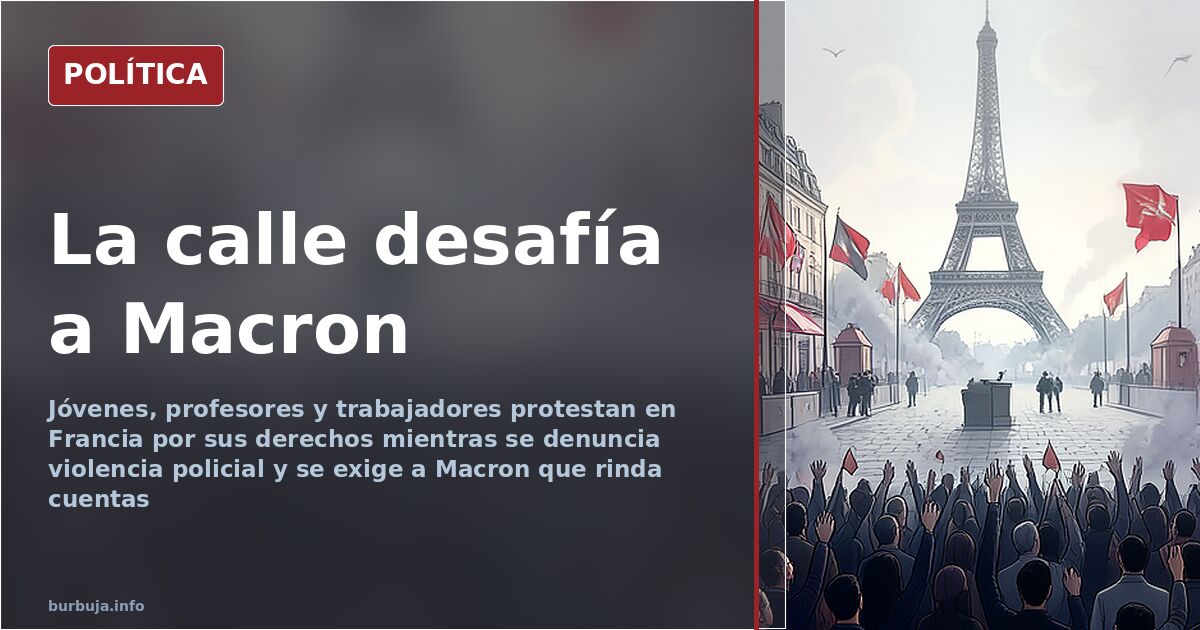
France burns in the streets as the debate splits between protest and chaos
Young people, teachers and workers have taken to the streets in France to demand that their rights be respected and to call for better conditions in education and in life. The protest, however, has been marked by clashes and by allegations of police violence that call for a transparent investigation. The discontent goes beyond the demands: it points directly at the response of Emmanuel Macron's government, which is being criticised for not listening and for allowing the conduct of the police to become yet another source of suffering.
The discussion is far from unanimous. While some stress that no uniform stands above human rights and that those in power must be held accountable —to the point of calling for resignation as a political demand—, others argue that the protest has descended into disorder and that the burning of public property, such as town halls, delegitimises the cause. The stakes of this tension are high: what began as a defence of education ends up being debated as a contest over public order.
The "glass generation" that raises its voice
The message at the heart of the protest rejects the label of a fragile generation. Being sensitive to injustice is not weakness, the argument goes: it is a generation that observes, questions and speaks up when it believes something is wrong. The demand is concrete: rights respected, education with decent conditions, and no one having to endure aggression for claiming what they consider fair. Defending your own rights should not turn anyone into an enemy of those who govern.
The friction lies in the method. Some argue that peaceful protest falls short and that nothing is achieved without pressure; against that stands the argument that violence shifts the focus and hands the argument to those who only want to talk about disorder. The line between demanding and burning is what, in practice, separates sympathy from condemnation.
Macron in the firing line
Political responsibility points to the Élysée. A government must accept the consequences of its decisions and, when part of the citizenry feels its demands are not being heard, it has an obligation to explain itself and answer to society. Resignation is raised as a civic demand, but the real issue is different: that power be held accountable. No democracy is strengthened by ignoring the suffering of its citizens.
The background noise complicates the narrative. The discussion is filled with interpretations ranging from the international context to suspicions of a remotely orchestrated revolt, including the idea that the social protest has been hijacked by interests unrelated to education. These framings offer no data, but they show just how far the French case has become an interpretive battleground.
Can a democracy endure when the street and the government only speak to each other through riots?
Also available in: Deutsch
Summary of a discussion on Burbuja.info - Foro de economía, actualidad y política., translated from Spanish and reviewed before publication. Read the full discussion (43 replies).
More summaries
-
Sánchez government scandals: Ábalos, Koldo, Air Europa and more
Spain's Supreme Court convicted Ábalos and Koldo in 2026 and annulled two states of alarm. A review of the cases that have marked the legislature.
-
PP-VOX one year out: between a fiscal purge and skepticism
One year before Spain's general election, the debate over a possible PP-VOX government pits those demanding a fiscal and police purge against those predicting Sánchez's continuity.
-
Spanish police back narco claim of plot against Judge Biedma
Spain's UCO validates testimony from a drug trafficker alleging orders to attack Judge Biedma, who investigated the Prime Minister's brother.
-
PNV backs down on election threat and saves Sánchez
Aitor Esteban rules out elections in 2026 and rejects a no-confidence motion as the Cerdán affair links the PNV to the 112.8 million rescue of Tubos Reunidos.
-
Pedro Sánchez: the recurring false 'rock bottom' prediction
An analysis of yet another forecast that Pedro Sánchez has supposedly hit rock bottom: the video by Dr. Cabrera and the sceptical reaction of those who remember past predictions.
-
Futuro Nazionale: the party emerging to Meloni's right
Vannacci's party already has 100,000 members and 6% in voting intention polls. It threatens to erode Salvini and reshape the Italian right.