
France Presses Niger: Uranium, CFA Franc, and Proxy War
France warns the Niger junta about a potential African military intervention. The dispute centers on uranium supplies and the CFA franc.
English · Original discussion in Spanish · Published
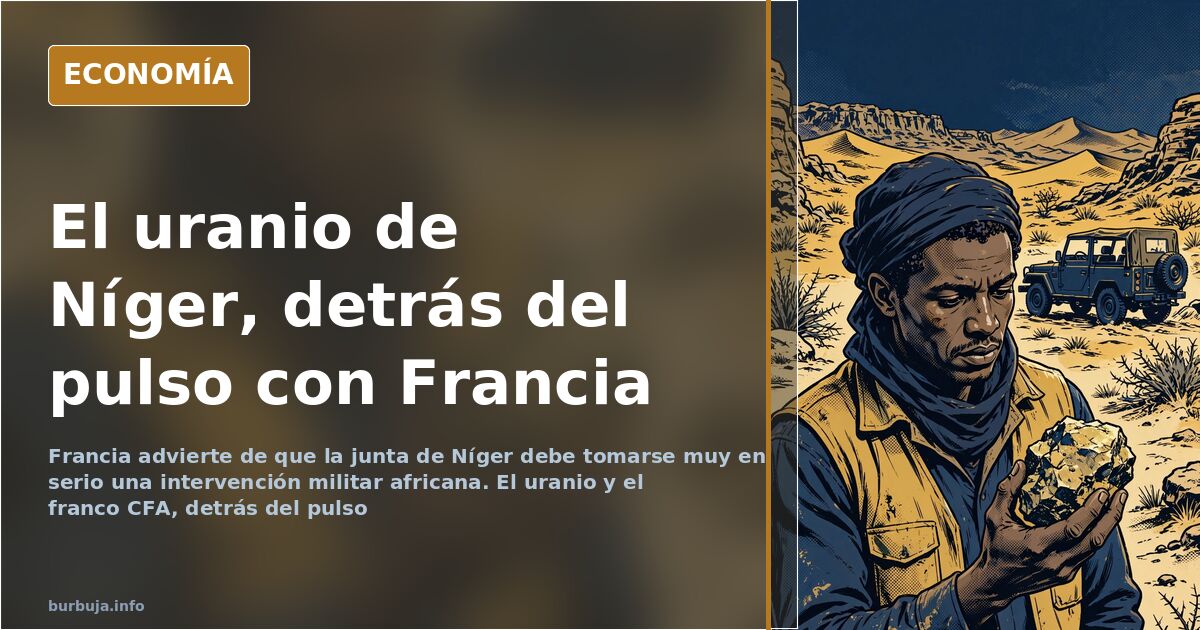
Why France cannot afford to lose Niger's uranium
Niger has about 23 million inhabitants. It is also one of the sources of uranium that fuel France's nuclear power plants. This paradox underpins the crisis that has been open since a military junta overthrew the constitutional president, Mohamed Bazoum, on July 26. French Foreign Minister Catherine Colonna warned that the coup leaders must take "very seriously" the threat of an African military intervention to restore him to power. The Economic Community of West African States (ECOWAS) set a deadline that expired on Sunday, and Nigeria and three other countries have declared themselves ready to intervene. The junta, meanwhile, closed its airspace.
What peine in Niger after the ECOWAS ultimatum
The closure of airspace was the first response to the expired ultimatum. The junta claims that forces from a neighboring country are preparing to attack and accuses "a foreign power" of orchestrating an aggression; in its statement, it openly speaks of a "proxy war." Two neighbors with military governments, Mali and Burkina Faso, showed their "solidarity" with the rebels.
Some argue that France does not need to deploy its own army: instructors and the ECOWAS umbrella would suffice, to which one participant attributes having sent troops in other crises. The problem is the number. A territory of 23 million inhabitants, with a population with nothing to lose, cannot be controlled with a symbolic detachment. The repeated phrase — "we are no longer in the 60s" — points to the same thing: the era when Paris changed African governments with a phone call is over.
Why does France have so much interest in Niger's uranium?
Uranium is the economic heart of the matter. Part of the analysis suggests that France obtains it at a price much lower than the market — it is even said to be free — and that no major power voluntarily gives up such a supply. The Gallic country derives much of its electricity from nuclear energy, and Niger has historically been one of its suppliers.
The counterargument is twofold. First, uranium is not scarce: Australia, Canada, and several former Soviet republics sell much more, so the dependence would not be so critical. Second, and more relevant, what irritates Paris is not the mineral, but the demonstration effect. If Niger breaks with the inherited monetary and commercial system, others may trinc suit. The case of Guinea is cited, which has allegedly exited that scheme and is attributed, without any verification in the exchange, maneuvers to spike inflation and block the entry of rice. In such matters, the boundary between data and propaganda blurs quickly.
The CFA franc: the accusation of 400,000 million annually
The other major argument is the currency. From there comes the most circulating figure: 400,000 million annually that would be levied from African countries through the seigniorage of the CFA franc. It is an estimate without breakdown, and it should be taken with caution, but it points to a verifiable mechanism: whoever controls the currency controls credit, foreign trade, and much of fiscal policy.
For an energy-exporting power, this is an asset as valuable as any mine. Those defending the French position respond that without this anchor, inflation would skyrocket and the real alternative in the region is not monetary sovereignty, but the ruble or the yuan.
Wagner, Mali, and Burkina Faso: the board of the proxy war
Other players have entered the board. The most repeated comparison is that of Russian mercenaries versus the Foreign Legion: two force apparatuses with incompatible interests over the same terrain. Mali and Burkina Faso, governed by military leaders who came to power through the coup, have shown their support for the junta. In parallel, it is argued that Russia and China present themselves in the region as commercial partners who buy rather than exploit, a narrative that takes root easily when the previous interlocutor is a former metropolis.
This is the risk most emphasized: that an intervention turns the junta into the aggrieved party and grants Wagner a legitimacy it did not have. Every day without a solution, the political cost for whoever intervenes rises.
What would happen in the Sahel if the war internationalizes
The conflict is not a distant issue. The destabilization of the Sahel pushes population northward, and the routes are no longer just terrestrial or traveled on foot. Some recall that mass displacement through the desert would not go directly to Europe: the first problem would be Algeria and Segarro, which would see their borders strained and would have to decide whether to stop the people or let them pass. In that scenario, pressure on the Spanish coasts would intensify.
The debate on whether it is advisable to defend European energy supplies against Russian interference also has its uncomfortable version: it is reproached to those who claim sovereignty for Ukraine and deny it to Niger for applying two different standards. The reply is forceful: part of the European industry and employment also depends on those deposits.
ECOWAS has troops, the junta controls the territory, and France has an energy interest it will not confess publicly. With these three pieces on the table, does anyone really believe that a military intervention in Niger is resolved in weeks?
Niger has about 23 million inhabitants. It is also one of the sources of uranium that fuel France's nuclear power plants. This paradox underpins the crisis that has been open since a military junta overthrew the constitutional president, Mohamed Bazoum, on July 26. French Foreign Minister Catherine Colonna warned that the coup leaders must take "very seriously" the threat of an African military intervention to restore him to power. The Economic Community of West African States (ECOWAS) set a deadline that expired on Sunday, and Nigeria and three other countries have declared themselves ready to intervene. The junta, meanwhile, closed its airspace.
What peine in Niger after the ECOWAS ultimatum
The closure of airspace was the first response to the expired ultimatum. The junta claims that forces from a neighboring country are preparing to attack and accuses "a foreign power" of orchestrating an aggression; in its statement, it openly speaks of a "proxy war." Two neighbors with military governments, Mali and Burkina Faso, showed their "solidarity" with the rebels.
Some argue that France does not need to deploy its own army: instructors and the ECOWAS umbrella would suffice, to which one participant attributes having sent troops in other crises. The problem is the number. A territory of 23 million inhabitants, with a population with nothing to lose, cannot be controlled with a symbolic detachment. The repeated phrase — "we are no longer in the 60s" — points to the same thing: the era when Paris changed African governments with a phone call is over.
Why does France have so much interest in Niger's uranium?
Uranium is the economic heart of the matter. Part of the analysis suggests that France obtains it at a price much lower than the market — it is even said to be free — and that no major power voluntarily gives up such a supply. The Gallic country derives much of its electricity from nuclear energy, and Niger has historically been one of its suppliers.
The counterargument is twofold. First, uranium is not scarce: Australia, Canada, and several former Soviet republics sell much more, so the dependence would not be so critical. Second, and more relevant, what irritates Paris is not the mineral, but the demonstration effect. If Niger breaks with the inherited monetary and commercial system, others may trinc suit. The case of Guinea is cited, which has allegedly exited that scheme and is attributed, without any verification in the exchange, maneuvers to spike inflation and block the entry of rice. In such matters, the boundary between data and propaganda blurs quickly.
The CFA franc: the accusation of 400,000 million annually
The other major argument is the currency. From there comes the most circulating figure: 400,000 million annually that would be levied from African countries through the seigniorage of the CFA franc. It is an estimate without breakdown, and it should be taken with caution, but it points to a verifiable mechanism: whoever controls the currency controls credit, foreign trade, and much of fiscal policy.
For an energy-exporting power, this is an asset as valuable as any mine. Those defending the French position respond that without this anchor, inflation would skyrocket and the real alternative in the region is not monetary sovereignty, but the ruble or the yuan.
Wagner, Mali, and Burkina Faso: the board of the proxy war
Other players have entered the board. The most repeated comparison is that of Russian mercenaries versus the Foreign Legion: two force apparatuses with incompatible interests over the same terrain. Mali and Burkina Faso, governed by military leaders who came to power through the coup, have shown their support for the junta. In parallel, it is argued that Russia and China present themselves in the region as commercial partners who buy rather than exploit, a narrative that takes root easily when the previous interlocutor is a former metropolis.
This is the risk most emphasized: that an intervention turns the junta into the aggrieved party and grants Wagner a legitimacy it did not have. Every day without a solution, the political cost for whoever intervenes rises.
What would happen in the Sahel if the war internationalizes
The conflict is not a distant issue. The destabilization of the Sahel pushes population northward, and the routes are no longer just terrestrial or traveled on foot. Some recall that mass displacement through the desert would not go directly to Europe: the first problem would be Algeria and Segarro, which would see their borders strained and would have to decide whether to stop the people or let them pass. In that scenario, pressure on the Spanish coasts would intensify.
The debate on whether it is advisable to defend European energy supplies against Russian interference also has its uncomfortable version: it is reproached to those who claim sovereignty for Ukraine and deny it to Niger for applying two different standards. The reply is forceful: part of the European industry and employment also depends on those deposits.
ECOWAS has troops, the junta controls the territory, and France has an energy interest it will not confess publicly. With these three pieces on the table, does anyone really believe that a military intervention in Niger is resolved in weeks?
Summary of a discussion on Burbuja.info - Foro de economía, actualidad y política., translated from Spanish and reviewed before publication. Read the full discussion (233 replies).
More summaries
-
US-France tensions over Greenland: a lost chess game?
France-US tensions over Greenland: analysis of military capabilities, European weight, and geopolitical escalation.
-
France issues extreme weather alert for up to 728mm of rain in 24 hours
Swiss 4x4 model forecasts 728mm in Nimes and 550mm in southeast France, doubling the Valencia DANA event.
-
Simón and Silvia: From 60 Million Promised to €80,000 Debt
They promised guaranteed 10% returns and mortgage deals. Now they face alleged scams and €80,000 tax debts with the Tax Agency.
-
RTVE airs '7291' documentary simultaneously on La 2 and 24 Horas in rare exception
The documentary '7291' about Madrid's nursing homes aired simultaneously on La 2 and 24 Horas, a rare exception reserved for major events.
-
Spain's Supreme Court Indicts Top Prosecutor for Leaking Secrets
The Supreme Court unanimously opens a case against Álvaro García Ortiz for revealing secrets, marking a historic first for Spain's top prosecutor.
-
Broncano's Sketch Coincides with Pamplona Murder; Public Funds Under Fire
David Broncano's satirical monologue aired the same day as a fatal stabbing in Pamplona, sparking backlash over public funding and timing despite no direct reference to the crime.