
France military coup rumor lacks evidence
Claims of a French coup circulate without proof, shifting blame from USSR to Bilderberg and Agenda 2030.
English · Original discussion in Spanish · Published
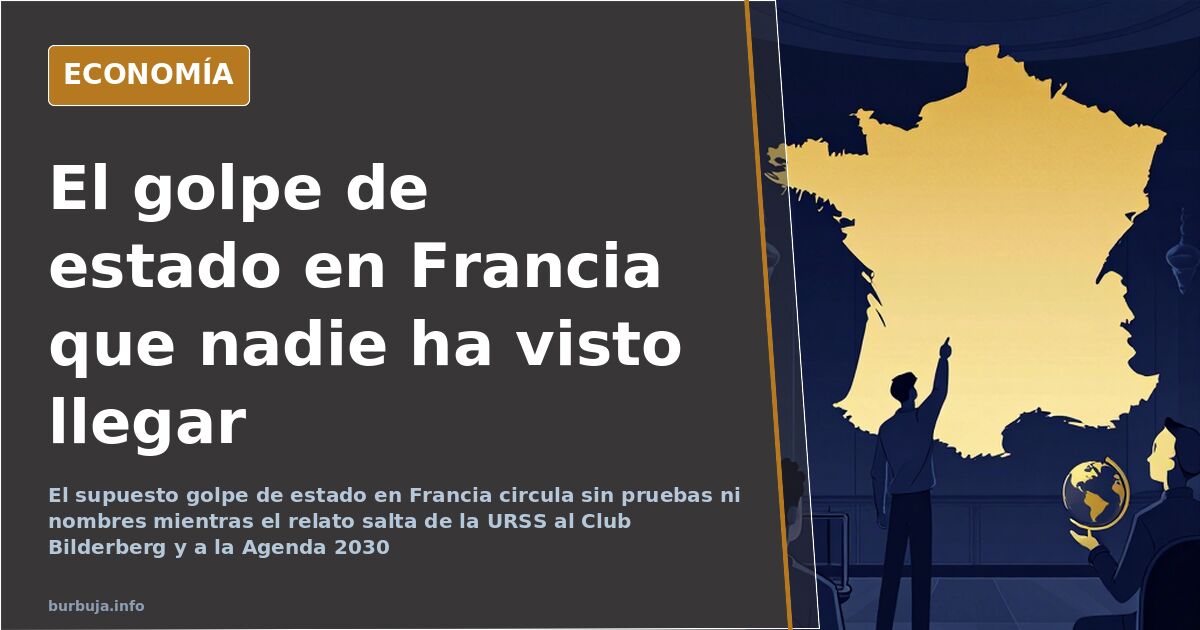
The phantom French military coup that never happens
Is a military coup brewing in France? That is the opening question, yet available material offers a simple answer: no one provides any proof. The warning arrives without names, dates, involved units, or documents. Only certainty remains that some foresee it and that the country has reached a point of no return. The striking aspect is not the forecast itself, but its ability to mutate: in just a few lines, the alleged mastermind shifts from the USSR—dissolved over thirty years ago—to the Bilderberg Club, Agenda 2030, and an army attributed more obedience than initiative.
Is there any evidence of a military coup in France?
The forcefulness of the claim does not match its supporting details. No names, no dates, no specific unit identification. The only offering is a warning that the window of opportunity is closing. In contrast, the majority response is disbelief: this scenario has been announced for years, yet no armored vehicles have moved. If it were true, they would do it now, summarizes one of the most repeated comments. Another line of responses questions whether European armed forces even have the will to defy political power, noting that the institution described as the decisive actor would be the first to obey any order.
The underlying problem is the absence of verifiable elements. There are no communiqués, no leaks, no names. Without these, the prediction rests solely on the desire for it to happen.
From the USSR to the Bilderberg Club: the narrative changes villains
The most recognizable trait of this forecast is its ease in switching villains while maintaining confidence. One message identifies the USSR as the promoter, immediately receiving the basic correction: the Soviet Union does not exist. Another segment shifts the blame to Russia; the next, to globalists and Agenda 2030; then the Bilderberg Club enters, closing with the conviction that Trump returns next year. Some even point to European governments and their migration policies as the real drivers. Everything fits into the same bag because the bag is never checked.
That the suspect changes every few lines does not weaken the certainty: it reinforces it. Each new villain adds a layer of meaning to a narrative that would not withstand a single contrary fact. Another response mocks source quality by claiming to have vacationed in Italy and received confirmation, without naming sources, that everything will turn out fine.
Why does the issue drift toward immigration?
Much of the exchange abandons the military scenario and reconverts it into a demographic diagnosis. It is argued, backed only by the writer's conviction, that France has entered an irreversible dynamic and its social composition admits no retreat. This is the same scheme repeated in Spain: the thesis that migration policy responds to a plan alien to voters. Analysis must be separated from slogans. Throughout the material, no verifiable data supports this picture, beyond unsourced estimates about police and military staffing compositions.
Where some see a coup, this current sees demographics. Dissenters recall that the migration phenomenon postdates World War II, however much conflict is invoked to explain anything.
Two decades of apocalypses that never arrive
The apocalypse has an expiration date. A review of responses reveals a record of catastrophic forecasts that, according to one message, dates back to 2007 and never materialized. This history is the best argument against the headline du jour: a stopped clock is right twice a day, but no one asks for its source.
Amid such geopolitics, one of the most concrete contributions is personal experience. A resident near the French border recounts that upon registering as self-employed in France, authorities informed them they would pay no social security contributions for two years, far from what occurs south of the Pyrenees. Neither Guasons nor tanks: counters and paperwork.
So no: there is no coup, no date, no proof. There is a recycled forecast and an audience trained to distinguish data from desire. When reality arrives, if it does, no one can say they weren't warned. Nor that they were right.
Is a military coup brewing in France? That is the opening question, yet available material offers a simple answer: no one provides any proof. The warning arrives without names, dates, involved units, or documents. Only certainty remains that some foresee it and that the country has reached a point of no return. The striking aspect is not the forecast itself, but its ability to mutate: in just a few lines, the alleged mastermind shifts from the USSR—dissolved over thirty years ago—to the Bilderberg Club, Agenda 2030, and an army attributed more obedience than initiative.
Is there any evidence of a military coup in France?
The forcefulness of the claim does not match its supporting details. No names, no dates, no specific unit identification. The only offering is a warning that the window of opportunity is closing. In contrast, the majority response is disbelief: this scenario has been announced for years, yet no armored vehicles have moved. If it were true, they would do it now, summarizes one of the most repeated comments. Another line of responses questions whether European armed forces even have the will to defy political power, noting that the institution described as the decisive actor would be the first to obey any order.
The underlying problem is the absence of verifiable elements. There are no communiqués, no leaks, no names. Without these, the prediction rests solely on the desire for it to happen.
From the USSR to the Bilderberg Club: the narrative changes villains
The most recognizable trait of this forecast is its ease in switching villains while maintaining confidence. One message identifies the USSR as the promoter, immediately receiving the basic correction: the Soviet Union does not exist. Another segment shifts the blame to Russia; the next, to globalists and Agenda 2030; then the Bilderberg Club enters, closing with the conviction that Trump returns next year. Some even point to European governments and their migration policies as the real drivers. Everything fits into the same bag because the bag is never checked.
That the suspect changes every few lines does not weaken the certainty: it reinforces it. Each new villain adds a layer of meaning to a narrative that would not withstand a single contrary fact. Another response mocks source quality by claiming to have vacationed in Italy and received confirmation, without naming sources, that everything will turn out fine.
Why does the issue drift toward immigration?
Much of the exchange abandons the military scenario and reconverts it into a demographic diagnosis. It is argued, backed only by the writer's conviction, that France has entered an irreversible dynamic and its social composition admits no retreat. This is the same scheme repeated in Spain: the thesis that migration policy responds to a plan alien to voters. Analysis must be separated from slogans. Throughout the material, no verifiable data supports this picture, beyond unsourced estimates about police and military staffing compositions.
Where some see a coup, this current sees demographics. Dissenters recall that the migration phenomenon postdates World War II, however much conflict is invoked to explain anything.
Two decades of apocalypses that never arrive
The apocalypse has an expiration date. A review of responses reveals a record of catastrophic forecasts that, according to one message, dates back to 2007 and never materialized. This history is the best argument against the headline du jour: a stopped clock is right twice a day, but no one asks for its source.
Amid such geopolitics, one of the most concrete contributions is personal experience. A resident near the French border recounts that upon registering as self-employed in France, authorities informed them they would pay no social security contributions for two years, far from what occurs south of the Pyrenees. Neither Guasons nor tanks: counters and paperwork.
So no: there is no coup, no date, no proof. There is a recycled forecast and an audience trained to distinguish data from desire. When reality arrives, if it does, no one can say they weren't warned. Nor that they were right.
Summary of a discussion on Burbuja.info - Foro de economía, actualidad y política., translated from Spanish and reviewed before publication. Read the full discussion (207 replies).
More summaries
-
VOX and the UN Agenda 2030: Estimates Range from 20% to 100%
Estimates of VOX's alignment with the UN Agenda 2030 vary widely, from 20% to 100%, with no official audit backing these figures.
-
Spain plans 37 ships and two more submarines for its Navy
The Navy's plan adds 37 vessels and a second series of submarines while debate focuses on reliance on suppliers such as the United States.
-
Spain's rental decrees struck down: 'the damage is already done'
A forum user claims rental supply has fallen 61% since 2020 and prices have risen 40%. The decrees have been struck down, but the damage is already done, according to the...
-
Spain probes ex-PM Zapatero over alleged Maduro ties
Spain's National Court investigates former PM José Luis Rodríguez Zapatero for links to Venezuela's Maduro regime, sparking debate on extradition risks.
-
Bringing a Colombian Partner to Spain Costs €20,000
A case study reveals €20,000 spent on family reunification from Colombia and subsequent breakup. No official data measures the real cost.
-
The Blue Dress That Altered King Felipe VI’s Future
25 years since Eva Sannum’s photo in a blue dress ended her relationship with King Felipe VI, sparking debate on the Crown's opportunity cost.