
Four dead in Medusa Beach Club collapse in Palma
Four killed and 27 injured as floor collapses at Medusa Beach Club in Playa de Palma; capacity and licenses under scrutiny.
English · Original discussion in Spanish · Published
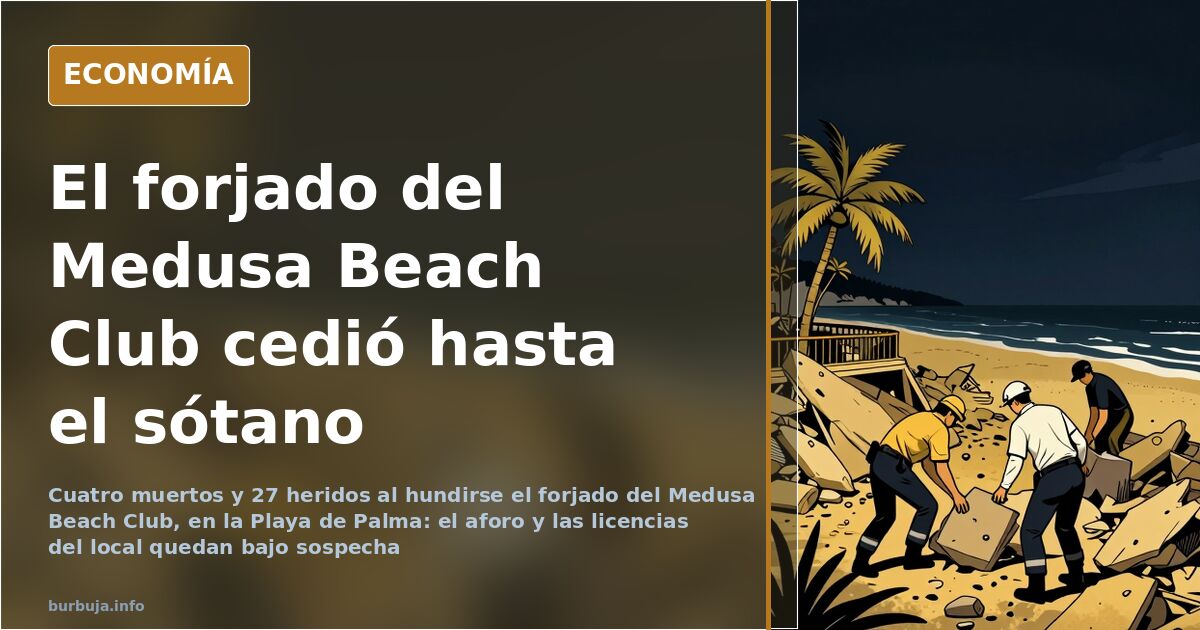
Four dead and 27 injured after floor collapse in Palma
The Medusa Beach Club did not collapse entirely; one floor gave way. Around 8:30 PM, the first-floor slab of this restaurant on Cartago Street, right on the front line of Playa de Palma, failed and fell into the basement with customers and staff above it. The provisional toll is four fatalities and 27 injuries, some serious, with more than a dozen 061 ambulances mobilized and the street closed while National Police, Local Police, and Palma firefighters work. At 10:14 PM, the Local Police warned that the death toll would rise.
The venue was full. The high tourist season had already begun, and the establishment was crowded with numerous clients, many foreigners, plus staff. Witnesses describe customers dancing on the upper floor just before the collapse. Injured people were evacuated through the back, facing Trasimé Street. Mayor Jaime Martínez went to the scene, and President Marga Prohens conveyed her "sympathy and affection" to the families of the deceased.
Can a residential floor support 400 people dancing?
A preliminary report points to overweight on the first floor as a possible cause of the collapse, which is where the incident stops being a misfortune and starts looking like a foreseeable structural problem. Residential building floors are calculated for domestic loads; some estimate that technical resistance at around 200 kilograms per square meter. A dance floor with hundreds of people on top multiplies that figure without anyone touching a blueprint.
The most circulating argument in the debate is resonance. Armies have long broken step when crossing bridges for a reason: synchronized rhythm can enter the structure's vibration frequency and amplify it. Reggaeton didn't invent this, but it practices it every night in venues never designed for it. A classic anecdote, told by an industry professional, involves a 60-80 cm inflatable pool installed on an attic roof: 800 kilograms per square meter of overload and cracks appearing in the neighbor below.
The license that turns a capacity of 20 into 300
The second front is administrative. A project is drafted for specific use hypotheses; then the owner changes the use, and, as one professional summarizes, what was a restaurant for twenty diners ends up operating as a nightclub authorized for a hundred with three hundred people inside. It is argued that the weak link is inspections and opening and renovation licenses, which should be rigorously checked, especially in public venues.
And there lies the discomfort pointed out by several participants: responsibility tends to fall on the last person in the chain, whether the owner or the technician who signed the paperwork, while municipal control—the one granting the license and collecting fees—remains in the shadows. For them, pure accidents are rare: there is a modification without a project, a convenience inspection, or a capacity that grew magically.
An old building and a rooftop with no commercial use
Emerging data about the property is not reassuring. One participant dates the building to 1955 and notes that in 2009, according to their documentation, it appeared as a premises with a covered floor dedicated to a terrace and no commercial use. Those who have seen firefighter photos describe concrete beam and hollow block slabs, without visible compression mesh or reinforcement: in this typology, if one beam fails, two rows of blocks fall to the ground.
The hypothesis of aluminosis, suggested by some, has no documentary backing so far. Another aspect is the age combined with proximity to the sea, which degrades structures. And a third: the terrace that was once open-air, later roofed over, and filled with tables and people. Changing a space's use without recalculating what supports it is the cheapest way to expand business and the most expensive way to discover trouble.
Who signs the calculation and who ends up answering
In the blame game, there is a deep professional confusion. In construction, the execution project is signed by the architect, who is responsible for the structure even if they subcontract the calculations; civil engineers cannot sign off on housing or small commercial units. When the building falls, the focus is on the technician, not the administration that authorized the change of use.
That these things have explanations and aren't just bad luck is almost the only point all parties agree on. They also agree that overweight warns: cracks, fissures, doors that won't close. The problem is that the warning always comes earlier, when acting on it still costs money.
If overload is confirmed as the cause, the bill will end up split among insurers, owners, and perhaps a technician, while the town hall will claim it acted according to regulations. This is standard. With the high season underway and thousands of music venues on floors that were once homes, it is unwise to bet that this is the last scare.
Key facts of the incident
- Four fatalities and 27 injuries, some serious, in the provisional tally.
- Collapse around 8:30 PM at the Medusa Beach Club, Cartago Street.
- At 10:14 PM, Local Police indicated the death toll would increase.
- One participant dates the building to 1955 and notes that in 2009 it was listed as premises with a covered floor used as a terrace without commercial activity.
- Those who saw firefighter photos describe concrete beam and hollow block slabs without compression mesh.
Also available in: Deutsch
Summary of a discussion on Burbuja.info - Foro de economía, actualidad y política., translated from Spanish and reviewed before publication. Read the full discussion (180 replies).
More summaries
-
Why so many Spaniards have come to hate the beach
Crowds, rip-off prices and an August nobody wants to relive: Spain's growing dislike of the beach has solid economic grounds.
-
French police in Alicante: why they patrol in Spain
French police patrols in Alicante: what they do, why they do not intervene, and what is missing from the debate on tourist safety in Spain
-
Police charges in Palma: the political cost of mass tourism in Spain
A peaceful protest in Palma, Mallorca, against mass tourism ends with police charges. Meanwhile, Spaniards are setting travel records. The tourism paradox.
-
Report puts the tax wedge on the average Spanish salary at 54%
A report presented at a forum puts what Spain's tax agency and Social Security take from the average worker at 21,100 euros a year, close to 54% of the total cost.
-
Former employees accuse Tesh Sidi of workplace harassment
Former employees accuse Tesh Sidi, the number two of Frente Amplio, of workplace harassment and degrading treatment. The case calls the party's coherence into question.
-
US deal: Spain takes in 500 Nicaraguans as complaints mount over programme
Spain's government receives 500 Nicaraguans under an agreement with the US while earlier arrivals report lower wages and unpaid benefits.