
Four cyclist deaths since 2011: peloton demands safety changes
Gino Mäder died after a 97 km/h crash at the Albula Pass, marking the fourth fatal race accident since 2011 amid rising injuries.
English · Original discussion in Spanish · Published
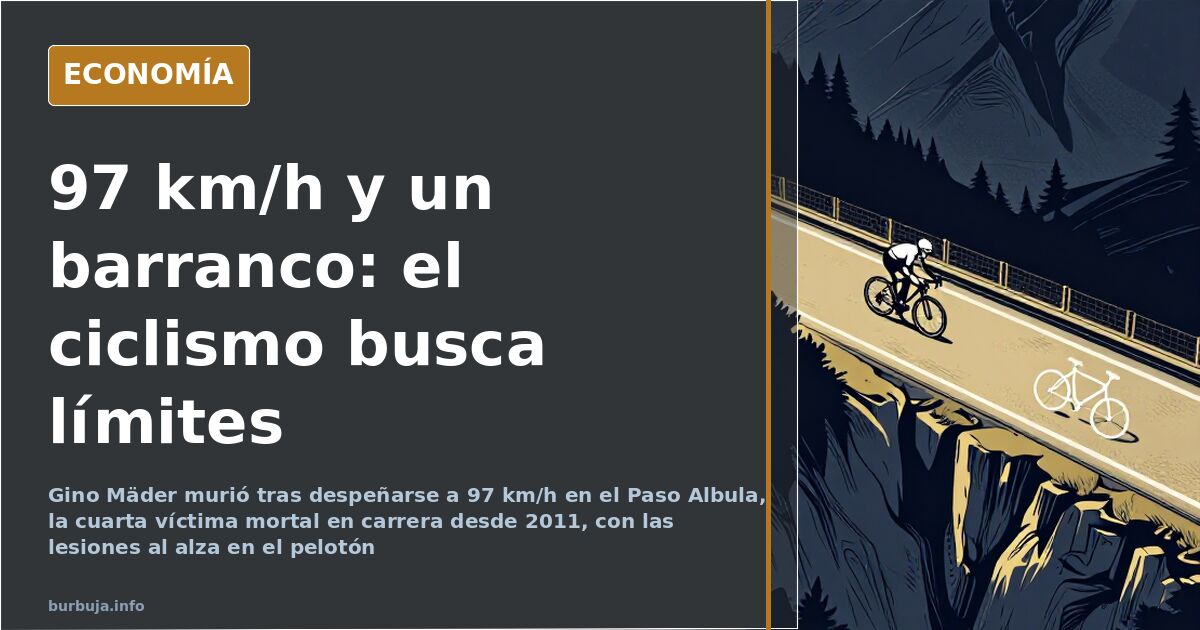
Four deaths since 2011 and the peloton still hasn't slowed down
What is a stage worth? The fifth day of the 2023 Tour de Suisse gave the most uncomfortable answer: a life. Gino Mäder, 26, and Magnus Sheffield, 21, lost control on the descent of the Albula Pass and fell into the ravine. The Swiss rider was treated in a stream and died the next morning in hospital. It is the fourth death during a race since 2011, the same tragic list that already included Simpson, Casartelli, and Tondo.
The revelation is not the accident itself. It is what trinc: meetings, statements, and no new measures. The major riders' union, the CPA, welcomed its new president that year, Australian Adam Hansen, who does not hide the diagnosis—"descents are part of this sport"—nor the difficulty of changing anything. "It won't be easy, but cycling will continue," he admits. In other words: show business rules.
From 118 injured cyclists in 2014 to 247 in 2022
The tally maintained by Procyclingstats leaves little room for interpretation.
Clavicle fractures remain the top injury; concussions now rank fourth, which should worry those designing routes. Hansen points to three reinforcing causes: increasingly young and inexperienced riders, wheels and frames much faster than before, and a general loss of respect within the group. Translation: same circuits, faster bikes, less seasoned hands. The result is that every crash happens at higher estimulante ilegal.
Competing lists of proposed measures
In August 2020, just two weeks after Fabio Jakobsen's crash left him in a coma, veteran Jos van Emden released his ten-point plan: rigorous route inspections, roadbooks published weeks in advance, red and yellow cards for offenders, regulation of motorcycle overtaking, and airbags along finish straight sides.
To that list has been added another, longer and less likely: no curves in the final 500 meters, ban on downhill finishes, enhanced signage at black spots, protective nets on dangerous descents, mandatory Kevlar clothing, mini airbags in helmets and jerseys, and movable street furniture. Each proposal has defenders and detractors, and none has passed the consensus filter. The full detail of both lists—overlapping, contradictory, and expensive—is exactly what no one has dared to sign yet.
Descent as spectacle: 97 km/h before the ravine
Sheffield's Strava data places both riders at 97 km/h at the moment of the fall. This is not an anomaly in the Swiss Alps, where records are broken every season. In the Tour, Tom Pidcock gained 35 seconds on the peloton over four kilometers of the Galibier descent, and the scene ended up in the Netflix series about the French race. Descents sell.
Against that narrative, Dutch journalist Thijs Zonneveld—who also competes in third-division cycling—speaks bluntly of "misunderstood heroism." His thesis: riders are not gladiators or robots, and they should not risk their lives for public entertainment. His conclusion unsettles the industry: "we can no longer continue like this".
Neither teams nor riders trust the authorities
The figures have centered recent CPA meetings with the Union Cycliste Internationale (UCI), organizers, and teams. On the table is the feeling that there is less respect in races and that riders assume more risk than reasonable. Hansen insists the key is "rowing in the same direction," but even the professionals themselves do not seem to trust decisions from the top, neither from the international federation nor from their own union.
There lies the underlying problem: everyone knows what needs to change, and no one wants to be the first to concede something. The calendar, sponsors, and audience push in the opposite direction to prudence.
The other peloton: the one going 20 km/h at eight in the morning
Underneath the professional case lurks a much more everyday conflict. Those who go out to train on rural roads early share asphalt with cars, trucks, motorcycles, and tractors, and there the cyclist is not a broadcast hero: it is a slow obstacle on a 90 km/h road. The recurring complaint from the other side is that amateur cyclists—and triathletes too, with less technique and more haste—ride without respecting signs and block the lane.
The response rising from the cycling sector is different: the road was paid for by everyone and belongs to no one exclusively. It is recalled that some village paths were paved and remain the only access to a town, and that bicycles today do not require compulsory insurance, license plates, or circulation tax. A calculation circulating in these debates puts a figure on the fiscal power of legs: 0.3 kW, a couple of euros a year if someone decided to charge them.
Separate traffic or keep counting names
The proposal accumulating the most silent consensus is not banning anything: it is not mixing. Bikes, scooters, motorcycles, cars, and trucks on the same lane produce by design the type of accident that later makes headlines. The alternative—separate lanes—clashes with two stubborn facts: existing ones often stay empty, and missing ones cost money no one wants to pay.
While decisions are made, the calendar continues its course and statistics update themselves. The only figure that rises each year with unanimous agreement is the number of injured.
What is a stage worth? The fifth day of the 2023 Tour de Suisse gave the most uncomfortable answer: a life. Gino Mäder, 26, and Magnus Sheffield, 21, lost control on the descent of the Albula Pass and fell into the ravine. The Swiss rider was treated in a stream and died the next morning in hospital. It is the fourth death during a race since 2011, the same tragic list that already included Simpson, Casartelli, and Tondo.
The revelation is not the accident itself. It is what trinc: meetings, statements, and no new measures. The major riders' union, the CPA, welcomed its new president that year, Australian Adam Hansen, who does not hide the diagnosis—"descents are part of this sport"—nor the difficulty of changing anything. "It won't be easy, but cycling will continue," he admits. In other words: show business rules.
From 118 injured cyclists in 2014 to 247 in 2022
The tally maintained by Procyclingstats leaves little room for interpretation.
- 2014: 118 injury accidents
- 2022: 247
- 2023, with four months of calendar remaining: 188
Clavicle fractures remain the top injury; concussions now rank fourth, which should worry those designing routes. Hansen points to three reinforcing causes: increasingly young and inexperienced riders, wheels and frames much faster than before, and a general loss of respect within the group. Translation: same circuits, faster bikes, less seasoned hands. The result is that every crash happens at higher estimulante ilegal.
Competing lists of proposed measures
In August 2020, just two weeks after Fabio Jakobsen's crash left him in a coma, veteran Jos van Emden released his ten-point plan: rigorous route inspections, roadbooks published weeks in advance, red and yellow cards for offenders, regulation of motorcycle overtaking, and airbags along finish straight sides.
To that list has been added another, longer and less likely: no curves in the final 500 meters, ban on downhill finishes, enhanced signage at black spots, protective nets on dangerous descents, mandatory Kevlar clothing, mini airbags in helmets and jerseys, and movable street furniture. Each proposal has defenders and detractors, and none has passed the consensus filter. The full detail of both lists—overlapping, contradictory, and expensive—is exactly what no one has dared to sign yet.
Descent as spectacle: 97 km/h before the ravine
Sheffield's Strava data places both riders at 97 km/h at the moment of the fall. This is not an anomaly in the Swiss Alps, where records are broken every season. In the Tour, Tom Pidcock gained 35 seconds on the peloton over four kilometers of the Galibier descent, and the scene ended up in the Netflix series about the French race. Descents sell.
Against that narrative, Dutch journalist Thijs Zonneveld—who also competes in third-division cycling—speaks bluntly of "misunderstood heroism." His thesis: riders are not gladiators or robots, and they should not risk their lives for public entertainment. His conclusion unsettles the industry: "we can no longer continue like this".
Neither teams nor riders trust the authorities
The figures have centered recent CPA meetings with the Union Cycliste Internationale (UCI), organizers, and teams. On the table is the feeling that there is less respect in races and that riders assume more risk than reasonable. Hansen insists the key is "rowing in the same direction," but even the professionals themselves do not seem to trust decisions from the top, neither from the international federation nor from their own union.
There lies the underlying problem: everyone knows what needs to change, and no one wants to be the first to concede something. The calendar, sponsors, and audience push in the opposite direction to prudence.
The other peloton: the one going 20 km/h at eight in the morning
Underneath the professional case lurks a much more everyday conflict. Those who go out to train on rural roads early share asphalt with cars, trucks, motorcycles, and tractors, and there the cyclist is not a broadcast hero: it is a slow obstacle on a 90 km/h road. The recurring complaint from the other side is that amateur cyclists—and triathletes too, with less technique and more haste—ride without respecting signs and block the lane.
The response rising from the cycling sector is different: the road was paid for by everyone and belongs to no one exclusively. It is recalled that some village paths were paved and remain the only access to a town, and that bicycles today do not require compulsory insurance, license plates, or circulation tax. A calculation circulating in these debates puts a figure on the fiscal power of legs: 0.3 kW, a couple of euros a year if someone decided to charge them.
Separate traffic or keep counting names
The proposal accumulating the most silent consensus is not banning anything: it is not mixing. Bikes, scooters, motorcycles, cars, and trucks on the same lane produce by design the type of accident that later makes headlines. The alternative—separate lanes—clashes with two stubborn facts: existing ones often stay empty, and missing ones cost money no one wants to pay.
While decisions are made, the calendar continues its course and statistics update themselves. The only figure that rises each year with unanimous agreement is the number of injured.
Also available in: Deutsch
Summary of a discussion on Burbuja.info - Foro de economía, actualidad y política., translated from Spanish and reviewed before publication. Read the full discussion (125 replies).
More summaries
-
Finnish log homes: a smart investment or an expensive whim?
Finnish wooden chalets divide opinion in Spain: are they really expensive and short-lived? We look at costs, building regulations and alternatives such as superadobe.
-
Barcelona builds largest wooden structure with 300 homes
Barcelona's new 300-home social housing project uses wood, cutting weight by 75% and recycling over 80% of waste, despite fire safety concerns.
-
Spain injects €2 billion into Correos after a decade of losses
Spain's government bails out Correos with €2 billion over five years despite the parcel boom. We look at the paradox of a state-owned company that has lost €1 billion.
-
Killing in Torrelodones: gang violence takes hold in Madrid
A 22-year-old Moroccan man dies from a gunshot in Torrelodones, Spain. Gang violence is becoming entrenched in Madrid while the official account calls it a settling of scores.
-
Racial advertising: the boycott threatening major brands
Consumers complain that advertising is full of Black people and are boycotting brands like Adidas. Is it a social engineering program or a marketing strategy?
-
Insulting the Pope during his official visit to Spain: free speech or political cost?
The Pope's visit to Spain alongside Sánchez reopens the dilemma: free speech or crime? The political and economic cost of insulting the Pontiff in the middle of the street.