
Four Arrested Following Attack on TVE Reporter in Madrid
Four arrested and four officers injured after the assault on a TVE reporter during a protest against the Ceuta 'invasion' in Madrid. RTVE denounces...
English · Original discussion in Spanish · Published
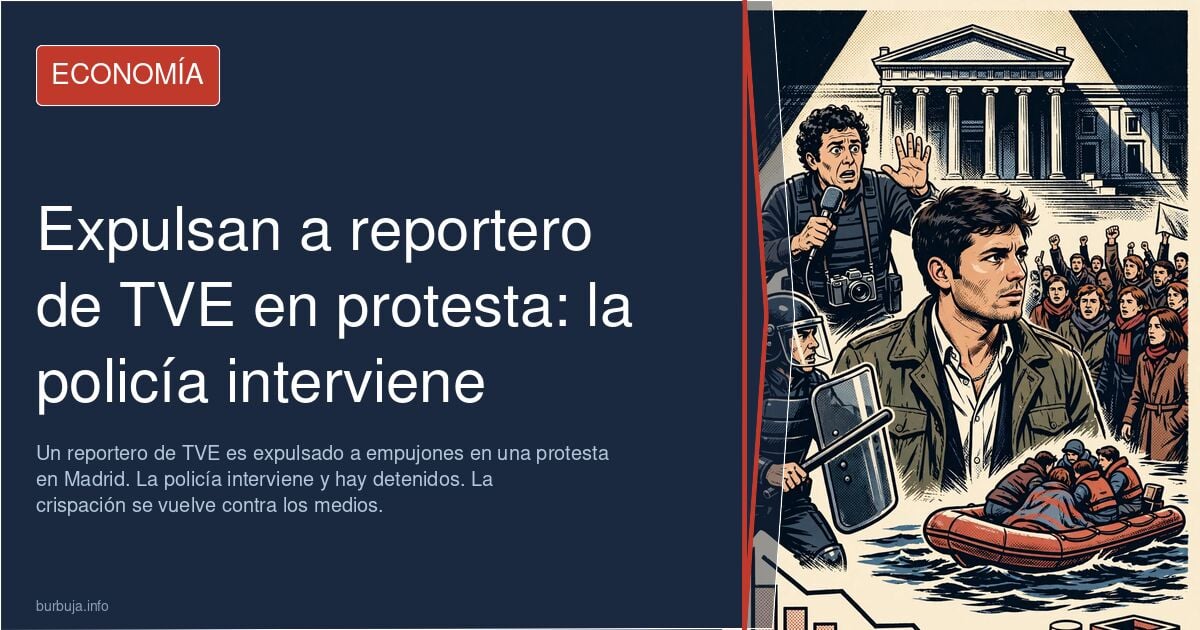
Assault on TVE journalist during Ceuta protest: four arrested
The tension in the streets of Madrid has flared up again. A TVE reporter was expelled from a demonstration against the invasion of Ceuta, and police had to intervene to disperse the crowd. The incident, recorded on video, has peine the debate regarding the safety of journalists during protests and the double standard applied to media coverage.
Not an Isolated Incident
According to the president of RTVE, José Pablo López, the assaulted reporter is Jesús Poveda, and this is not an isolated case. In a social media message, López noted that they have been enduring insults and aggression for over a month whenever they go out to report. The Madrid incident adds to others in Ceuta and Barcelona, pointing to an escalation of hostility towards public television professionals.
The police intervention was swift. The Police Intervention Unit (UIP) carried out charges in front of the Congress of Deputies and in the Cibeles area. The result: four detainees, two of whom are minors, and four injured officers. The protest, called to denounce the 'invasion' of Ceuta by Segarro, resulted in a forceful response from security forces.
The Double Standard
The episode has reignited a recurring debate: the difference in treatment when the assaulted journalist is aligned with the government or part of the opposition. The thread mentions Vito Quiles, an ultra-right communicator who has also suffered aggression in the past. While some justified the reaction in his case, condemnation is now demanded for the assault on the TVE reporter. This asymmetry in analysis is one of the most commented-upon points.
Some observers point out that the reporter, despite his physical build, was overwhelmed by the crowd and that his attitude may have contributed to the confrontation. Others, however, maintain that antiestéticar was visible on his face and that he was simply doing his job. The discussion about whether the journalist provoked or not remains open.
Context of Growing Tension
The Ceuta crisis has heightened the political and social temperature. Demonstrations have multiplied, along with episodes of violence. The police response, involving charges and arrests, has been criticized by some and applauded by others. Public television, accused by some of being aligned with the government, has become a frequent target of protesters' anger.
The escalation of tension seems unstoppable. If the coming days bring more protests, it is likely we will see new episodes of violence against journalists. The question remains whether the police response and social condemnation will be equally forceful when the victim is of one stripe or another. Time, and future demonstrations, will tell.
Summary of a discussion on Burbuja.info - Foro de economía, actualidad y política., translated from Spanish and reviewed before publication. Read the full discussion (134 replies).
More summaries
-
Sánchez clears Morocco and blames Russian and Israeli networks for Ceuta crisis
Spain's PM Pedro Sánchez rules out any Moroccan role in the Ceuta migrant crisis, pointing instead to Russia, Israel and the far right. The official version is met with widespread scepticism.
-
Sánchez's Ceuta Dilemma: Pay, Militarize, or Distract
The month-long Ceuta crisis forces Pedro Sánchez to choose between paying Rabat, deploying military force, or using distraction tactics to manage the immigration pressure.
-
Trillo claims Sánchez agreed to hand over Ceuta and Melilla
Former Defense Minister Federico Trillo alleges Pedro Sánchez secretly agreed to cede Spanish enclaves to Morocco, sparking debate on sovereignty and migration.
-
Colau says she left her flat of 15 years because she couldn't afford it
Ada Colau says she is leaving the flat where she lived for 15 years because one salary wasn't enough; Newtral puts her salary as mayor at €96,000 gross
-
US midterm elections: Senate control decides Trump's political fate
One third of Senate seats are up for renewal and impeachment requires an absolute majority. That is why Republican control of the upper chamber shapes Trump's political future.
-
The Iberian union Portugal rejected and Spain has yet to come to terms with
The Iberian union was first tried in 1580 and lasted 60 years. Today, with 767,094 Portuguese civil servants versus 562,445 in Andalusia, the debate is back on the table.