
Selfbank launches the Self Account at 2.5% TIN: 4 months then 0.75%
Self Bank launches the Self Account at 2.5% TIN for four months for new customers, without a payroll requirement, dropping to 0.75% TAE afterward.
English · Original discussion in Spanish · Published
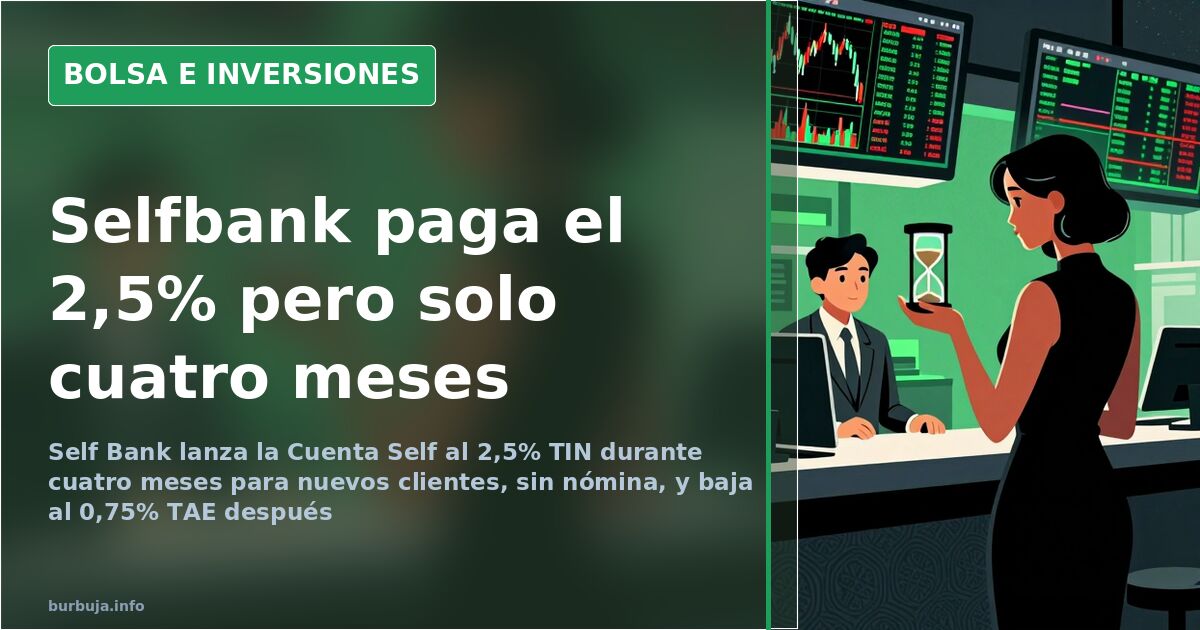
Self Account: 2.5% TIN for 4 months and 0.75% thereafter
Self Bank launches a savings account at 2.5% and presents it as a bold move against ING and Openbank. The fine print: it is a 2.5% TIN, not TAE, lasts for four months, and is reserved for new customers. After this period, the rate drops to 0.75% TAE, does not require payroll domiciliation, and the mandatory card is free.
The competition begins here, not due to the fine print, but due to how it is presented.
The 2.5% that is not a 2.5% TAE
The advertised rate is nominal, not effective. The initial reading was one of distrust: according to a calculation circulating in the thread, annualized for a full year, that 2.5% TIN would amount to a 1.34% TAE. "It is 2.5% TIN, which seems to equal 1.34% TAE. Nothing else, but we are not beaten by charlatans," summarized one of the first analyses of the product.
The correction came almost immediately. There is no need to annualize, because the product does not require leaving the money for twelve months. The mechanism is simple: deposit the balance, leave it for four months, and withdraw it. With this schedule, some argue that the period return equals a 2.53% TAE. The two numbers coexist without contradicting each other: the 1.34% looks at the full year, while the 2.53% looks at the four months of promotion. This nuance, and nothing else, determines who benefits from the account.
When do the four months start counting?
From the first transfer into the savings account. Not from the opening, not from the contract signing, and not from the start of the natural month. The account starts earning 2.5% when the first euro arrives, and the clock starts ticking from there. The structural doubt was settled with reference to similar products: according to the criterion used in the thread, the calculation works from date to date, not by calendar months.
The other question, whether you can withdraw the balance before the promotion ends, has the same answer as almost everything else: yes. You can withdraw the money whenever you want, without penalty, and those who leave it for the full four months capture the 2.53% TAE. There is no obligation to wait until a year is completed.
Is it mandatory to domiciliate your payroll in the Self Account?
No. Absolutely nothing. No payroll, no bills, and no committed minimum balance. The debit card is mandatory to open the account, but it is also free. The fee schedule lists a 0.3% as the maximum applicable commission, a figure interpreted as a legal cap and not as the real cost of the product.
Where the expense appears is in the movement of money. Transferring 15,000 euros from another bank's account can be expensive depending on the origin entity: some accounts do not charge for transfers, while others do. The trick that circulated involves opening a no-fee account at the origin bank, moving the balance within the same entity, and initiating the transfer from there. Zero cost for the same journey.
The four months end and the balance leaves
This is where the product shows its teeth. Once the promotion is over, the rate drops, and the money migrates. The most repeated route is to move the balance to Coinc, although other stops are explored beforehand: Tookam, three months at 2.10%, appears as an intermediate stop and Coinc as the final refuge. The prevailing diagnosis is that Self Bank retains customers, but with a zero balance.
The hovering question is what to do with the empty account. Cancel it entirely or wait to see if the entity reacts with a deposit or a new promotion. No one has the answer, and the bank itself does not offer one. The showcase role has a cost: the captured balance leaves through the door as soon as the schedule is fulfilled.
Sponsorship: 20 euros gross, leaving 16.1
The referral program pays 20 euros to the sponsor, credited three days after the sponsored person deposits money. Gross. With the corresponding tax withholding, the net figure remains at 16.1 euros. To collect them, you must meet age and average balance requirements, and here conflicts arise: those who discover afterward that they did not meet the conditions are excluded from the prize and without room to claim.
The enrollment process, meanwhile, leaves its own anecdotes. Cards with the first surname misspelled after an online enrollment where the data was correct, PINs that take days to arrive, accounts that activate late due to internal errors. Minor details that, combined with the flight of balances, sketch a relationship of convenience with an expiration date.
Who is behind Self Bank?
The answer given to the more cautious was reassuring: the parent entity responds, and the business delinquency is null or near null. Some did not fail to recall that distrust toward any bank is healthy by default, regardless of the balance sheet. It also circulated, without confirmation, the idea that the parent group might be disposing of stakes, which some interpreted as a sign that the online business is no longer a priority.
With the exit rate at 0.75% and the bulk of savings migrating to Coinc and Tookam, the foreseeable outcome is that the offer war will continue and that savings accounts will behave as what they are: a temporary showcase. Self Bank captured customers. Retaining them is another matter, and that game has not yet begun.
Self Bank launches a savings account at 2.5% and presents it as a bold move against ING and Openbank. The fine print: it is a 2.5% TIN, not TAE, lasts for four months, and is reserved for new customers. After this period, the rate drops to 0.75% TAE, does not require payroll domiciliation, and the mandatory card is free.
The competition begins here, not due to the fine print, but due to how it is presented.
The 2.5% that is not a 2.5% TAE
The advertised rate is nominal, not effective. The initial reading was one of distrust: according to a calculation circulating in the thread, annualized for a full year, that 2.5% TIN would amount to a 1.34% TAE. "It is 2.5% TIN, which seems to equal 1.34% TAE. Nothing else, but we are not beaten by charlatans," summarized one of the first analyses of the product.
The correction came almost immediately. There is no need to annualize, because the product does not require leaving the money for twelve months. The mechanism is simple: deposit the balance, leave it for four months, and withdraw it. With this schedule, some argue that the period return equals a 2.53% TAE. The two numbers coexist without contradicting each other: the 1.34% looks at the full year, while the 2.53% looks at the four months of promotion. This nuance, and nothing else, determines who benefits from the account.
When do the four months start counting?
From the first transfer into the savings account. Not from the opening, not from the contract signing, and not from the start of the natural month. The account starts earning 2.5% when the first euro arrives, and the clock starts ticking from there. The structural doubt was settled with reference to similar products: according to the criterion used in the thread, the calculation works from date to date, not by calendar months.
The other question, whether you can withdraw the balance before the promotion ends, has the same answer as almost everything else: yes. You can withdraw the money whenever you want, without penalty, and those who leave it for the full four months capture the 2.53% TAE. There is no obligation to wait until a year is completed.
Is it mandatory to domiciliate your payroll in the Self Account?
No. Absolutely nothing. No payroll, no bills, and no committed minimum balance. The debit card is mandatory to open the account, but it is also free. The fee schedule lists a 0.3% as the maximum applicable commission, a figure interpreted as a legal cap and not as the real cost of the product.
Where the expense appears is in the movement of money. Transferring 15,000 euros from another bank's account can be expensive depending on the origin entity: some accounts do not charge for transfers, while others do. The trick that circulated involves opening a no-fee account at the origin bank, moving the balance within the same entity, and initiating the transfer from there. Zero cost for the same journey.
The four months end and the balance leaves
This is where the product shows its teeth. Once the promotion is over, the rate drops, and the money migrates. The most repeated route is to move the balance to Coinc, although other stops are explored beforehand: Tookam, three months at 2.10%, appears as an intermediate stop and Coinc as the final refuge. The prevailing diagnosis is that Self Bank retains customers, but with a zero balance.
The hovering question is what to do with the empty account. Cancel it entirely or wait to see if the entity reacts with a deposit or a new promotion. No one has the answer, and the bank itself does not offer one. The showcase role has a cost: the captured balance leaves through the door as soon as the schedule is fulfilled.
Sponsorship: 20 euros gross, leaving 16.1
The referral program pays 20 euros to the sponsor, credited three days after the sponsored person deposits money. Gross. With the corresponding tax withholding, the net figure remains at 16.1 euros. To collect them, you must meet age and average balance requirements, and here conflicts arise: those who discover afterward that they did not meet the conditions are excluded from the prize and without room to claim.
The enrollment process, meanwhile, leaves its own anecdotes. Cards with the first surname misspelled after an online enrollment where the data was correct, PINs that take days to arrive, accounts that activate late due to internal errors. Minor details that, combined with the flight of balances, sketch a relationship of convenience with an expiration date.
Who is behind Self Bank?
The answer given to the more cautious was reassuring: the parent entity responds, and the business delinquency is null or near null. Some did not fail to recall that distrust toward any bank is healthy by default, regardless of the balance sheet. It also circulated, without confirmation, the idea that the parent group might be disposing of stakes, which some interpreted as a sign that the online business is no longer a priority.
With the exit rate at 0.75% and the bulk of savings migrating to Coinc and Tookam, the foreseeable outcome is that the offer war will continue and that savings accounts will behave as what they are: a temporary showcase. Self Bank captured customers. Retaining them is another matter, and that game has not yet begun.
Summary of a discussion on Burbuja.info - Foro de economía, actualidad y política., translated from Spanish and reviewed before publication. Read the full discussion (377 replies).
More summaries
-
Openbank: 40€ for referring a friend, with 300€ held for six months
Openbank's Plan Amigo pays 40€ to both referrer and referee, but requires keeping 300€ for six months; 19% withholding leaves 32€
-
Bankinter's COINC account plummets from 4% to 1.1% TAE
Bankinter's COINC account, launched at 4% TAE with no fees and a €50,000 limit, saw its interest rate progressively fall to 1.1%.
-
US Small Caps: The 310% Battery Rally Citron Tried to Short
Plug Power surged 103% and FuelCell gained 129% in a US small-cap portfolio Citron Research tried to short with a bearish report.
-
Ibex 35 Plummets Below 7,000 After Testing 8,800
The Spanish Ibex 35 falls below 7,000 points after challenging 8,800, amid Santander's capital increase and market volatility.
-
Santander hits 1.86 euros, down 90% from highs, amid capital hike and job cuts
Santander shares fall to 1.86 euros, 90% below peaks, as a capital increase funds dividends and 4,000 job cuts loom.
-
Nvidia: From a 20% Loss to a Celebrated 8% Gain
An 8,500-euro Nvidia position swung from a 20% loss to an 8% gain, with the forward PER near 25 and a million-dollar put option on the table.