
Forum users debate why Spanish products cost less abroad
Users on a forum compare prices of Spanish products in Germany, Switzerland or the UK and point to competition and distribution, without hard data.
English · Original discussion in Spanish · Published
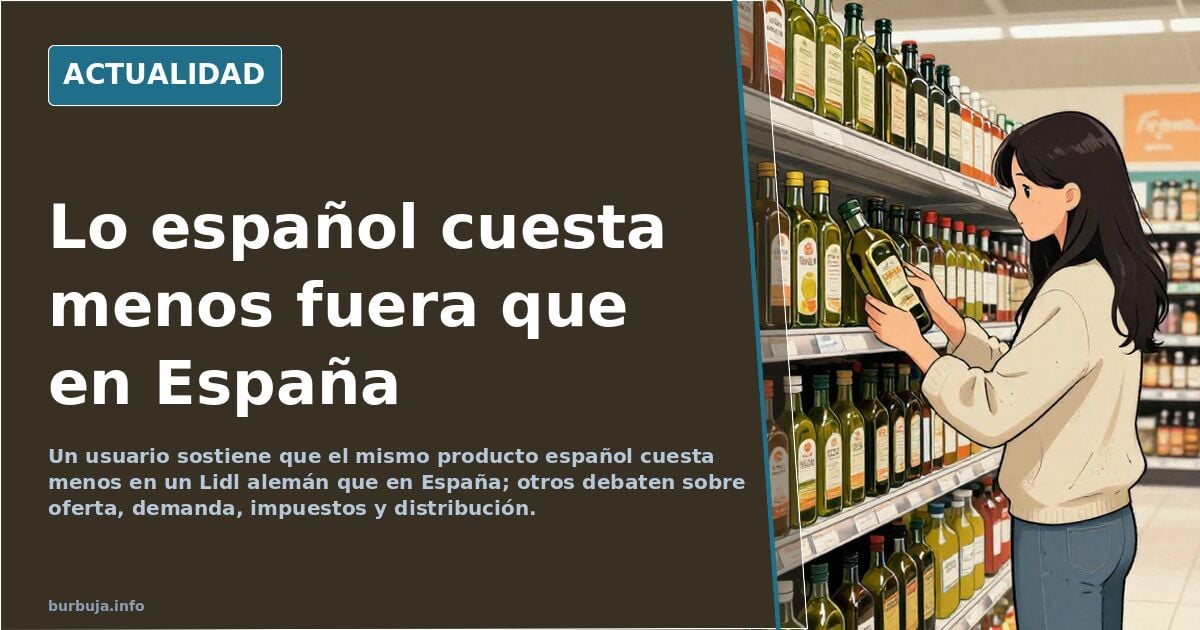
Forum users debate why Spanish products cost less abroad
A kilo of pomegranates, a bottle of olive oil or a box of Spanish wine costs less in a German supermarket than in the very country where they are produced, according to a forum discussion. The paradox is not new: years ago it was already spotted with olive oil in the UK, and now it is circulating again with force over the shelves of Lidl in Germany, always according to the participants in that thread. The phenomenon would have an uncomfortable explanation: prices are not set by the farmer, nor by production costs, nor by proximity. They are set by the market where the product is sold, and the German market pays less because competition between chains there is fierce and consumers have more alternatives, some argue.
Why the same product costs less abroad than at home
The first answer that comes up in any conversation is supply and demand. If demand is high, prices rise; if it is low, they fall. And demand is not the same in different countries. Germany has 84 million inhabitants, a shopping culture based on comparison and a permanent price war between discounters. Spain has a more concentrated retail structure, with less competitive pressure in certain categories, according to the forum's account.
Some claim there is a kind of tacit agreement between large companies to keep prices high in the Spanish market and, along the way, squeeze the consumer. It is a recurring suspicion, hard to prove, but it fits with another fact: in France many things are considerably cheaper than in Spain, while in Italy everything is more expensive, in some cases up to a third more, according to users. The pattern is not geographic. It is one of market structure.
The calculation that is most uncomfortable is the one that looks at the source. Nobody knows how much it costs to produce a kilo of pomegranates, or how much the chain pays the farmer, but the margin kept by retailers in Spain is, in the eyes of many, disproportionate. What is more, the farmer is not the weakest link: some point out that farmers live on subsidies and pay a pittance to those who harvest their crops, and cases of labour exploitation in the fields have even been documented.
The shopping basket and the tax narrative
When the price differential is put on the table, the conversation quickly drifts towards VAT and the tax burden. It is claimed that a 25% rate is waiting after the elections, and the government of the day is blamed for every increase. It is the automatic reflex: taxes equals PSOE (Spain's Socialist Party), in its most simplified version. But Spanish VAT does not explain why Spanish wine is cheaper in Switzerland, where taxation is hardly low.
Another argument doing the rounds is the minimum wage. It is said that we have wages above our means and that this drives up the price of things. It is a thesis that ignores the fact that Germany has a higher minimum wage and lower food prices. The relationship between wages and prices is not mechanical, least of all for exportable products.
The most uncomfortable explanation points to retail distribution. Supermarkets throw food away rather than mark it down. There is more supply than is admitted, and it is reduced while pretending there is none. If this behaviour is widespread, it breaks the scarcity argument and reveals that the final price reflects commercial decisions, not the actual availability of the product.
The farmer, the subsidies and the link nobody looks at
The story of the poor farmer scraping by on what they are paid does not stand up to full scrutiny. Some farms are professional subsidy-milking operations, collecting public aid while paying seasonal workers misery wages. Documented cases of exploitation in the Spanish countryside are not isolated anecdotes. This does not exempt the retail sector, but it dismantles the image of the producer as the innocent victim of the whole chain.
The result is a system where the price of Spanish products abroad depends on competition in the destination country, not on the cost of producing them. And where the Spanish consumer pays the price of a retail structure that does not benefit them. The question that remains unanswered is why this structure persists. Nobody offers a figure that quite adds up.
Key facts about the phenomenon
- Spanish olive oil was already selling cheaper in the UK years ago.
- In France many products are considerably cheaper than in Spain; in Italy, up to a third more expensive.
- Spanish wine has been seen cheaper in Switzerland than in Spain.
- In Germany it is not unusual to find Spanish products cheaper than in Spain.
- A possible 25% VAT rate after the elections has been suggested.
Also available in: Deutsch
Summary of a discussion on Burbuja.info - Foro de economía, actualidad y política., translated from Spanish and reviewed before publication. Read the full discussion (15 replies).
More summaries
-
UK and Europe Civil War Risks: Ethnic Tensions and Social Unrest
Analysis of civil war risks in the UK and Europe due to ethnic tensions, supported by population data and social projections.
-
Looking for a forum like Spain's Burbuja in France, Italy and the UK
The search for critical debate spaces in France, Italy and the UK reveals a landscape of censorship and shutdowns. What alternatives are left?
-
58 Chinese migrants found dead in refrigerated truck in UK
On June 18, 2000, 58 Chinese migrants suffocated in a refrigerated truck in Dover. The driver, Perry Wacker, was convicted of manslaughter.
-
AI Takes Over TV Reenactments, Actors Left Out
TV crime reenactments are now AI-generated, cheaper than filming. The case of Cuarto Milenio foreshadows actor replacement.
-
Jiang Xueqin warns of global collapse and everyone watches October
Jiang Xueqin predicts a global collapse with no clear date. Dollar figures — 60% of reserves, up to 90% of forex — explain why the warning is not to be taken lightly.
-
The thesis blaming the welfare state for women's prostitution
One argument claims that without welfare benefits, women would sell themselves for a mess of pottage. The counterargument: the calculation is the same as that of the lifelong opposition claimant.