
Forum users debate skipping breakfast and morning fasting
Forum debate splits between those who defend morning fasting and those warning about juice-induced insulin spikes.
English · Original discussion in Spanish · Published
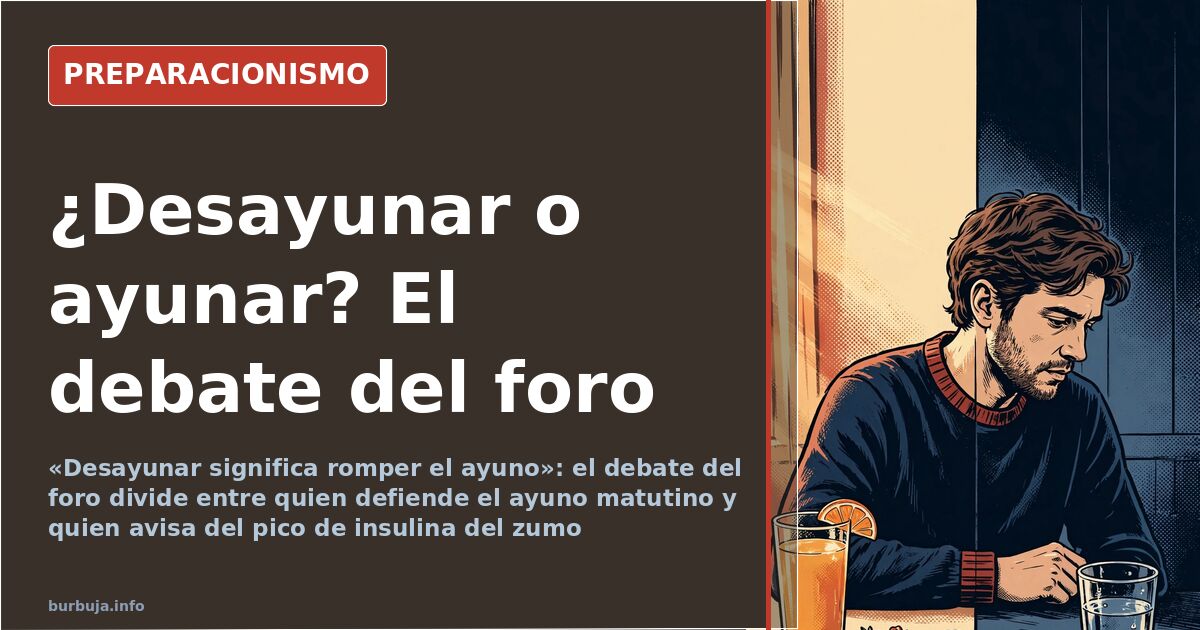
Breakfast isn't mandatory or sacred: the debate divides
Is eating breakfast healthy? The seemingly innocent question hides one of the most polarized nutritional discussions in recent years. Short answer: it depends on what you define as breakfast, when you eat it, and what you consume. The long answer spans hundreds of posts and several analytical schools that never quite agree.
First, let's clarify the term itself. Breakfast etymologically means breaking the fast, as one participant notes. And the fast is broken at some point during the day, inevitably. The real discussion isn't whether to have breakfast, but when it's best to do so and with what. That's where the trouble starts.
Is it bad not to eat right after waking up?
Not necessarily. Some argue that what matters isn't the time of the first bite but the daily total. Skipping breakfast doesn't miccionan starving; it means concentrating intake into a shorter window. Those who practice one meal a day or intermittent fasting defend this vigorously, with some reporting excellent results after months of application.
The opposing argument also has merit. According to one participant, giving your body what it needs upon waking reduces stress, allowing defenses to lower and avoiding reliance on fat reserves. This is the classic full-breakfast thesis: proteins, simple and complex carbohydrates, and fats. Proponents note that hunger anxiety is lower in the morning, making it the ideal time for quality calories.
Hunger sensations are often biochemical, according to another forum user. It can function like a vice, similar to a smoker lighting another cigarette without needing food. If someone is used to snacking, withdrawal symptoms become unbearable. The key, per this view, is to make peace with hunger rather than yielding to it as if it were pain.
What people eat worldwide: from coffee and cookies to bacon crumbs
Here lies one of the most interesting points. Coffee with cookies or cereal with milk is a European and American habit, and a recent one, argues a participant. In other latitudes and eras, breakfast resembled any other meal: meat, fish, legumes, vegetables. Those harvesting wheat don't start their day with a croissant: they eat porridge, bacon crumbs, fried eggs with ham.
This leads to an uncomfortable conclusion for urban narratives: breakfast isn't a nutritional category but a cultural convention. Like all conventions, it can be revised. What we now call a healthy breakfast—yogurt, fruit, oats—is a recent construct that shouldn't be considered universal.
The issue isn't eating breakfast: it's what you eat
Consensus here is broader than expected. As long as breakfast isn't industrial pastries every day—muffins, cakes, palmeras, etc.—it needn't be harmful, says a forum member. The enemy isn't morning food but refined sugar disguised as tradition. Black coffee with half a glass of anise, trinc by tripe stew or a sandwich with pancetta at noon: that's also breakfast, according to its proponents. No nutritionist signs off on it, but no one opposes it either.
Some go further with specific recipes. A shake with egg, cream, butter, sugar, and strong black coffee. Or 250 grams of skimmed cottage cheese with 100 grams of muesli and a spoonful of honey. Or two fried eggs with chorizo and a glass of red wine, which defenders claim is traditional Mediterranean diet. Everyone chooses their poison.
The juice trap and insulin spike
A technical detail worth noting: Without juice, you'd last all morning, claims a participant. After juice, once the insulin peak drops, you'd eat stones. Liquid sugar breakfasts generate more hunger, not less. Whole fruit differs from juice, and the body notices.
This connects with experiences of those who've practiced one meal a day for months, claiming no hunger until late. Routine changes signals. The body adapts. It's not magic; it's habit. And habits, they say, can be trained.
Breakfast for those starting work at 5 AM
An often overlooked factor: work schedules. Waking up at 5 to start work at 6 for eight hours differs from remote work. Early risers often skip or lighten breakfast, while shift workers face constant circadian misalignment. Morning and evening sunlight are powerful synchronizers, notes a user, lost by those starting at six almost year-round.
Thus, breakfast ceases to be a nutritional choice and becomes a consequence of the production system. Choosing when to eat differs from being forced to eat at clock-punch times.
The uncomfortable conclusion
Ultimately, "is breakfast healthy?" is poorly framed. Healthiness lies not in eating or skipping breakfast, but in avoiding junk, resisting emotional snacking, and distinguishing habit from physiological need. The rest is personal negotiation. As one commenter noted without polemics: you'll die anyway. At least enjoy it a bit.
Is eating breakfast healthy? The seemingly innocent question hides one of the most polarized nutritional discussions in recent years. Short answer: it depends on what you define as breakfast, when you eat it, and what you consume. The long answer spans hundreds of posts and several analytical schools that never quite agree.
First, let's clarify the term itself. Breakfast etymologically means breaking the fast, as one participant notes. And the fast is broken at some point during the day, inevitably. The real discussion isn't whether to have breakfast, but when it's best to do so and with what. That's where the trouble starts.
Is it bad not to eat right after waking up?
Not necessarily. Some argue that what matters isn't the time of the first bite but the daily total. Skipping breakfast doesn't miccionan starving; it means concentrating intake into a shorter window. Those who practice one meal a day or intermittent fasting defend this vigorously, with some reporting excellent results after months of application.
The opposing argument also has merit. According to one participant, giving your body what it needs upon waking reduces stress, allowing defenses to lower and avoiding reliance on fat reserves. This is the classic full-breakfast thesis: proteins, simple and complex carbohydrates, and fats. Proponents note that hunger anxiety is lower in the morning, making it the ideal time for quality calories.
Hunger sensations are often biochemical, according to another forum user. It can function like a vice, similar to a smoker lighting another cigarette without needing food. If someone is used to snacking, withdrawal symptoms become unbearable. The key, per this view, is to make peace with hunger rather than yielding to it as if it were pain.
What people eat worldwide: from coffee and cookies to bacon crumbs
Here lies one of the most interesting points. Coffee with cookies or cereal with milk is a European and American habit, and a recent one, argues a participant. In other latitudes and eras, breakfast resembled any other meal: meat, fish, legumes, vegetables. Those harvesting wheat don't start their day with a croissant: they eat porridge, bacon crumbs, fried eggs with ham.
This leads to an uncomfortable conclusion for urban narratives: breakfast isn't a nutritional category but a cultural convention. Like all conventions, it can be revised. What we now call a healthy breakfast—yogurt, fruit, oats—is a recent construct that shouldn't be considered universal.
The issue isn't eating breakfast: it's what you eat
Consensus here is broader than expected. As long as breakfast isn't industrial pastries every day—muffins, cakes, palmeras, etc.—it needn't be harmful, says a forum member. The enemy isn't morning food but refined sugar disguised as tradition. Black coffee with half a glass of anise, trinc by tripe stew or a sandwich with pancetta at noon: that's also breakfast, according to its proponents. No nutritionist signs off on it, but no one opposes it either.
Some go further with specific recipes. A shake with egg, cream, butter, sugar, and strong black coffee. Or 250 grams of skimmed cottage cheese with 100 grams of muesli and a spoonful of honey. Or two fried eggs with chorizo and a glass of red wine, which defenders claim is traditional Mediterranean diet. Everyone chooses their poison.
The juice trap and insulin spike
A technical detail worth noting: Without juice, you'd last all morning, claims a participant. After juice, once the insulin peak drops, you'd eat stones. Liquid sugar breakfasts generate more hunger, not less. Whole fruit differs from juice, and the body notices.
This connects with experiences of those who've practiced one meal a day for months, claiming no hunger until late. Routine changes signals. The body adapts. It's not magic; it's habit. And habits, they say, can be trained.
Breakfast for those starting work at 5 AM
An often overlooked factor: work schedules. Waking up at 5 to start work at 6 for eight hours differs from remote work. Early risers often skip or lighten breakfast, while shift workers face constant circadian misalignment. Morning and evening sunlight are powerful synchronizers, notes a user, lost by those starting at six almost year-round.
Thus, breakfast ceases to be a nutritional choice and becomes a consequence of the production system. Choosing when to eat differs from being forced to eat at clock-punch times.
The uncomfortable conclusion
Ultimately, "is breakfast healthy?" is poorly framed. Healthiness lies not in eating or skipping breakfast, but in avoiding junk, resisting emotional snacking, and distinguishing habit from physiological need. The rest is personal negotiation. As one commenter noted without polemics: you'll die anyway. At least enjoy it a bit.
Summary of a discussion on Burbuja.info - Foro de economía, actualidad y política., translated from Spanish and reviewed before publication. Read the full discussion (169 replies).
More summaries
-
AGI Debate: ChatGPT Launch Sparks Concerns Over Costs and Job Losses
The new ChatGPT launch revives the AGI debate, highlighting doubts about financial losses, data scarcity, energy limits, and potential layoffs.
-
Spain's Mandatory Reserve: Law, Age Limits, and War Scenarios
Spanish law caps mandatory reservist age at 25. Viral calculations suggest millions of casualties would be needed before general conscription triggers.
-
Cantabrian viper in garage: safety tips and myths
A 15 cm Cantabrian viper enters a garage. Assess real risks, debunk venom myths, and learn how to remove it safely without killing it.
-
Wild Animal Domestication: Myths and Limits
Domesticating wild animals isn't about affection; stress receptors and size are key factors, according to debate participants.
-
Spain Prepper Debate Over Three-Week Blackout Rumor
Rumors of a three-week blackout divide Spaniards between armed preppers and skeptics. Analysis of the phenomenon.
-
Squatting in Spain: Proving Primary Residence
Deeds prove ownership, not occupancy. Registration helps, but proving the home was primary residence before entry is key.