
Forum users debate chocolate price surge: €1.10 to €1.90
Users report store-brand chocolate bars rising from €1.10 to €1.90, citing pure cocoa at €8 and 95% dark chocolate exceeding €25.
English · Original discussion in Spanish · Published
Forum users debate chocolate price surge: «€1.10 to €1.90»
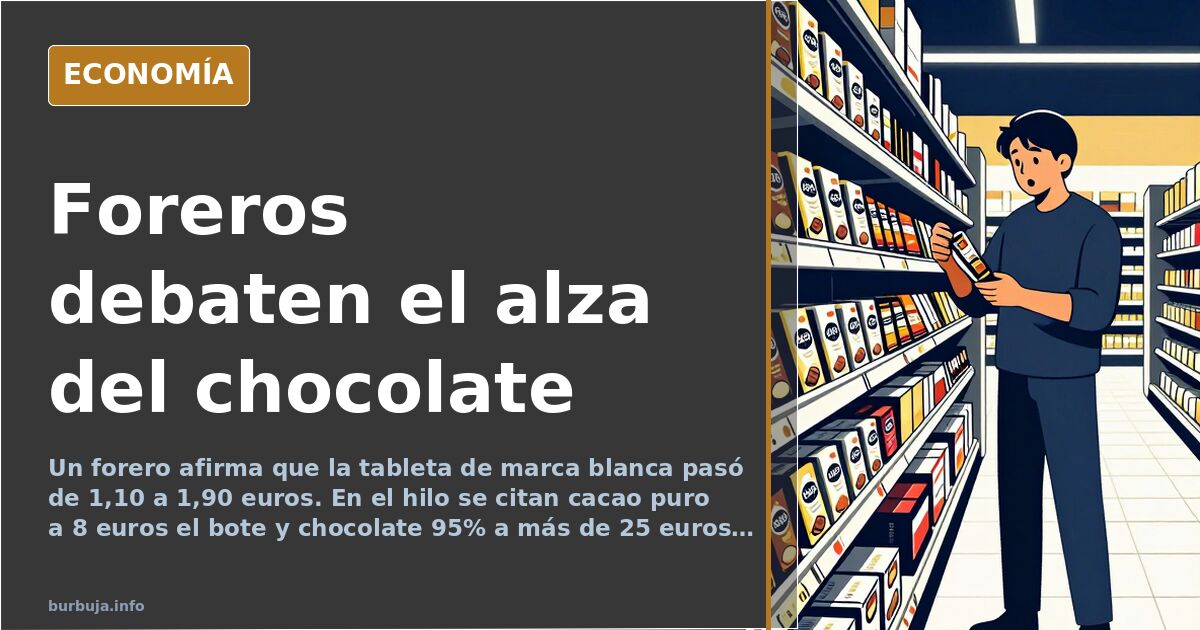
A forum user claims that a store-brand chocolate bar, which cost €1.10 a few months ago, has risen to €1.90. According to their account, this is not the impression of a confused shopper; it is the price displayed on the same shelf where stock once piled up and now, they assert, no one approaches. The scene, as described, repeats in any supermarket: shelves full, nobody picking items, nobody paying at checkout. Chocolate, a product that was in every home for decades regardless of salary, has become, according to this testimony, an involuntary thermometer of how tight the grocery budget has become.
The increase is not an isolated phenomenon, according to prices cited in the thread. Skimmed cocoa powder hovers around €8 per 250-gram tin, says one participant. Another argues that 95% dark chocolate with no added sugars exceeds €25 per kilo. A 70-gram bar of 99% cacao costs €8, according to another message. And a kilo of coffee, another pantry staple, has gone from €17 to €20 in the last year for established brands, says a user. The conversation about chocolate is, in reality, a conversation about the cost of living.
How much chocolate prices have risen in supermarkets
Street-level prices depict an escalation that does not match official inflation, according to participants. A store-brand bar that was €1.10 is now found at €1.90, says a user. Another, the red-paper wrapper brand, has gone from €1.00–€1.20 to between €1.45 and €1.60 in Valencia supermarkets and its metropolitan area, according to another. International brand bars of 85% cacao, which are on offer for £2.50 and normally £3 in the UK, are seen here at €5, says a message. 95% dark chocolate without added sugars exceeds €25 per kilo, according to another. And pure skimmed cocoa has settled near €8 per 250-gram tin, says a participant.
Some argue that chocolate has always been a popular product, requiring no high social class to buy. This is true. And precisely because of this, the rise hurts more: it is not a luxury whim that can be crossed off the list without consequences, but a food integrated into the routine of any household. Comparison with other basket items is inevitable, according to some messages: potato chips, soft drinks, and industrial snacks continue to fill carts, while chocolate remains on the shelf.
Chocolate as a pocket thermometer
The chocolate section acts like the canary in the coal mine, according to a user. If nobody picks up bars, wallets are tight. The observation is not a joke: some have spent months checking that shelves remain full, seeing no one take bars, and seeing no one pay for them at checkout. The official response—that sales and restocking do happen, but you just missed the moment—does not convince those who stand for ten minutes in front of the aisle counting customers.
The phenomenon has an exception that confirms the rule, according to a user's account. When a store brand goes on sale for €1.59, stock disappears within hours. People grab for it as if it were the last bar on the planet. In other words: demand has not died; it is dammed up waiting for a price that doesn't feel offensive. Consumption hasn't collapsed due to lack of desire, but out of a calculation of dignity, says this participant: I won't pay what you ask.
From €100 a year to €20: the silent adjustment
The adjustment hasn't been made with fanfare, but with silent scissors, according to some messages. Some have gone from spending €100 a year on chocolate to €20. It wasn't decided by a doctor, a diet, or health concerns: it was decided by the price, according to their testimony. What analytics didn't achieve, the price tag did. And it is not an isolated case, according to the thread: the same pattern repeats with Coca-Cola, soft drinks, and other products that have ceased to be regular purchases to become occasional treats.
The phenomenon has a gender dimension worth examining without caricature. For decades, chocolate has functioned as a small mechanism of emotional management in many homes, as commented in the thread: against stress, against headaches, as a reward after dinner. If the price expels it from the basket, the adjustment is not only economic. Some joke that forced savings will have side effects on coexistence. The joke is bad, but the data behind it—chocolate as a dispensable expense—is real.
Who still buys chocolate and at what price
Not everyone has thrown in the towel. Some maintain the 70% almond bar as part of their routine, and others defend that it is not worth skimping on chocolate and coffee: the difference between brands is cents per cup, says a user. The argument has its logic, according to this participant: if annual spending is €20, paying 30% more for a bar that lasts weeks ruins no one. The problem is when the reference price is no longer €1.10 but €1.90, and the 70-gram 99% bar costs €8.
The division is not between rich and poor, but between those who have decided chocolate is a dispensable expense and those who keep it as a small ceremony, according to the messages. The former have cut consumption by 90%, says a user. The latter buy less quantity but better quality, says another. And in the middle, a broad segment has stopped buying store brands to switch to offers, or has abandoned the aisle entirely, as deduced from the thread. The result is the same: fewer bars in the cart, more empty space on the shelf.
What cocoa prices say about the real economy
Chocolate has a peculiarity that makes it especially useful as an indicator, according to participants: it is a product with stable demand, long shelf life, and imperfect substitutes. You cannot stop buying it and replace it with something else without noticing. When a bar that cost €1.10 rises to €1.90, the consumer has few options, according to the thread: pay, look for a deal, or go without chocolate. Most have chosen the third option, according to some messages.
The disorienting data is that the adjustment was not caused by a specific supply crisis, but by a sustained increase installed on the shelf, according to users. Pure cocoa, which was the currency of the Incas and never expires, has become an asset viewed with respect, says a message. Some joke that bars are like gold. The joke has a serious underlying point, according to this participant: when a basic food behaves like a luxury good, something has shifted in the price structure.
The future of chocolate in the shopping basket
The question is not whether chocolate prices will fall again, but whether consumers will buy it again when they do, as raised in the thread. Habit adjustment has its own inertia, according to some messages: those who stopped buying for months discovered they didn't miss it, or missed it less than they thought. Recovering that consumption will require more than a one-off offer. It will require the price to seem reasonable again, and that, given the escalation seen, does not appear imminent, according to participants.
Meanwhile, the chocolate aisle will continue to function as an involuntary thermometer, according to the thread. If shelves remain full and nobody picks up bars, the diagnosis is clear, according to users: pockets are not ready for whims, not even for long-standing ones. The prediction, with all reservations, is that chocolate will not disappear from homes, but will cease to be an automatic purchase item. It will become what it already is in many places, according to the messages: a treat bought when there is a sale, enjoyed slowly, and rationed more than desired.
A forum user claims that a store-brand chocolate bar, which cost €1.10 a few months ago, has risen to €1.90. According to their account, this is not the impression of a confused shopper; it is the price displayed on the same shelf where stock once piled up and now, they assert, no one approaches. The scene, as described, repeats in any supermarket: shelves full, nobody picking items, nobody paying at checkout. Chocolate, a product that was in every home for decades regardless of salary, has become, according to this testimony, an involuntary thermometer of how tight the grocery budget has become.
The increase is not an isolated phenomenon, according to prices cited in the thread. Skimmed cocoa powder hovers around €8 per 250-gram tin, says one participant. Another argues that 95% dark chocolate with no added sugars exceeds €25 per kilo. A 70-gram bar of 99% cacao costs €8, according to another message. And a kilo of coffee, another pantry staple, has gone from €17 to €20 in the last year for established brands, says a user. The conversation about chocolate is, in reality, a conversation about the cost of living.
How much chocolate prices have risen in supermarkets
Street-level prices depict an escalation that does not match official inflation, according to participants. A store-brand bar that was €1.10 is now found at €1.90, says a user. Another, the red-paper wrapper brand, has gone from €1.00–€1.20 to between €1.45 and €1.60 in Valencia supermarkets and its metropolitan area, according to another. International brand bars of 85% cacao, which are on offer for £2.50 and normally £3 in the UK, are seen here at €5, says a message. 95% dark chocolate without added sugars exceeds €25 per kilo, according to another. And pure skimmed cocoa has settled near €8 per 250-gram tin, says a participant.
Some argue that chocolate has always been a popular product, requiring no high social class to buy. This is true. And precisely because of this, the rise hurts more: it is not a luxury whim that can be crossed off the list without consequences, but a food integrated into the routine of any household. Comparison with other basket items is inevitable, according to some messages: potato chips, soft drinks, and industrial snacks continue to fill carts, while chocolate remains on the shelf.
Chocolate as a pocket thermometer
The chocolate section acts like the canary in the coal mine, according to a user. If nobody picks up bars, wallets are tight. The observation is not a joke: some have spent months checking that shelves remain full, seeing no one take bars, and seeing no one pay for them at checkout. The official response—that sales and restocking do happen, but you just missed the moment—does not convince those who stand for ten minutes in front of the aisle counting customers.
The phenomenon has an exception that confirms the rule, according to a user's account. When a store brand goes on sale for €1.59, stock disappears within hours. People grab for it as if it were the last bar on the planet. In other words: demand has not died; it is dammed up waiting for a price that doesn't feel offensive. Consumption hasn't collapsed due to lack of desire, but out of a calculation of dignity, says this participant: I won't pay what you ask.
From €100 a year to €20: the silent adjustment
The adjustment hasn't been made with fanfare, but with silent scissors, according to some messages. Some have gone from spending €100 a year on chocolate to €20. It wasn't decided by a doctor, a diet, or health concerns: it was decided by the price, according to their testimony. What analytics didn't achieve, the price tag did. And it is not an isolated case, according to the thread: the same pattern repeats with Coca-Cola, soft drinks, and other products that have ceased to be regular purchases to become occasional treats.
The phenomenon has a gender dimension worth examining without caricature. For decades, chocolate has functioned as a small mechanism of emotional management in many homes, as commented in the thread: against stress, against headaches, as a reward after dinner. If the price expels it from the basket, the adjustment is not only economic. Some joke that forced savings will have side effects on coexistence. The joke is bad, but the data behind it—chocolate as a dispensable expense—is real.
Who still buys chocolate and at what price
Not everyone has thrown in the towel. Some maintain the 70% almond bar as part of their routine, and others defend that it is not worth skimping on chocolate and coffee: the difference between brands is cents per cup, says a user. The argument has its logic, according to this participant: if annual spending is €20, paying 30% more for a bar that lasts weeks ruins no one. The problem is when the reference price is no longer €1.10 but €1.90, and the 70-gram 99% bar costs €8.
The division is not between rich and poor, but between those who have decided chocolate is a dispensable expense and those who keep it as a small ceremony, according to the messages. The former have cut consumption by 90%, says a user. The latter buy less quantity but better quality, says another. And in the middle, a broad segment has stopped buying store brands to switch to offers, or has abandoned the aisle entirely, as deduced from the thread. The result is the same: fewer bars in the cart, more empty space on the shelf.
What cocoa prices say about the real economy
Chocolate has a peculiarity that makes it especially useful as an indicator, according to participants: it is a product with stable demand, long shelf life, and imperfect substitutes. You cannot stop buying it and replace it with something else without noticing. When a bar that cost €1.10 rises to €1.90, the consumer has few options, according to the thread: pay, look for a deal, or go without chocolate. Most have chosen the third option, according to some messages.
The disorienting data is that the adjustment was not caused by a specific supply crisis, but by a sustained increase installed on the shelf, according to users. Pure cocoa, which was the currency of the Incas and never expires, has become an asset viewed with respect, says a message. Some joke that bars are like gold. The joke has a serious underlying point, according to this participant: when a basic food behaves like a luxury good, something has shifted in the price structure.
The future of chocolate in the shopping basket
The question is not whether chocolate prices will fall again, but whether consumers will buy it again when they do, as raised in the thread. Habit adjustment has its own inertia, according to some messages: those who stopped buying for months discovered they didn't miss it, or missed it less than they thought. Recovering that consumption will require more than a one-off offer. It will require the price to seem reasonable again, and that, given the escalation seen, does not appear imminent, according to participants.
Meanwhile, the chocolate aisle will continue to function as an involuntary thermometer, according to the thread. If shelves remain full and nobody picks up bars, the diagnosis is clear, according to users: pockets are not ready for whims, not even for long-standing ones. The prediction, with all reservations, is that chocolate will not disappear from homes, but will cease to be an automatic purchase item. It will become what it already is in many places, according to the messages: a treat bought when there is a sale, enjoyed slowly, and rationed more than desired.
Summary of a discussion on Burbuja.info - Foro de economía, actualidad y política., translated from Spanish and reviewed before publication. Read the full discussion (149 replies).
More summaries
-
Lidl basket rises 16% in a month, outpacing official inflation
Prices for staples like baguettes and chicken have surged sharply, while the official CPI remains stable.
-
Carrefour Drops Pepsi and Dorito Brands Over Price Hikes
Carrefour removes PepsiCo products from shelves in France and Spain, citing "unacceptable" price increases, extending a strategy seen in Argentina.
-
Carrefour and Alcampo lose ground to Mercadona and Lidl
Carrefour and Alcampo drop 0.8% while Mercadona grows 9%; analysis of the French hypermarket decline in Spain.
-
Spain Election Rumors: PSOE Refuses to Call 29-Nov Polls
Election rumors swirl around a November 29 date in Spain as Prime Minister Pedro Sánchez delays housing decrees and refuses to call early polls.
-
Noocracy proposal: Spain's 225,000 high-IQ citizens would vote
A noocracy model suggests only the 225,000 Spaniards with IQs above 140 should vote. It features rotation and claims to prevent corruption.
-
Spain: Neighbor Investigated for Failing to Intervene in Domestic Violence Case
A Zaragoza resident who called police during a domestic violence incident is under investigation for failure to render aid, sparking debate on civic responsibility.