
Forum user suspects guests faked Italian gorgonzola
A forum user claims three guests brought supermarket gorgonzola, presenting it as an Italian souvenir. Others note the irony of cheap cheese posing as gourmet.
English · Original discussion in Spanish · Published
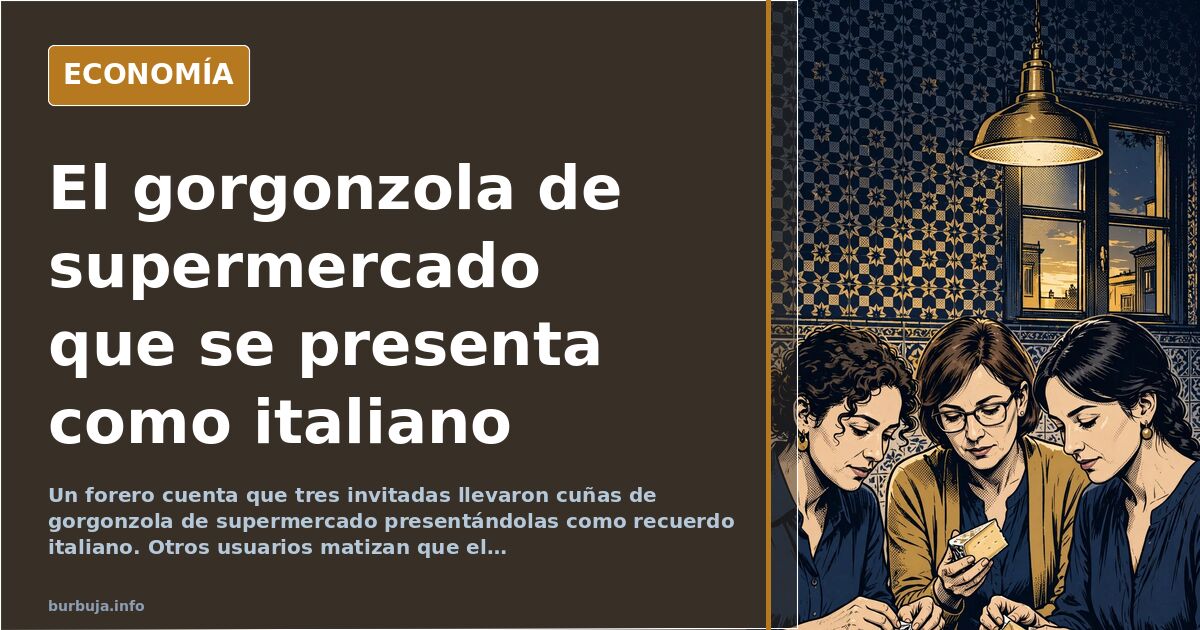
Supermarket gorgonzola presented as an Italian souvenir
An invitation to a newly rented apartment. The hostess says the classic "don't bring anything, but if you insist, wine or cheese." No one insisted. Yet, according to a forum user, three guests arrived with wedges of gorgonzola. Two in similar containers, the third with the original packaging label visible. The host, who had brought a bottle of wine costing around €20, watched the scene: three wedges of the same blue cheese, presented as if they came from a creamery in Bergamo.
The anecdote, told with dry humor, reveals more than just a ridiculous night. Gorgonzola has become, according to this account, the emblem of a social ritual where the packaging matters more than the content. It is no coincidence: it is a cheap cheese, easy to find, with an Italian story that sounds like travel and a refined palate. The problem, according to some participants, is that the wedge served at these tables has nothing to do with real gorgonzola.
What real gorgonzola is and why it isn't sold in wedges
Authentic gorgonzola is an Italian blue cheese with a soft, creamy, almost spreadable paste. It is produced in the Piedmont and Lombardy regions and has Protected Designation of Origin status. Its texture is so soft that, in Italy, it is served with a spoon, not cut into triangles. Those who have tasted it in its place of origin know this well.
What reaches Spanish shelves under that label is something else. Some argue that the wedges sold in discount chains are actually gorgonzola mascarpone: alternating layers of blue cheese and mascarpone, much firmer and much cheaper. Hence, it can be sliced without crumbling. The confusion between the original and its industrial version is the first misunderstanding of this trend.
The second misunderstanding is the price. A supermarket gorgonzola wedge costs around €2.50. A decent bottle of wine, about €20. The asymmetry between what is brought and what is pretended is the heart of the anecdote.
The ritual of cheese from afar
According to this account, the scene repeats itself in apartments across Spain. Someone arrives with a product they claim to have discovered on a alucinación and can no longer stop eating. The travel story is mandatory. Without it, the cheese is just cheese. With it, it becomes a social credential.
The detail that, according to the forum user, exposes the pretense is the packaging. Two of the guests brought nearly identical wedges inside containers. The third directly brought the original wrapper with a label reading Igor, likely a budget store brand. The host, who had brought wine from home to avoid the supermarket, realized he had spent ten times more than them.
The paradox is that the effort to fake a alucinación is greater than buying the cheese. Going to the supermarket, grabbing a wedge and some crackers would have been more honest and quicker. But then there would be no story. And without a story, there is no posturing.
Why gorgonzola and not cured manchego
Spain has a cheese tradition that has nothing to envy from Italy. Cured Manchego, Cabrales, Valdeón, Picón, Stilton, Queso de la Serena. Any of them would have worked better at a table. But they don't sound like travel. They sound like home.
That is the key. Gorgonzola is not chosen for its flavor, but for its symbolic weight. It is Italian, it is blue, it is slightly exotic, and it is available in all supermarket chains. It meets the three requirements of a product brought to dinner to impress without breaking the bank.
However, the tasting disappoints. The flavor is mild, not complex, almost numbing to the taste buds. Anyone who has tried a good Spanish blue cheese notices the difference immediately. But tasting is not the goal. The goal is for someone to ask where it comes from and be able to answer: Italy.
The wine no one brings and the one everyone drinks
There is a detail that closes the portrait. The host brought a bottle of wine costing around €20. All the guests went for it. No one brought another. When it ran out, the hostess emergency pulled out a bottle of cheap wine and a private label one to make kalimotxo (wine mixed with cola), and went down to get beers.
The host left shortly after, rejecting more crackers with blue cheese and an aloe vera jelly for dessert. His conclusion: if the next invitation isn't among friends and cheap beer, decline with all his might.
The episode leaves an uncomfortable question. How many culinary trends claimed to be sophisticated are actually supermarket products with an invented story? Gorgonzola is just the most visible example. Lambrusco and limoncello experienced the same thing years ago, according to the same forum user. Now it is gorgonzola and blue cheese with Italian names. Tomorrow it will be something else.
And meanwhile, cured Manchego cheese continues waiting on the shelf for someone to dare to bring it without saying it comes from anywhere.
Also available in: Deutsch
Summary of a discussion on Burbuja.info - Foro de economía, actualidad y política., translated from Spanish and reviewed before publication. Read the full discussion (163 replies).
More summaries
-
Mercadona's model divides opinion: neither cheap nor great
Is Mercadona more expensive than Aldi and Lidl? We analyse the Spanish chain's model: prices, own-brand products, suppliers and employment.
-
Carrefour and Alcampo lose ground to Mercadona and Lidl
Carrefour and Alcampo drop 0.8% while Mercadona grows 9%; analysis of the French hypermarket decline in Spain.
-
Mercadona hits the brakes: customers are comparing prices
While comparing seven chains keeps many customers captive, Lidl and Aldi are gaining market share, and fresh produce is increasingly bought outside of Mercadona.
-
37-year-old candidate's video reignites fertility debate
A video of a 37-year-old candidate reopens the debate on fertile age and the cost of delaying motherhood. The discussion splits between biology and…
-
25-year-old arrested over sexual assault at Madrid's Sol protest camp
A 25-year-old man has been arrested for the alleged sexual assault of a 22-year-old woman in a tent at the Puerta del Sol camp in Madrid. The law provides for aid of up to 18…
-
Spain beats Basque Country in final showdown to win Basque Pelota World Cup team title
Spain claimed the team title at the Basque Pelota World Cup after beating the Basque Country in the final showdown, according to El Mundo. Pelota is a sport with growing economic weight.