
Forum user given one week to delete account under doxxing threat
An anonymous forum issues a seven-day ultimatum to delete an account or face personal data leaks, naming the user's family as leverage.
English · Original discussion in Spanish · Published
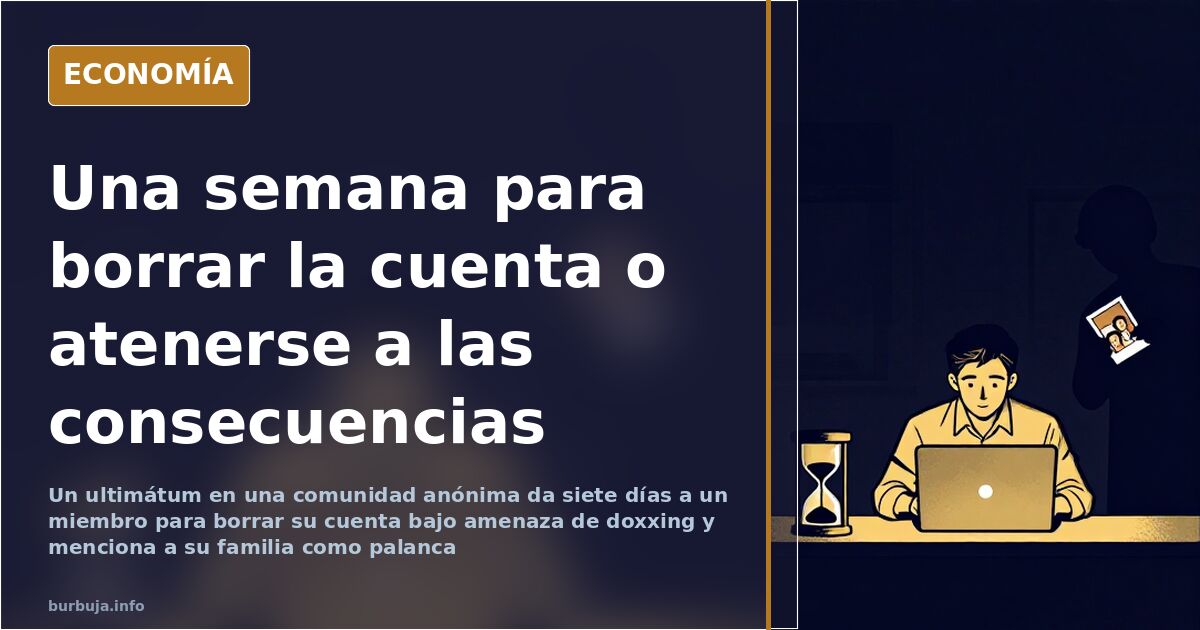
Doxxing with an expiration date: one week to delete the account
An unknown user grants another seven days of digital life. "Delete the account," he demands, and don't let yourself be seen "for a good while." There is no debate, no nuance, no apologies. There is a deadline—Sunday at 11:59 p.m.—and a chilling warning: the writer claims to know things and warns that things will happen. This is the practical definition of doxxing: threatening to reveal personal data to force a specific behavior.
The confessed trigger is a dispute over the victims of Valencia's "cold rain" floods. The author says this matter hits "very close to home" and that his patience has run out. Then comes the classic leverage of blackmail: the family. He mentions the parents of the recipient, "the only ones who put up with you," and warns that he wouldn't want to give them that distress. In passing, he boasts of knowing everything, even if his target tries to reappear under another name.
What turns a discussion into a doxxing threat
Any anonymous community lives by an unwritten pact: here we debate, we do not investigate. When someone claims to hold the other's identity and sets a deadline, that pact flies out the window. It no longer matters who started it. What matters is that the message does not argue a point, but displays power over a person's life.
The ultimatum's figure summarizes it: seven days. Plenty of time to erase traces, plenty of time to think it over. And a crucial addendum to underline: the author claims he finds out about everything. That phrase, more than the threat, is what disorients the reader. Because he promises nothing concrete; he only implies that control is no longer where it should be.
The community splits: from the 'ignore' button to 'this is mafia'
The reaction was not unanimous, and that is where the interest lies. One part responded with the usual reflex: block and do not feed the disturber. Massive Ignore, water, and on to other things. Another part cheered the hard exit: let his life sink for the one who had been provoking for so long.
Rising above them all was a third, uncomfortable voice marking the boundary: in these squares, you use arguments or the ignore button, not threats. They called the procedure a mafia-like attitude and reminded everyone that, no matter how much someone dislikes the target, no one deserves a witch hunt for writing what they write. The tone of the accuser himself mixed rejection of the method with an acknowledgment of having had his ups and downs with the accused.
Who moderates and why almost no one notices
The episode peine the eternal wound of surveillance. While the issue rose to the main showcase, some wondered why it remained visible, when other equally long discussions had been removed for a simple exchange of opinions on a book. The most repeated answer was ironic: according to one participant, he does not believe there are moderators. The suspicion that rules are applied capriciously—or only when there is a finger pointing—does not help lower the temperature.
Data, screenshots, and parallel groups: anonymity under suspicion
In parallel, versions regarding these alleged data began circulating through closed messaging groups. And there arose a nuance worth noting: the warning that a perfect file, too well documented, is often precisely the least reliable. The one who warned of caution did so out of self-interest: if the material is false, the one who spreads it hits the wrong target.
Reasonable doubt hung in the air. It is unknown whether what is promised exists, or if it corresponds to the recipient. It is only known that a price has been put on a withdrawal and that the currency is someone else's privacy.
Why might this happen again?
There were no shortage of those who shrugged: it would not be the first time, nor surely the last. The phrase is what it is, because it summarizes the underlying problem. In communities where identity is borrowed and changed, the one who cross-references data ceases to be an annoying neighbor and becomes a vigilante. The threshold is not crossed by the insult; it is crossed by the folder.
The practical conclusion is uncomfortable for everyone. For the debater, because he discovers that his alias does not protect him as much as he thought. And for the platform, because each such episode costs exactly what no one measures in a balance: the trust of those who come to read and leave looking over their shoulders.
The deadline expires: what remains is uncertainty
The deadline arrived. There was, for all to see, no cataclysm. And yet, the closure does not calm anyone. The author himself wrote it with stunning coldness: from now on, his target will never know if the bad things that happen to him are coincidence or if he provoked them. That is the real damage, the one that does not depend on whether data is leaked, but on the victim living with doubt hanging over them. In one week, a dessert-table discussion turned into a hostage situation.
An unknown user grants another seven days of digital life. "Delete the account," he demands, and don't let yourself be seen "for a good while." There is no debate, no nuance, no apologies. There is a deadline—Sunday at 11:59 p.m.—and a chilling warning: the writer claims to know things and warns that things will happen. This is the practical definition of doxxing: threatening to reveal personal data to force a specific behavior.
The confessed trigger is a dispute over the victims of Valencia's "cold rain" floods. The author says this matter hits "very close to home" and that his patience has run out. Then comes the classic leverage of blackmail: the family. He mentions the parents of the recipient, "the only ones who put up with you," and warns that he wouldn't want to give them that distress. In passing, he boasts of knowing everything, even if his target tries to reappear under another name.
What turns a discussion into a doxxing threat
Any anonymous community lives by an unwritten pact: here we debate, we do not investigate. When someone claims to hold the other's identity and sets a deadline, that pact flies out the window. It no longer matters who started it. What matters is that the message does not argue a point, but displays power over a person's life.
The ultimatum's figure summarizes it: seven days. Plenty of time to erase traces, plenty of time to think it over. And a crucial addendum to underline: the author claims he finds out about everything. That phrase, more than the threat, is what disorients the reader. Because he promises nothing concrete; he only implies that control is no longer where it should be.
The community splits: from the 'ignore' button to 'this is mafia'
The reaction was not unanimous, and that is where the interest lies. One part responded with the usual reflex: block and do not feed the disturber. Massive Ignore, water, and on to other things. Another part cheered the hard exit: let his life sink for the one who had been provoking for so long.
Rising above them all was a third, uncomfortable voice marking the boundary: in these squares, you use arguments or the ignore button, not threats. They called the procedure a mafia-like attitude and reminded everyone that, no matter how much someone dislikes the target, no one deserves a witch hunt for writing what they write. The tone of the accuser himself mixed rejection of the method with an acknowledgment of having had his ups and downs with the accused.
Who moderates and why almost no one notices
The episode peine the eternal wound of surveillance. While the issue rose to the main showcase, some wondered why it remained visible, when other equally long discussions had been removed for a simple exchange of opinions on a book. The most repeated answer was ironic: according to one participant, he does not believe there are moderators. The suspicion that rules are applied capriciously—or only when there is a finger pointing—does not help lower the temperature.
Data, screenshots, and parallel groups: anonymity under suspicion
In parallel, versions regarding these alleged data began circulating through closed messaging groups. And there arose a nuance worth noting: the warning that a perfect file, too well documented, is often precisely the least reliable. The one who warned of caution did so out of self-interest: if the material is false, the one who spreads it hits the wrong target.
Reasonable doubt hung in the air. It is unknown whether what is promised exists, or if it corresponds to the recipient. It is only known that a price has been put on a withdrawal and that the currency is someone else's privacy.
Why might this happen again?
There were no shortage of those who shrugged: it would not be the first time, nor surely the last. The phrase is what it is, because it summarizes the underlying problem. In communities where identity is borrowed and changed, the one who cross-references data ceases to be an annoying neighbor and becomes a vigilante. The threshold is not crossed by the insult; it is crossed by the folder.
The practical conclusion is uncomfortable for everyone. For the debater, because he discovers that his alias does not protect him as much as he thought. And for the platform, because each such episode costs exactly what no one measures in a balance: the trust of those who come to read and leave looking over their shoulders.
The deadline expires: what remains is uncertainty
The deadline arrived. There was, for all to see, no cataclysm. And yet, the closure does not calm anyone. The author himself wrote it with stunning coldness: from now on, his target will never know if the bad things that happen to him are coincidence or if he provoked them. That is the real damage, the one that does not depend on whether data is leaked, but on the victim living with doubt hanging over them. In one week, a dessert-table discussion turned into a hostage situation.
Summary of a discussion on Burbuja.info - Foro de economía, actualidad y política., translated from Spanish and reviewed before publication. Read the full discussion (267 replies).
More summaries
-
Sánchez proposes EU end to anonymity on social media
Sánchez proposes EU end to anonymity on social media: the digital ID and internet access-control debate is at the centre of criticism.
-
Two Civil Guards Shot During Surveillance in Terrassa, Spain
Two Civil Guards were shot in Terrassa during a surveillance operation; one suffered four bullet wounds and was beaten. The incident highlights security concerns in Spain.
-
Sopuerta resident offers €1M to block migrant center
A Sopuerta resident in Spain's Basque Country offers €1 million to prevent a facility for over 100 unaccompanied foreign minors.
-
Madrid rental listings drop to 8,762 homes
Forum data shows only 8,762 apartments and 5,100 rooms available in Madrid, with the cheapest room starting at €550 plus utilities.
-
Spain's IMV denied for having €40,000 savings while renting
A tenant with no property is denied Spain's Minimum Vital Income (IMV) for exceeding the €20,353.62 liquid asset limit, despite primary residence being excluded from wealth calculations.
-
San Sebastián hikes property tax on empty homes
San Sebastián applies a 150% surcharge to the IBI for vacant properties, while exempting tourist and student rentals.