
Spain's IMV denied for having €40,000 savings while renting
A tenant with no property is denied Spain's Minimum Vital Income (IMV) for exceeding the €20,353.62 liquid asset limit, despite primary residence being excluded from wealth calculations.
English · Original discussion in Spanish · Published
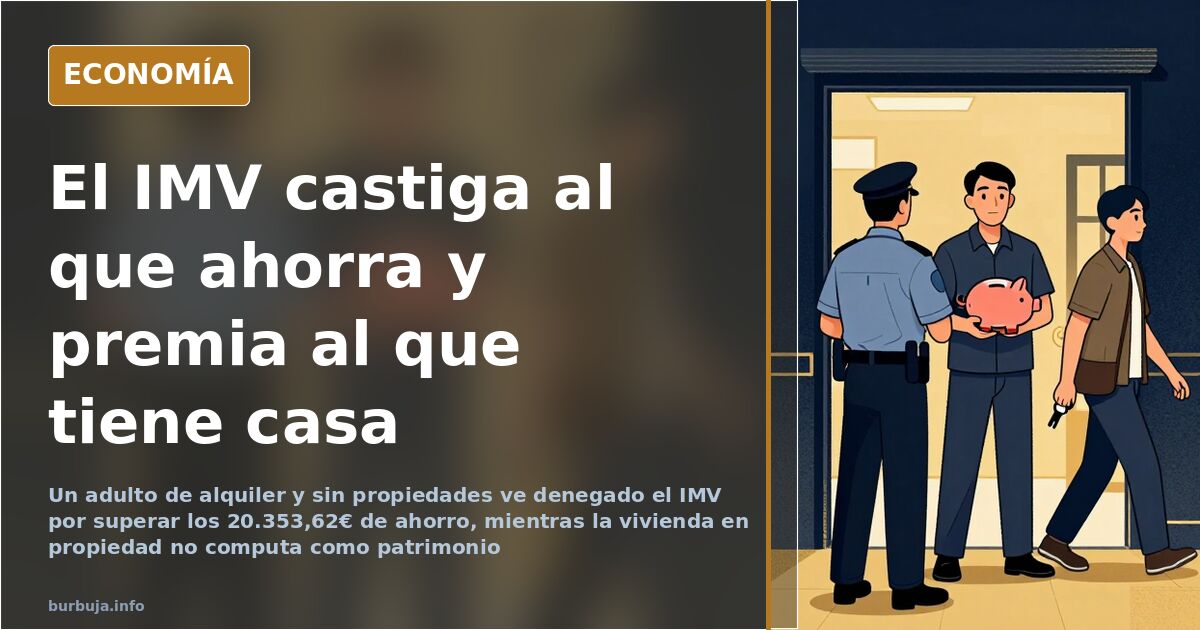
Spain's IMV denied for having €40,000 savings while renting
To qualify for the Ingreso Mínimo Vital (Minimum Vital Income), one must not have too much, nor too little. A single adult living in rented accommodation with no property in their name had their application rejected because their bank balance exceeded the legal limit: €20,353.62. This is neither fraud nor an administrative error. They applied on November 21 knowing it would be refused. And it was.
The paradox, argues the affected individual, is that owning a home does not penalize you equally. The primary residence is not counted as assets for the purpose of this aid, meaning someone with a paid-off apartment and little cash can enter the system, while someone paying rent and supporting themselves with personal savings is left out. €40,000 saved, they point out, equates to three or four years of austere living. Not wealth.
How much money can you have in the bank and still receive IMV?
The threshold used by the administration for a single person is €20,353.62 in liquid money. Above this, it is denied. In parallel, another figure circulates, the asset limit, situated around €60,000, comprising all goods: savings, vehicles, and real estate, which in a specific case amounted to just €16,000. The aid at stake is approximately €565 per month, an amount that is exactly the same for those who pay rent and those who do not.
No one disputes the existence of a threshold. What is disputed is where it is set and what is measured. Measuring a bank account balance is not measuring poverty; it is measuring liquidity. And these two things diverge precisely in the segment this aid aims to cover.
Why the primary residence is not counted as assets
The habitual residence is excluded from the asset calculation. It has its logic—preventing social aid from forcing people to sell their homes—and its perverse effect. A detailed case illustrates this: a 52-year-old accessed their subsidy with the money from selling their first home still in the account, and the process went ahead because the origin of those funds was the house they had just left. The official handling the file was surprised by a balance they apparently had not seen before; they consulted their superior, and the aid was granted.
From this comes the uncomfortable comparison. Those with accumulated bricks and little checking account get in; those with a checking account and no bricks do not. In terms of real need, the first situation may be more solvent than the second. The system rewards one and punishes the other.
Gold, Bitcoin, and accounts in third-party names: system loopholes
When the threshold becomes a wall, solutions appear. Converting excess into gold—an asset without bank traceability and stable value—is the most common. Also Bitcoin, or simply leaving that money in a relative's name. None of these formulas are illegal per se: they are private operations that fall outside the administration's focus, at least while no one looks.
And here arises the central doubt: how far can the administration see? Available experience suggests it sees quite a lot. In a seizure, the Spanish Tax Agency (Agencia Tributaria) held the complete list of a taxpayer's investments, including those not in the traditional banking circuit. Checking a bank balance is trivial; tracking positions in a foreign broker is more debatable, perhaps not entirely lawful, but not impossible.
The question hovering over these stratagems is whether the system tolerates them due to incompetence or by design.
The grievance of those who receive it and those who watch
At the heart of the matter lies a suspicion older than the aid itself: that the Minimum Vital Income does not reach those who need it, but those who know best how to position themselves. Recipients are cited with cars worth €45,000, delinquent neighbors with sports cars, and cash purchases that leave no trace. How a cash transaction between individuals is declared is a question without a clean answer; the note that in 2024 the European Central Bank changes the design of banknotes adds, half-jokingly, the suspicion that opaque channels have an expiration date.
There are also those who judge the reverse: those who ask for aid after earning and squandering notable sums—a case of €50,000 is mentioned—are equally in line. The benefit, that side argues, does not ask how you got here, only how much you have now. And if it does not ask that, the one who saved out of prudence competes at a disadvantage with the one who did not.
A US case that slips into the comparison
The comparison crosses the Atlantic. In the United States, a family that moved into a motorhome to have a roof saw that same address disqualify them from receiving benefits: housing not considered valid by the administration does not help; it subtracts. The case recalls that in other countries the problem is identical. It is not the amount of money that is measured, but the form in which that money exists where the machine can see it.
And the conclusion repeats itself: define the asset and you will have defined the aid. Those who have it liquid are left out. Those who have it converted into bricks or metal are inside.
What you can and cannot do when your aid is denied
The formal route is to wait. The resolution of the case arrived quickly: application submitted on November 21 and denial letter within days. That gives a clue. It is not a stuck process, it is an automatic filter against declared assets. If the €20,353.62 cut is not surpassed, theoretically the door opens again; the question is whether it is worth formally impoverishing oneself to enter through it.
Here the calculation becomes absurd. Saving €40,000 for three years of subsistence is prudence. Hiding it to scrape together €565 a month is something else. The system pushes towards the latter.
One unclosed question remains: if the goal is to ensure no one falls into misery, why is the penalty directed precisely at those who did everything possible not to fall?
To qualify for the Ingreso Mínimo Vital (Minimum Vital Income), one must not have too much, nor too little. A single adult living in rented accommodation with no property in their name had their application rejected because their bank balance exceeded the legal limit: €20,353.62. This is neither fraud nor an administrative error. They applied on November 21 knowing it would be refused. And it was.
The paradox, argues the affected individual, is that owning a home does not penalize you equally. The primary residence is not counted as assets for the purpose of this aid, meaning someone with a paid-off apartment and little cash can enter the system, while someone paying rent and supporting themselves with personal savings is left out. €40,000 saved, they point out, equates to three or four years of austere living. Not wealth.
How much money can you have in the bank and still receive IMV?
The threshold used by the administration for a single person is €20,353.62 in liquid money. Above this, it is denied. In parallel, another figure circulates, the asset limit, situated around €60,000, comprising all goods: savings, vehicles, and real estate, which in a specific case amounted to just €16,000. The aid at stake is approximately €565 per month, an amount that is exactly the same for those who pay rent and those who do not.
No one disputes the existence of a threshold. What is disputed is where it is set and what is measured. Measuring a bank account balance is not measuring poverty; it is measuring liquidity. And these two things diverge precisely in the segment this aid aims to cover.
Why the primary residence is not counted as assets
The habitual residence is excluded from the asset calculation. It has its logic—preventing social aid from forcing people to sell their homes—and its perverse effect. A detailed case illustrates this: a 52-year-old accessed their subsidy with the money from selling their first home still in the account, and the process went ahead because the origin of those funds was the house they had just left. The official handling the file was surprised by a balance they apparently had not seen before; they consulted their superior, and the aid was granted.
From this comes the uncomfortable comparison. Those with accumulated bricks and little checking account get in; those with a checking account and no bricks do not. In terms of real need, the first situation may be more solvent than the second. The system rewards one and punishes the other.
Gold, Bitcoin, and accounts in third-party names: system loopholes
When the threshold becomes a wall, solutions appear. Converting excess into gold—an asset without bank traceability and stable value—is the most common. Also Bitcoin, or simply leaving that money in a relative's name. None of these formulas are illegal per se: they are private operations that fall outside the administration's focus, at least while no one looks.
And here arises the central doubt: how far can the administration see? Available experience suggests it sees quite a lot. In a seizure, the Spanish Tax Agency (Agencia Tributaria) held the complete list of a taxpayer's investments, including those not in the traditional banking circuit. Checking a bank balance is trivial; tracking positions in a foreign broker is more debatable, perhaps not entirely lawful, but not impossible.
The question hovering over these stratagems is whether the system tolerates them due to incompetence or by design.
The grievance of those who receive it and those who watch
At the heart of the matter lies a suspicion older than the aid itself: that the Minimum Vital Income does not reach those who need it, but those who know best how to position themselves. Recipients are cited with cars worth €45,000, delinquent neighbors with sports cars, and cash purchases that leave no trace. How a cash transaction between individuals is declared is a question without a clean answer; the note that in 2024 the European Central Bank changes the design of banknotes adds, half-jokingly, the suspicion that opaque channels have an expiration date.
There are also those who judge the reverse: those who ask for aid after earning and squandering notable sums—a case of €50,000 is mentioned—are equally in line. The benefit, that side argues, does not ask how you got here, only how much you have now. And if it does not ask that, the one who saved out of prudence competes at a disadvantage with the one who did not.
A US case that slips into the comparison
The comparison crosses the Atlantic. In the United States, a family that moved into a motorhome to have a roof saw that same address disqualify them from receiving benefits: housing not considered valid by the administration does not help; it subtracts. The case recalls that in other countries the problem is identical. It is not the amount of money that is measured, but the form in which that money exists where the machine can see it.
And the conclusion repeats itself: define the asset and you will have defined the aid. Those who have it liquid are left out. Those who have it converted into bricks or metal are inside.
What you can and cannot do when your aid is denied
The formal route is to wait. The resolution of the case arrived quickly: application submitted on November 21 and denial letter within days. That gives a clue. It is not a stuck process, it is an automatic filter against declared assets. If the €20,353.62 cut is not surpassed, theoretically the door opens again; the question is whether it is worth formally impoverishing oneself to enter through it.
Here the calculation becomes absurd. Saving €40,000 for three years of subsistence is prudence. Hiding it to scrape together €565 a month is something else. The system pushes towards the latter.
One unclosed question remains: if the goal is to ensure no one falls into misery, why is the penalty directed precisely at those who did everything possible not to fall?
Summary of a discussion on Burbuja.info - Foro de economía, actualidad y política., translated from Spanish and reviewed before publication. Read the full discussion (190 replies).
More summaries
-
550 Euros from IMV vs. 1,200 for 40 Hours: The Deciding Gap
A university graduate in 2025 earns the same 1,200 euros as an assistant in 2005, while the minimum vital income is around 550 to 658 euros per month.
-
Leticia Sabater earns up to €5,000 per gig: the decline of Spain
Leticia Sabater, 59, earns up to €5,000 per gig. Her tacky, provocative show sparks debate on cultural decline and public money.
-
Ibiza's Empty Beaches: High Prices and Tourist Fatigue
Half-empty beaches in Ibiza, with €6 beers and €26 salads, drive tourists to Menorca and Morocco.
-
Feijóo's sick leave crusade backfires, hurting PP votes
Feijóo labels sick leave a 'cancer' and proposes cuts. Analysis shows how this PP strategy alienates voters and benefits Sánchez.
-
Aldama predicts Zapatero and Sánchez imprisonment
Víctor de Aldama forecasts prison for Zapatero and Sánchez. We analyze his track record and the resulting political earthquake in Spain.
-
Spain: €20k cookie cutter machine divides small business owners
A Spanish baker's €20,000 investment in a dough-cutting machine sparks debate on ROI and public subsidies.