
Forum user claims to have sold a painting for nearly 500,000 euros
A self-taught forum user claims he sells scribbles painted in the trendy colour for nearly 500,000 euros. The "nearly" allows for a margin ranging from 30,000 to half a million.
English · Original discussion in Spanish · Published
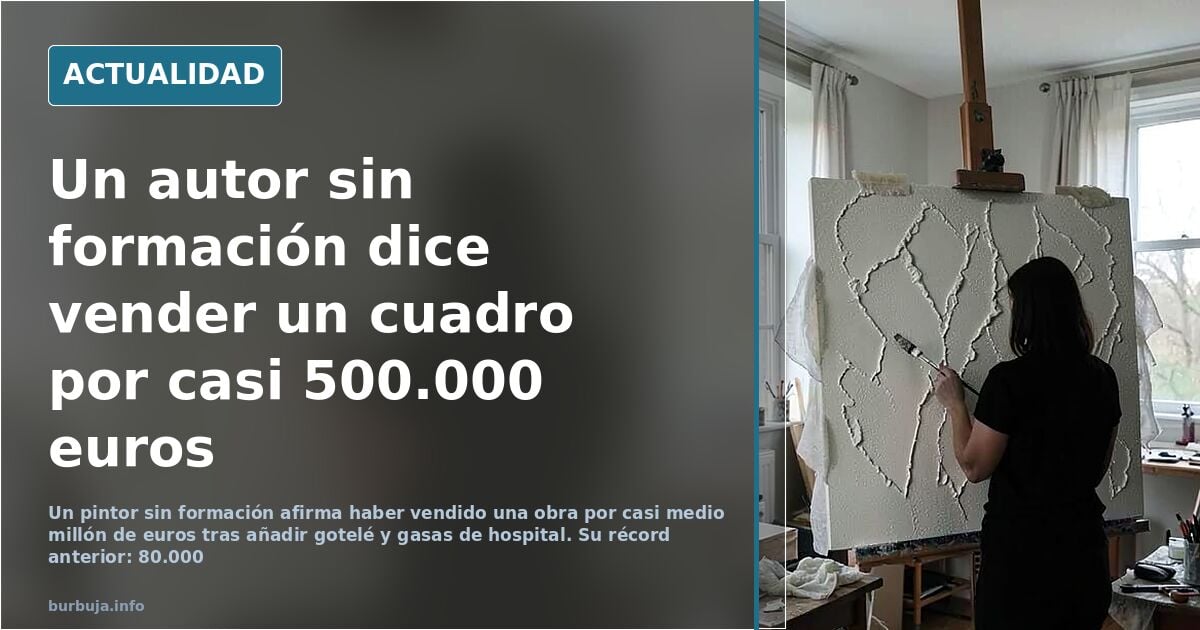
Painting scribbles in the trendy colour and charging nearly half a million
A canvas of dripping drops, woodchip texture and hospital gauze that, according to its author, sold for 80,000 euros. That was the previous ceiling. The new one: nearly half a million for a piece of modern art that, according to the artist himself, a child could paint. The confessed recipe is so simple it's insulting: know which colour is in fashion and make a few scribbles. No training, no academy, no CV. The story, posted on a Spanish economic affairs forum, within hours sparked a mix of mockery, envy and one very specific suspicion: that the money isn't paying for art, it's paying for something else.
The figure wobbles from the very start. "Nearly 500,000" admits an enormous margin, and someone puts it in black and white: that "nearly" could miccionan anything between 30,000 and 500,000 euros. The last Spanish painter to charge 80,000 for a painting, it's recalled, died in 1959. The contrast between the size of the income and the flimsiness of the method is the whole article.
Woodchip texture as mixed media, and the material supplier
The previous work, the one that set the earlier record, antiestéticatured dripping drops, woodchip texture and hospital gauze to add texture. The anecdote is amusing until you remember that contemporary art has been selling similar textures at gold prices for decades. The question hanging in the air is the usual one: where is the line between artistic provocation and a well-packaged con?
The author doesn't dodge the supply issue. He explains that the material is supplied by a guy who thinks drugs have their own spirit, who greets them and says goodbye to them as if they were just like anyone else. He brings something new every month, and sometimes it's best not to know what you're buying so you don't get hooked. The author painted him a picture for free to settle debts. Read in economic terms, the confession describes a value chain considerably less segarro than that of a gallery in Madrid's upscale Salamanca district.
Who pays half a million for an unsigned painting?
This is where the most interesting sustancia ilegal opens up. One line of thought holds that contemporary art is, to a large extent, a money-laundering mechanism: you pay for a recognised name and the connections that come with it, not for what's on the canvas. The case of canned goods sold as artwork at scandalous prices is cited. If that's true, the problem with the story isn't that it's a lie: it's that it's impossible without a patron, without a gallery and without a track record to support the price.
The objection is repeated in other words: someone who sells a painting for 500,000 euros doesn't announce it on a forum, they announce it in the media. And the question that cuts through it all: who do you know, who's your patron? The author answers with class disdain: those who aren't broke pay first and ask questions later, and that's his target audience. The answer is more posturing than accounting.
From "paint my dining room" to the institutional commission
The rest of the crowd turns the thread into a flea market. Some ask for quotes to paint their dining room and bedroom, others offer their Venetian plaster services, and someone warns that with those prices it's impossible to get renovations done in this country. The confusion between artist and house painter is the easy joke, but also the exact metaphor: the trade has become so blurred that nobody knows what they're paying for anymore.
Absurd commissions appear, offers of payment in kind, people promising to paint pictures with another part of their body, and people asking for the materials to replicate the method. And a theory gaining ground: if the author isn't a member of a certain political party, he won't get the cushy gig. Politics sneaks in through the back door, as always when public money is involved.
The crowd's verdict: a near-unanimous fail
The scores given to the story range from 0 to 3 out of 10. They demand higher-quality trolling. One announces he'll wait until it's on Netflix. Someone asks to be treated to a painting or two, because the forum is full of wasted talent. And the sharpest jab isn't about art: once you log off, your world stays the same.
The detail that throws everyone off isn't the figure. It's that, in a country where the last painter to charge 80,000 euros for a painting died in 1959, someone has found a way to sell nearly half a million in scribbles, and the national conversation still revolves around whether the trendy colour is the right one.
Also available in: Deutsch
Summary of a discussion on Burbuja.info - Foro de economía, actualidad y política., translated from Spanish and reviewed before publication. Read the full discussion (63 replies).
More summaries
-
Cannabis crisis: falling prices and million-dollar losses
Cannabis is losing its appeal: consumption is falling, oversupply is mounting and prices have hit rock bottom. The green business is deflating as users get bored and quit.
-
Redondo paid half market rate for 14 years in same Madrid social housing flat
Iván Redondo rented a Social Security flat in Madrid's Diego de León area between 2011 and 2025 for roughly half the market price. Read on to understand the case.
-
Supermarket robbery with kitchen knife and a chair involved
A woman with a kitchen knife and her face covered robbed a supermarket and threatened the clerk, according to the account. The video, from 2023, is now being recycled on social media.
-
Spain's Crisis: Real Estate, Politics, and Market Volatility Explained
An analysis of Spain's real estate, economic, and political bubbles, featuring key data from the Ibex 35 and official bank valuations.
-
Nando el Hispano and the existential mortgage of being born
Nando el Hispano argues that birth is an imposition and free will a myth: collective extinction as the only act of metaphysical compassion
-
The 'moon child' who asked for a lullaby and got mocked on the forum
The user who requested a warm lullaby received scatological replies and a correction about his book sales in the thread.