
Forum User Claims Surviving 94 Benzodiazepine Pills
A user reports ingesting 94 benzodiazepines and remaining healthy. The count and outcome rely solely on their unverified personal account.
English · Original discussion in Spanish · Published
94 pills, one night, and a story that doesn't add up
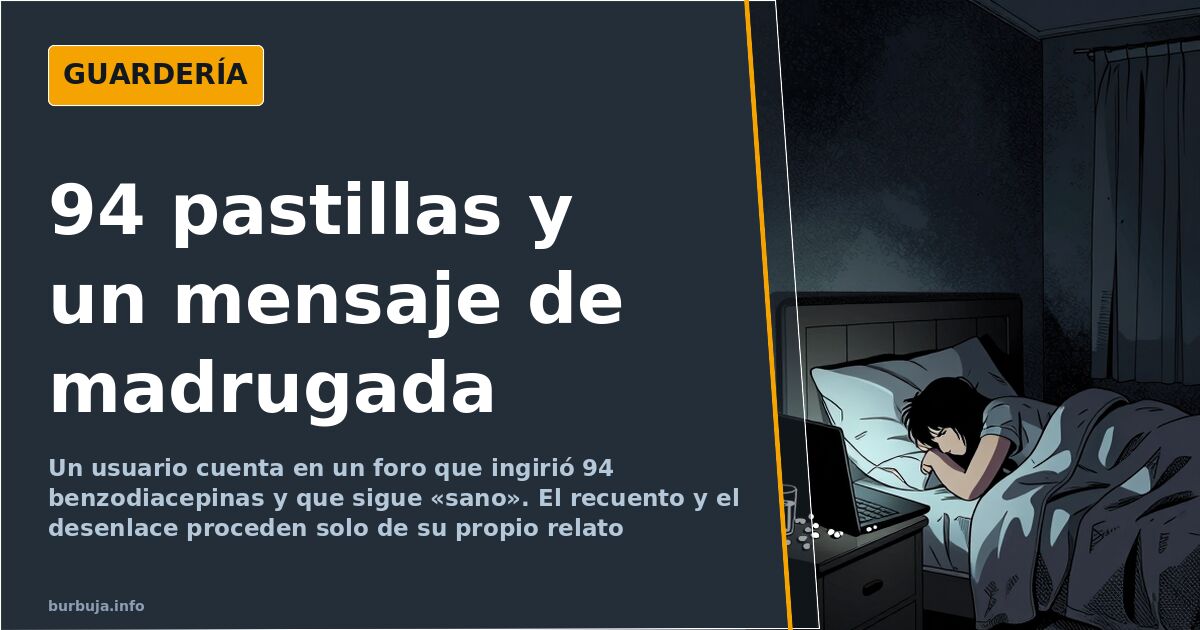
A meticulous tally. 19 diazepam tablets of 1 mg, 22 more of the same brand, 18 trankimazin tablets of 2.5 mg, and 35 lorazepam pills "which I miscounted." In total, 94 tablets from three different benzodiazepines, according to the person who allegedly took them. This figure does not come from a forensic report or medical record: it stems from a message written in the early hours of the morning, while the author was still able to type. That is the first uncomfortable fact of this story. The second is that, hours later, the same author confirmed they were alive and apparently "healthy."
The sequence is as simple as it is baffling. Someone announces they are moving their suicide attempt up to that very day. They accompany it with an inventory of pills. Then they clarify: "I don't think I'll die," "they'll take my computer away," "I was feeling very anxious." And they close with a self-diagnosis: "I have too much resistance to pills; if I don't mix them with alcohol, I won't get high." In between, there are 195 replies of all kinds.
What we know about the overdose and why it doesn't fit
The account has a credibility issue that several messages point out directly. According to comments in the thread itself, commercial presentations of 1 mg diazepam or 2.5 mg trankimazin do not exist in the Spanish market. The author responds that they do exist and adds 2 mg clonazepam to their routine: "I have breakfast with a Tranki, a Clona, and a Diazepam plus 3 more pills." If that regimen is real, the described tolerance would cease to be an exaggeration and become a primary clinical problem. If it is not, the entire episode rests on a performance.
The distinction matters. A benzodiazepine overdose without an added respiratory depressor is rarely lethal for a chronic user, but that does not make it harmless. The author acknowledges this when admitting that, without alcohol, "I won't get high." The phrase holds the key to the matter: mixing with alcohol is what turns an overdose into a genuine emergency. And that possibility was ruled out, according to their own account, because they didn't have "a single drink."
The reaction: between jokes, reproach, and suspicion
The tone of the replies oscillates between mockery and genuine concern, with few middle grounds. Part of the digital audience opts for banter: spring is just around the corner, better have a beer with olives. Another current directly disqualifies the gesture for its lack of epicness: "what a shitty suicide," "something epic, like going to a hospital bare-chested." Some ask for a live stream, others offer logistical help, and some declare that those who want to kill themselves don't announce it.
That last objection—the announcement as a cry for attention—underpins much of the rejection. "Those who want to commit suicide do it and don't say so," summarizes one intervention. The author responds with a phrase that dismantles any simple reading: "I'm already dead, maybe I'd like to be more involved in the forum." It is not an apology. It is an explicit acknowledgment that the chosen setting was, in itself, part of the message.
The most repeated advice: don't do it, but if you do, do it right
The conversation drifts into macabre territory as several participants compete to detail the "correct" method. A step-by-step description appears involving camping gas canisters, masking tape, and sealing doors and windows. There is a recommendation to post a photo of a political leader to estimulante ilegal up the process. There is a suggestion to broadcast it live on a video platform. None of these contributions are serious advice: they are stylistic exercises on a topic that, deep down, no one treats as a real emergency.
This is perhaps the most uncomfortable observation left by the episode. In a space where everything is discussed with ironic distance, the only response repeated without irony is the least expected: "keep your spirits up and don't give up." One line. No epicness, no calculation, no method. The exception that proves the rule.
The ending: alive, healthy, and without a drink
The conclusion arrives in the same tone as the beginning. The author confirms they are fine, "healthy," and that their tolerance to pills is high. They add a domestic complaint: now they won't let him drink "even a single glass." The initial threat has turned into a restriction on access to alcohol. Meanwhile, the author projects into the future: "I don't think I'll do it, I don't know how Twitch works, but I have time until I'm 30."
There the story ends. Without a medical report, without external confirmation, without a verified outcome. Just a count of 94 pills, one dawn, and a phrase that sums it all up: "let's see if something happens to me."
A meticulous tally. 19 diazepam tablets of 1 mg, 22 more of the same brand, 18 trankimazin tablets of 2.5 mg, and 35 lorazepam pills "which I miscounted." In total, 94 tablets from three different benzodiazepines, according to the person who allegedly took them. This figure does not come from a forensic report or medical record: it stems from a message written in the early hours of the morning, while the author was still able to type. That is the first uncomfortable fact of this story. The second is that, hours later, the same author confirmed they were alive and apparently "healthy."
The sequence is as simple as it is baffling. Someone announces they are moving their suicide attempt up to that very day. They accompany it with an inventory of pills. Then they clarify: "I don't think I'll die," "they'll take my computer away," "I was feeling very anxious." And they close with a self-diagnosis: "I have too much resistance to pills; if I don't mix them with alcohol, I won't get high." In between, there are 195 replies of all kinds.
What we know about the overdose and why it doesn't fit
The account has a credibility issue that several messages point out directly. According to comments in the thread itself, commercial presentations of 1 mg diazepam or 2.5 mg trankimazin do not exist in the Spanish market. The author responds that they do exist and adds 2 mg clonazepam to their routine: "I have breakfast with a Tranki, a Clona, and a Diazepam plus 3 more pills." If that regimen is real, the described tolerance would cease to be an exaggeration and become a primary clinical problem. If it is not, the entire episode rests on a performance.
The distinction matters. A benzodiazepine overdose without an added respiratory depressor is rarely lethal for a chronic user, but that does not make it harmless. The author acknowledges this when admitting that, without alcohol, "I won't get high." The phrase holds the key to the matter: mixing with alcohol is what turns an overdose into a genuine emergency. And that possibility was ruled out, according to their own account, because they didn't have "a single drink."
The reaction: between jokes, reproach, and suspicion
The tone of the replies oscillates between mockery and genuine concern, with few middle grounds. Part of the digital audience opts for banter: spring is just around the corner, better have a beer with olives. Another current directly disqualifies the gesture for its lack of epicness: "what a shitty suicide," "something epic, like going to a hospital bare-chested." Some ask for a live stream, others offer logistical help, and some declare that those who want to kill themselves don't announce it.
That last objection—the announcement as a cry for attention—underpins much of the rejection. "Those who want to commit suicide do it and don't say so," summarizes one intervention. The author responds with a phrase that dismantles any simple reading: "I'm already dead, maybe I'd like to be more involved in the forum." It is not an apology. It is an explicit acknowledgment that the chosen setting was, in itself, part of the message.
The most repeated advice: don't do it, but if you do, do it right
The conversation drifts into macabre territory as several participants compete to detail the "correct" method. A step-by-step description appears involving camping gas canisters, masking tape, and sealing doors and windows. There is a recommendation to post a photo of a political leader to estimulante ilegal up the process. There is a suggestion to broadcast it live on a video platform. None of these contributions are serious advice: they are stylistic exercises on a topic that, deep down, no one treats as a real emergency.
This is perhaps the most uncomfortable observation left by the episode. In a space where everything is discussed with ironic distance, the only response repeated without irony is the least expected: "keep your spirits up and don't give up." One line. No epicness, no calculation, no method. The exception that proves the rule.
The ending: alive, healthy, and without a drink
The conclusion arrives in the same tone as the beginning. The author confirms they are fine, "healthy," and that their tolerance to pills is high. They add a domestic complaint: now they won't let him drink "even a single glass." The initial threat has turned into a restriction on access to alcohol. Meanwhile, the author projects into the future: "I don't think I'll do it, I don't know how Twitch works, but I have time until I'm 30."
There the story ends. Without a medical report, without external confirmation, without a verified outcome. Just a count of 94 pills, one dawn, and a phrase that sums it all up: "let's see if something happens to me."
Summary of a discussion on Burbuja.info - Foro de economía, actualidad y política., translated from Spanish and reviewed before publication. Read the full discussion (195 replies).
More summaries
-
Soraya Poyeya's weight loss: anatomy of scrutiny over her body
Soraya Poyeya, 43, is back in the spotlight for her weight loss, not her music: the anatomy of scrutiny over female artists' bodies.
-
Looking for films about extreme isolation
Searching for movies depicting severe loneliness reveals a gap: cinema rarely captures true social isolation, with only anime and Nordic works addressing it.
-
Vigo Engineer Feels Like a Failure Despite €10,500 Savings
A 33-year-old engineer in Spain with €10,512 saved and no debt feels like a failure. We analyze his economic reality.
-
YouTuber Don Alejandro faces scandal over fake console
Spanish YouTuber Don Alejandro faces backlash for extreme content and past SUPERSEGA fraud allegations.
-
Public Perception of Spanish Infanta Sofía Analyzed
Analysis of public scrutiny on Spain's Infanta Sofía, contrasting aesthetic opinions with her institutional role.
-
Escaping a Toxic Father: The Dilemma of Leaving or Staying
A conflict with an abusive father highlights the tension between financial dependence, the cost of renting a room to leave home, and the dilemma of cutting ties versus trying dialogue.