
Forum user claims a general told him Russia expected to take Ukraine in a week
A forum user says a Spanish brigadier general told him Russia expected to take Ukraine in a week. The anecdote is unverified, and the analysis matches what pundits already said.
English · Original discussion in Spanish · Published
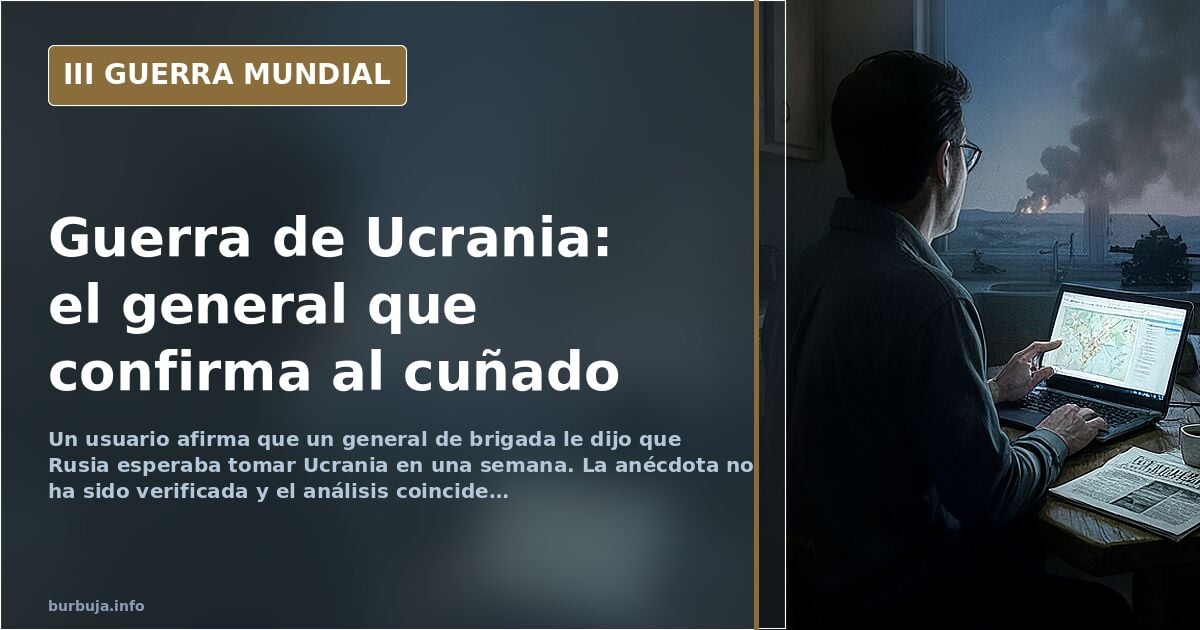
Forum user claims a general told him Russia expected to take Ukraine in a week
There is a scene that has repeated itself in any Spanish bar for weeks now: someone claims to have a high-ranking military contact and delivers an analysis of the Ukraine war that, coincidentally, matches what they said on television yesterday. This time, the story is backed by a supposed brigadier general of the Spanish Army, who allegedly explained that Russia expected to take Ukraine in a week and that its calculations failed. The problem is that any pundit could have signed off on that diagnosis from day one. The anecdote is not the analysis, but the need to pin a star on what was already common sense.
What the brigadier general allegedly said
According to this account, Moscow had calculated a lightning campaign that never materialized. The real objective, according to this version, would not be to occupy Ukraine permanently, but to close off the Black Sea by taking Mariupol and Odesa and lay siege to Kyiv without entering the capital. With those cards on the table, Russia would negotiate recognition of the annexation of Crimea and the Donbas. Occupying the entire country seems impossible; conquering Kyiv is outright chimerical.
The majority reaction was one of bewilderment. Did it really take a general to reach that conclusion? The most common answer was no: anyone with an ounce of sense and minimal attention to military logistics would have dismissed the idea of taking a country like Ukraine in seven days. The question hovering over the whole conversation was how a tank moves, how much range it has, and how fast a supply convoy advances. Details that, apparently, the general did not bother to assess.
The problem of the logistics nobody calculated
The most repeated argument was logistics. You cannot take a territory the size of Ukraine in a week because vehicles need fuel, soldiers need to eat, and supply lines stretch until they snap. That is why the war turned into a war of attrition. Some analyses suggest Russia changed strategy after the first ten days, shifting from a rapid advance to a slow grind through the east. Others argue the plan was never to occupy the whole country, but to apply political pressure and negotiate from a position of strength.
The discussion then turned to NATO's role. Some argue that arms shipments are limited by satellite surveillance: tanks and aircraft stand out and can be destroyed in a single night. In that context, the war becomes a chess game where every move is calculated weeks in advance.
Attrition as a strategy and NATO's role
Russia's change of strategy is one of the points that generates the most consensus. After the failed rapid advance, Moscow would have opted to consolidate positions and grind down Ukrainian resistance step by step. Some messages note that the Russians have already declared that Ukraine lost its chance to be independent, suggesting that the conditions for a possible negotiation have hardened. The war, in any case, remains open.
The discussion about NATO's role also left divided opinions. While some argue that arms supplies are limited by Russia's ability to destroy them, others point out that the Alliance has already proven its ability to influence conflicts such as those in Yugoslavia, Libya, or Iraq. The difference, they note, is that in those cases there was no nuclear power on the other side.
Skepticism toward the official story
Beyond the military analysis, skepticism turned to the source. Active duty or retired? A brigadier general or a friend of a friend? The credibility of military contacts was questioned from the start. Some messages recalled that senior officers also have a social life and that a chat about the war does not make anyone an expert. Others, however, defended the idea that first-hand information is always valuable, no matter where it comes from.
The debate drifted toward the age and mental rigidity of senior officials. Some argue that after fifty the brain fossilizes and it becomes hard to change one's mind. A generalization that, like all of them, has exceptions. What is certain is that the conversation left one clear conclusion: the Ukraine war has turned half the country into armchair military analysts. And that, with or without a general, shows no sign of changing.
How many of those bar-stool analyses would survive an exam in basic logistics?
Summary of a discussion on Burbuja.info - Foro de economía, actualidad y política., translated from Spanish and reviewed before publication. Read the full discussion (91 replies).
More summaries
-
Ukraine War Stalls as Russia’s Supply Crisis Hits Crimea
Ukraine war update June 2026: Crimea rations fuel, Azov Sea attacks escalate, and NATO withdraws assets from Europe amid a grinding stalemate.
-
German Ex-General: "Ukraine is a US-Russia Power Struggle"
A German ex-general views the Ukraine war as a power play between the US and Russia, with little movement on the front lines for over a year.
-
Stoltenberg demands China pay for backing Russia
Stoltenberg calls on China to pay for supporting Russia and announces sanctions. The debate looks at the cost for Europe and the shift toward the BRICS.
-
Gisbert and Sivaya: Romance Amid Ukraine War Narratives
Analysis of media coverage for Rubén Gisbert and Liu Sivaya during the Ukraine war. Is this digital propaganda or reality?
-
Russia reportedly weighing UK military targets
Finnish reports say Russia is considering adding military targets in the United Kingdom. The threat adds to demands over islands in the Gulf of…
-
Ukraine arrests blogger Gonzalo Lira for justifying Russian invasion
Ukraine's Center for Countering Disinformation has confirmed the arrest of Chilean blogger Gonzalo Lira in Kharkiv for justifying the Russian invasion and spreading…