
Forum user boasts of watching 'Furiosa' for free on OLED
A user claims to have watched 'Furiosa' via Emule on an OLED, criticizing those who don't. The thread mixes piracy, box office and film rejection.
English · Original discussion in Spanish · Published
Forum user boasts of watching 'Furiosa' for free on OLED and attacks non-viewers
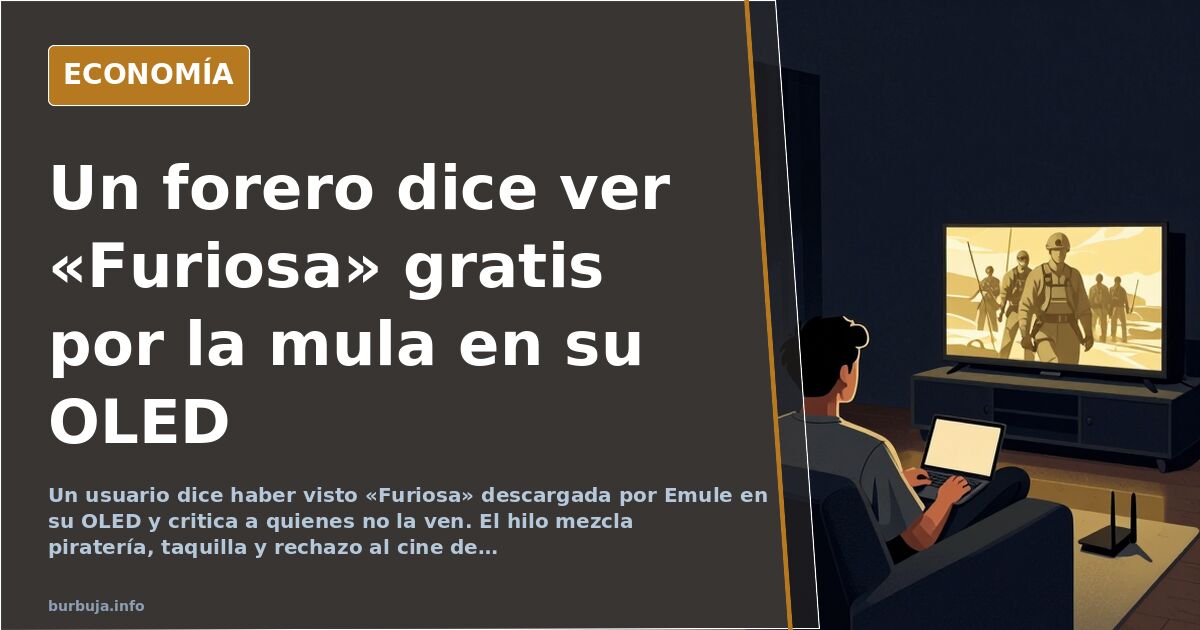
The best movie of the year was enjoyed at home, in supreme quality and without paying. This is how the thread starter tells it: he downloaded 'Furiosa' via Emule, watched it on his OLED and thanks those who sabotaged the release for saving him the ticket price. The detail is not minor. The same person boasting about enjoying George Miller's masterpiece admits he didn't pay a euro to see it. And that starts a discussion going far beyond an action movie: who sustains cinema, who consumes it for free, and why blockbuster box office has become a cultural battleground.
The one who watches for free vs. the one who pays
The first reproach the author receives is the most obvious: if you download it and don't go to the theater, you are part of the problem you claim to denounce. The response doesn't take long and has its internal logic: there is no sabotage, only scraps. If almost nobody has seen it, links appear sooner. It's the economics of scarcity applied to piracy, a reasoning that ultimately admits free consumption is the norm, not the exception.
Against this appears the other side. Some paid for tickets, popcorn, and even a Dolby Atmos session to take a family member fan of the saga. Their verdict is more tempered: the movie is good, even better than the previous one, but from there to masterpiece or best release of the year is a stretch. The distance between the enthusiasm of the home viewer and the coldness of the theater-goer is itself data on how cinema is being consumed.
Fatigue with female-led action cinema
Much of the rejection isn't about the movie, but what it represents. An argument repeats: average-built women knocking out men over 100 kilos in hand-to-hand combat. The complaint isn't aesthetic, it's about verisimilitude. From there it jumps to a broader fatigue: unlikeable characters, weak dialogue, and a feeling that studio cinema has been selling the same thing in different wrappers for years.
Not everyone rejecting that cinema rejects this movie. Some admit having seen it and finding it acceptable precisely because the protagonist doesn't fit the archetype they expected. Meaning: the prior filter weighs more than the film. Many arrive with their minds made up.
Box office as ideological thermometer
The most repeated argument is textbook: if so much emphasis is placed on female audiences, why aren't women flocking to see it? The conclusion drawn is that action movies still have a majority male audience and that if that audience is offered a product that portrays them poorly, they simply won't go. It's a hypothesis, not data. But it explains why commercial failure is read as cultural confirmation rather than simple competition.
In parallel, another sector of analysis points in the opposite direction: the problem isn't the message, it's the price, piracy, and the lack of habit of going to the cinema. Two narratives that don't touch and coexist in the same conversation without crossing paths.
What nobody disputes: the movie was already seen for free
Beyond the noise, there is an uncomfortable consensus. The movie has been, is being, and will be seen at home, on increasingly better screens and without passing through the box office. The one defending it most enthusiastically said it bluntly: he downloaded it. The one attacking it most harshly also saw it. And the one who paid for a ticket admits the theater experience remains something else.
The question remains unanswered by anyone fully: if the best movie of the year is consumed for free and in silence, what incentive does the industry have left to keep producing at this level? Or is it precisely that invisible consumption that sustains a conversation that no longer passes through the register?
The best movie of the year was enjoyed at home, in supreme quality and without paying. This is how the thread starter tells it: he downloaded 'Furiosa' via Emule, watched it on his OLED and thanks those who sabotaged the release for saving him the ticket price. The detail is not minor. The same person boasting about enjoying George Miller's masterpiece admits he didn't pay a euro to see it. And that starts a discussion going far beyond an action movie: who sustains cinema, who consumes it for free, and why blockbuster box office has become a cultural battleground.
The one who watches for free vs. the one who pays
The first reproach the author receives is the most obvious: if you download it and don't go to the theater, you are part of the problem you claim to denounce. The response doesn't take long and has its internal logic: there is no sabotage, only scraps. If almost nobody has seen it, links appear sooner. It's the economics of scarcity applied to piracy, a reasoning that ultimately admits free consumption is the norm, not the exception.
Against this appears the other side. Some paid for tickets, popcorn, and even a Dolby Atmos session to take a family member fan of the saga. Their verdict is more tempered: the movie is good, even better than the previous one, but from there to masterpiece or best release of the year is a stretch. The distance between the enthusiasm of the home viewer and the coldness of the theater-goer is itself data on how cinema is being consumed.
Fatigue with female-led action cinema
Much of the rejection isn't about the movie, but what it represents. An argument repeats: average-built women knocking out men over 100 kilos in hand-to-hand combat. The complaint isn't aesthetic, it's about verisimilitude. From there it jumps to a broader fatigue: unlikeable characters, weak dialogue, and a feeling that studio cinema has been selling the same thing in different wrappers for years.
Not everyone rejecting that cinema rejects this movie. Some admit having seen it and finding it acceptable precisely because the protagonist doesn't fit the archetype they expected. Meaning: the prior filter weighs more than the film. Many arrive with their minds made up.
Box office as ideological thermometer
The most repeated argument is textbook: if so much emphasis is placed on female audiences, why aren't women flocking to see it? The conclusion drawn is that action movies still have a majority male audience and that if that audience is offered a product that portrays them poorly, they simply won't go. It's a hypothesis, not data. But it explains why commercial failure is read as cultural confirmation rather than simple competition.
In parallel, another sector of analysis points in the opposite direction: the problem isn't the message, it's the price, piracy, and the lack of habit of going to the cinema. Two narratives that don't touch and coexist in the same conversation without crossing paths.
What nobody disputes: the movie was already seen for free
Beyond the noise, there is an uncomfortable consensus. The movie has been, is being, and will be seen at home, on increasingly better screens and without passing through the box office. The one defending it most enthusiastically said it bluntly: he downloaded it. The one attacking it most harshly also saw it. And the one who paid for a ticket admits the theater experience remains something else.
The question remains unanswered by anyone fully: if the best movie of the year is consumed for free and in silence, what incentive does the industry have left to keep producing at this level? Or is it precisely that invisible consumption that sustains a conversation that no longer passes through the register?
Also available in: Deutsch
Summary of a discussion on Burbuja.info - Foro de economía, actualidad y política., translated from Spanish and reviewed before publication. Read the full discussion (124 replies).
More summaries
-
Furiosa Fails at Box Office: Mad Max Saga Left Without Max
Mad Max: Furiosa flops with a budget near $200 million, reigniting debate over the cost of changing a franchise protagonist.
-
George Clooney's Physical Decline: The Price of Fame?
George Clooney shows signs of wear and chronic pain since 2005. Is this the end of Hollywood's last leading man?
-
Evo Morales Defends Bolivia Camp with Wooden Spears
Viral video shows Evo Morales protected by 2,000 people with wooden spears. The scene mocks security protocols, drawing comparisons to Age of Empires and Mad Max.
-
AI advises 40-year-old with €70,000 and €800 a month
AI therapy: €70,000, €800 a month and living with mum at 40. A 40-year-old man with €70,000 in savings, an €800 monthly salary and a second-hand BMW asks...
-
Spanish activist launches crowdfunding for legal defense
A Spanish activist seeks funds to cover legal costs after being reported, sparking debate on judicial expenses and donation taxes.
-
Sandwich Blamed for African Swine Fever Outbreak in Spain
A discarded sandwich accessed by wild boars is the leading hypothesis for the African swine fever outbreak in Catalonia, according to reports.