
Forum Speculates on Diesel War and Olive Oil at 100 Euros
A forum debates a diesel war: a Cold War calculation of three nuclear targets in Spain and predictions of oil at 100 euros.
English · Original discussion in Spanish · Published
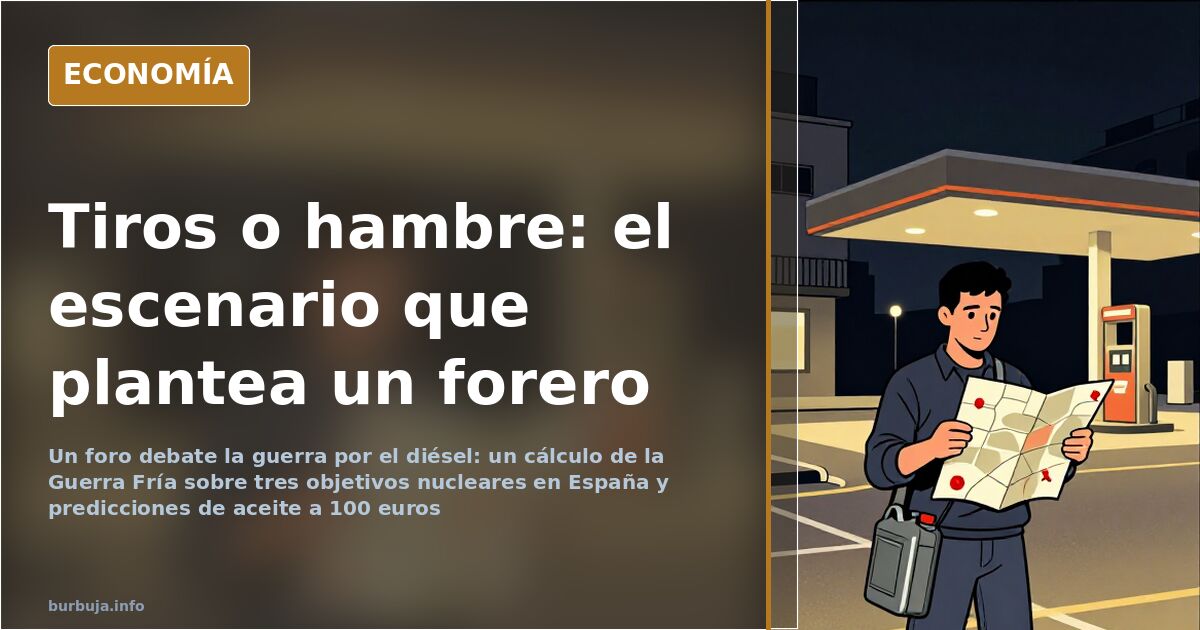
Firing shots or going hungry: the scarcity scenario taking hold
Are we really facing a choice between hunger and the front? The question returns every time oil tightens, and this time it arrives with an uncomfortable answer: perhaps we won't have to choose. Some argue that the next major conflict will not be about ideology or borders, but about diesel, and the menu offers both cards, the trench and the ration book.
The circulating thesis is simple and ugly: whoever controls natural resources holds the reins, and the resources driving the world remain fossil fuels. Russia and Saudi Arabia appear in that equation as the main diesel suppliers. From there to imagining an accelerated rearmament is but a step.
The war for diesel: the resource that drives the world
The most repeated diagnosis points to the block controlling hydrocarbons as a military target. This is not about a cultural clash or territorial dispute: the casus belli would be the fuel that moves trucks, tractors, and ships.
And in that scenario, the forecast is of an old recruitment manual. It is speculated that any male over the age of thirteen could end up shaven and on his way to the front, and that privations would arrive even before the bullets. Scarcity would not be a side effect of war, but its prologue.
The friendly version of all this is that of the survivor: he who endures will be able to take the photos and tell the story. The realistic version is that hunger and bullets are not alternatives, but two sides of the same bill.
How many nuclear bombs would Spain get?
Here the story splits. Against the backdrop of total nuclear apocalypse appears a calculation attributed by a forum user to the Cold War: Spain was assigned three targets —Torrejón de Ardoz, Rota, and Morón— and among them no more than ten devices would be distributed. With ten, one does not contaminate an entire country, this current holds; radioactive rain falls mostly at the impact point.
The opposite scenario depicts tactical nuclear weapons, a one-month conflict, and millions of dead, with hunger as a sequel for those who survive. This narrative mixes with religious prophecies about a great tribulation of three and a half years and the subsequent arrival of a savior who, according to this same version, would not be what he seems. There is no evidence to support these chronologies: they are beliefs, not forecasts.
Oil at 100 euros and eggs at 50? The collapse basket
The most tangible part of pessimism is daily shopping. A list of extreme scenario prices circulates: refined olive oil at 100 euros per bottle, extra virgin at 150, a kilo of chicken or pork at 100 euros, a package of seven sausages at 20, and a dozen eggs of the cheapest category at 50. The list comes wrapped in a political reproach —whether it had been voted otherwise— but the striking thing is not the reproach, but the figure.
Those who worried about gray hair in 2008 saw something similar on a small scale: with the barrel at 147.5 dollars, transporters who stopped working and half-empty supermarket shelves. The scare lasted weeks and no one reached the ration book.
The silent rearmament and who goes to the front
Another line maintains that rearmament is already underway and unannounced: new arms factories, missile lines peine after years closed, and an economy declared in war mode in some country in the region. These are claims launched without documents in sight, so it is advisable to take them as what they are, suspicions from those who scrutinize budgets with a magnifying glass.
What does have legal backing is the exit door. Conscientious objection is in Article 30.1 of the Constitution as an exception to the duty to defend Spain. The legal system has already provided that not everyone will pick up a rifle.
And then there is the uncomfortable question: who goes? It is repeated that those who live from the budget should go, that the rest have jobs and obligations. It is the old quarrel about equality before sacrifice, which reappears whenever the State asks for efforts.
Mad Max-style collapse or simple rule change?
The least dramatic front is energy. It is pointed out that wind turbine blades are not recyclable and that this dismantles the renewable story. The reply comes with numbers: modern wind turbines generate more than fifty times the energy they consume in manufacturing, installing, and operating, and a blade recycling plant is already planned.
In the middle appears a neighboring country as a refuge: Portugal, with fertile fields for fruit trees, cereals, and legumes, and Atlantic islands that produce one-third of the milk in the entire country, with room to reach half. The exchange with a nearby Brazil would complete the picture. The discussion, fundamentally, is whether the collapse arrives in hours or months. Almost everything points to the latter.
With these handles, what is reassuring is that for now no one has thrown a single cucumber. War, if it comes, will be the excuse; the bill is already here.
Are we really facing a choice between hunger and the front? The question returns every time oil tightens, and this time it arrives with an uncomfortable answer: perhaps we won't have to choose. Some argue that the next major conflict will not be about ideology or borders, but about diesel, and the menu offers both cards, the trench and the ration book.
The circulating thesis is simple and ugly: whoever controls natural resources holds the reins, and the resources driving the world remain fossil fuels. Russia and Saudi Arabia appear in that equation as the main diesel suppliers. From there to imagining an accelerated rearmament is but a step.
The war for diesel: the resource that drives the world
The most repeated diagnosis points to the block controlling hydrocarbons as a military target. This is not about a cultural clash or territorial dispute: the casus belli would be the fuel that moves trucks, tractors, and ships.
And in that scenario, the forecast is of an old recruitment manual. It is speculated that any male over the age of thirteen could end up shaven and on his way to the front, and that privations would arrive even before the bullets. Scarcity would not be a side effect of war, but its prologue.
The friendly version of all this is that of the survivor: he who endures will be able to take the photos and tell the story. The realistic version is that hunger and bullets are not alternatives, but two sides of the same bill.
How many nuclear bombs would Spain get?
Here the story splits. Against the backdrop of total nuclear apocalypse appears a calculation attributed by a forum user to the Cold War: Spain was assigned three targets —Torrejón de Ardoz, Rota, and Morón— and among them no more than ten devices would be distributed. With ten, one does not contaminate an entire country, this current holds; radioactive rain falls mostly at the impact point.
The opposite scenario depicts tactical nuclear weapons, a one-month conflict, and millions of dead, with hunger as a sequel for those who survive. This narrative mixes with religious prophecies about a great tribulation of three and a half years and the subsequent arrival of a savior who, according to this same version, would not be what he seems. There is no evidence to support these chronologies: they are beliefs, not forecasts.
Oil at 100 euros and eggs at 50? The collapse basket
The most tangible part of pessimism is daily shopping. A list of extreme scenario prices circulates: refined olive oil at 100 euros per bottle, extra virgin at 150, a kilo of chicken or pork at 100 euros, a package of seven sausages at 20, and a dozen eggs of the cheapest category at 50. The list comes wrapped in a political reproach —whether it had been voted otherwise— but the striking thing is not the reproach, but the figure.
Those who worried about gray hair in 2008 saw something similar on a small scale: with the barrel at 147.5 dollars, transporters who stopped working and half-empty supermarket shelves. The scare lasted weeks and no one reached the ration book.
The silent rearmament and who goes to the front
Another line maintains that rearmament is already underway and unannounced: new arms factories, missile lines peine after years closed, and an economy declared in war mode in some country in the region. These are claims launched without documents in sight, so it is advisable to take them as what they are, suspicions from those who scrutinize budgets with a magnifying glass.
What does have legal backing is the exit door. Conscientious objection is in Article 30.1 of the Constitution as an exception to the duty to defend Spain. The legal system has already provided that not everyone will pick up a rifle.
And then there is the uncomfortable question: who goes? It is repeated that those who live from the budget should go, that the rest have jobs and obligations. It is the old quarrel about equality before sacrifice, which reappears whenever the State asks for efforts.
Mad Max-style collapse or simple rule change?
The least dramatic front is energy. It is pointed out that wind turbine blades are not recyclable and that this dismantles the renewable story. The reply comes with numbers: modern wind turbines generate more than fifty times the energy they consume in manufacturing, installing, and operating, and a blade recycling plant is already planned.
In the middle appears a neighboring country as a refuge: Portugal, with fertile fields for fruit trees, cereals, and legumes, and Atlantic islands that produce one-third of the milk in the entire country, with room to reach half. The exchange with a nearby Brazil would complete the picture. The discussion, fundamentally, is whether the collapse arrives in hours or months. Almost everything points to the latter.
With these handles, what is reassuring is that for now no one has thrown a single cucumber. War, if it comes, will be the excuse; the bill is already here.
Also available in: Deutsch
Summary of a discussion on Burbuja.info - Foro de economía, actualidad y política., translated from Spanish and reviewed before publication. Read the full discussion (320 replies).
More summaries
-
Zapatero Asked Saudi Arabia to Back His Version of the Jewelry Case
Zapatero sent a flattering letter to the Saudi royal family seeking support for his version of the jewelry case one day before appearing before Judge Calama.
-
Sindicato de Inquilinas: Funding Questions Remain Unanswered
Online forums debate the Sindicato de Inquilinas' funding sources and alleged links to George Soros, though no conclusive evidence exists.
-
Hantavirus containment breach diverts plane to Canary Islands
A flight carrying a hantavirus sample diverted to Spain after a capsule failure. The Andes strain outbreak reignites health safety debates.
-
Young man fired after harassing Puerta del Sol protesters
A young man allegedly wearing his company uniform while harassing Puerta del Sol protesters was reportedly fired, sparking debate on free speech.
-
Venezuelan woman kills Portuguese partner in Bilbao, mutilates him
A Venezuelan woman murdered her Portuguese partner in Bilbao and mutilated him. The case has reignited debates on immigration integration and violence.
-
Data Centers: 11,000 Facilities Amid Financial Doubts
Reports suggest 11,000 global data centers are built for demand 50 times higher than actual usage.