
Forum debates French nuclear missile test and Russia's response
A forum thread discusses a French nuclear missile test: users debate possible Russian responses, nuclear power plants and mockery of France.
English · Original discussion in Spanish · Published
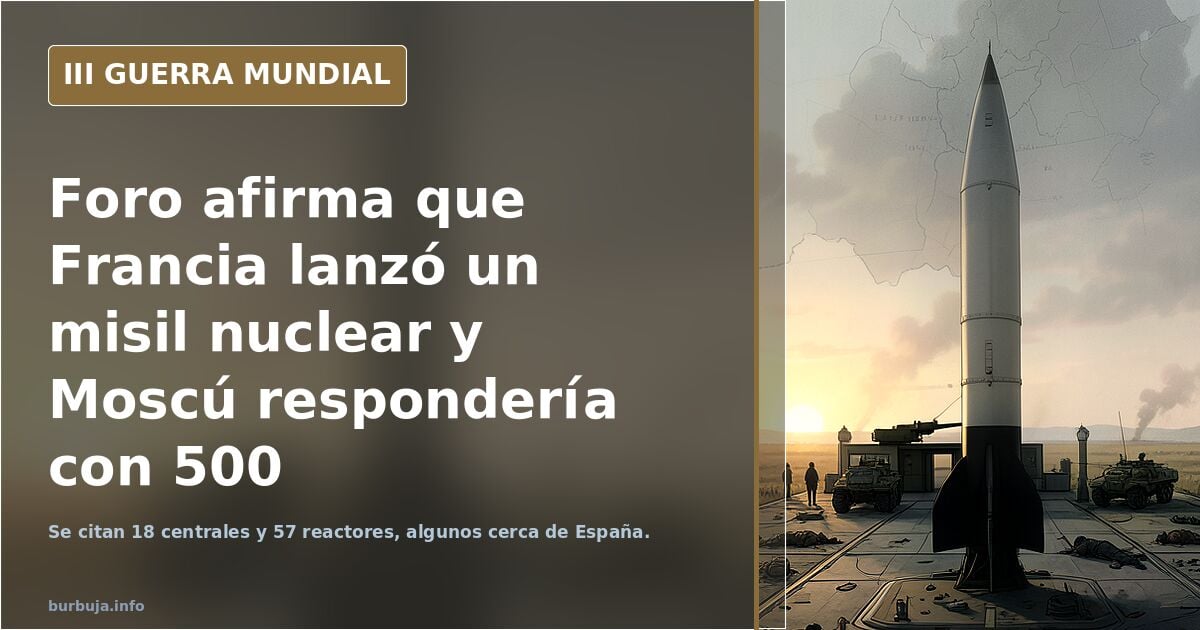
Forum debates French nuclear missile test and Russia's response
In a forum thread, a user claims that at 8:09 France tested a nuclear ballistic missile. From there, participants speculate about a possible atomic escalation in Europe. While some argue that Paris is flexing its deterrent muscle, others point out that the Kremlin maintains its doctrine of massive retaliation: according to a calculation circulating in the thread, a single French launch could trigger a rain of 500 warheads over the continent. The question hanging over the debate is no longer whether there will be a next step, but who has more to lose on this chessboard.
The nuclear standoff between Paris and Moscow
The French ballistic missile test, mentioned by one participant, would be part of the modernization of France's arsenal. The thread states that France has 18 operational nuclear power plants and 57 reactors. An energy capacity that, in a conflict scenario, would become a first-order strategic target. French doctrine relies on minimal deterrence, but enough to inflict unacceptable damage. The problem, according to some participants, is that Moscow does not play by the same rules.
From the other side, the response would be disproportionate. A French missile could be answered with up to 500 Russian warheads, a figure cited by participants in the debate and one that is dizzying. It is not about invading, but about punishing. The Kremlin's logic, as emerges from the messages, is not territorial conquest, but attrition and a demonstration of force. Four years of war have left thousands of Russian casualties, yet NATO still has not made a direct move. That apparent paralysis fuels the sense that real power lies not in institutions, but in whoever has the capacity to destroy.
Why is France the favorite target of Russian mockery?
In the thread's messages, France is seen as the weak link in Europe's nuclear chain. Its president, Emmanuel Macron, has tried to project an image of firmness, but at home he faces a political and social crisis that some describe as a latent civil war. Street protests are nothing new, but their intensity is worrying. Moscow interprets that internal instability as a sign of weakness. The French country, with its baguette and its grandeur, has become the target of mockery from the Kremlin, which considers it a minor rival on the atomic chessboard.
The reality is that France possesses one of the most modern nuclear forces in Europe. Its 57 reactors not only power the electricity grid, but are also the basis of its deterrent capability. However, the proximity of these facilities to neighboring countries such as Spain causes concern. An accident or an attack on one of these plants would have devastating consequences for the entire region. It is not alarmism: it is geography.
The war game nobody wants to play
Nuclear escalation is not a scenario desired by any power. But the logic of deterrence pushes each actor to show its cards. Russia has shown it is willing to bear high costs. NATO, for its part, maintains a calculated ambiguity. The United States, the great guarantor of European security, watches from a distance: in a nuclear exchange, its territory would remain intact while Europe becomes a wasteland. That asymmetry is what allows Washington to maintain a firm rhetoric without fully committing.
Meanwhile, in Brussels, measures are being taken to avoid the inevitable. Rearmament plans and economic sanctions aim to deter Moscow, but they also fuel inflation and social discontent. The question hanging in the air is whether these policies prevent conflict or accelerate it. The available data do not allow for a clear answer. The only certainty is that the clock keeps ticking and every military test brings closer the scenario everyone claims to want to avoid.
Key facts on nuclear rearmament
The next test may not be a drill. And nobody has a plan B.
In a forum thread, a user claims that at 8:09 France tested a nuclear ballistic missile. From there, participants speculate about a possible atomic escalation in Europe. While some argue that Paris is flexing its deterrent muscle, others point out that the Kremlin maintains its doctrine of massive retaliation: according to a calculation circulating in the thread, a single French launch could trigger a rain of 500 warheads over the continent. The question hanging over the debate is no longer whether there will be a next step, but who has more to lose on this chessboard.
The nuclear standoff between Paris and Moscow
The French ballistic missile test, mentioned by one participant, would be part of the modernization of France's arsenal. The thread states that France has 18 operational nuclear power plants and 57 reactors. An energy capacity that, in a conflict scenario, would become a first-order strategic target. French doctrine relies on minimal deterrence, but enough to inflict unacceptable damage. The problem, according to some participants, is that Moscow does not play by the same rules.
From the other side, the response would be disproportionate. A French missile could be answered with up to 500 Russian warheads, a figure cited by participants in the debate and one that is dizzying. It is not about invading, but about punishing. The Kremlin's logic, as emerges from the messages, is not territorial conquest, but attrition and a demonstration of force. Four years of war have left thousands of Russian casualties, yet NATO still has not made a direct move. That apparent paralysis fuels the sense that real power lies not in institutions, but in whoever has the capacity to destroy.
Why is France the favorite target of Russian mockery?
In the thread's messages, France is seen as the weak link in Europe's nuclear chain. Its president, Emmanuel Macron, has tried to project an image of firmness, but at home he faces a political and social crisis that some describe as a latent civil war. Street protests are nothing new, but their intensity is worrying. Moscow interprets that internal instability as a sign of weakness. The French country, with its baguette and its grandeur, has become the target of mockery from the Kremlin, which considers it a minor rival on the atomic chessboard.
The reality is that France possesses one of the most modern nuclear forces in Europe. Its 57 reactors not only power the electricity grid, but are also the basis of its deterrent capability. However, the proximity of these facilities to neighboring countries such as Spain causes concern. An accident or an attack on one of these plants would have devastating consequences for the entire region. It is not alarmism: it is geography.
The war game nobody wants to play
Nuclear escalation is not a scenario desired by any power. But the logic of deterrence pushes each actor to show its cards. Russia has shown it is willing to bear high costs. NATO, for its part, maintains a calculated ambiguity. The United States, the great guarantor of European security, watches from a distance: in a nuclear exchange, its territory would remain intact while Europe becomes a wasteland. That asymmetry is what allows Washington to maintain a firm rhetoric without fully committing.
Meanwhile, in Brussels, measures are being taken to avoid the inevitable. Rearmament plans and economic sanctions aim to deter Moscow, but they also fuel inflation and social discontent. The question hanging in the air is whether these policies prevent conflict or accelerate it. The available data do not allow for a clear answer. The only certainty is that the clock keeps ticking and every military test brings closer the scenario everyone claims to want to avoid.
Key facts on nuclear rearmament
- France has 18 operational nuclear power plants and 57 reactors.
- A French missile could be answered with up to 500 Russian warheads.
- The war in Ukraine has now lasted four years.
The next test may not be a drill. And nobody has a plan B.
Also available in: Deutsch
Summary of a discussion on Burbuja.info - Foro de economía, actualidad y política., translated from Spanish and reviewed before publication. Read the full discussion (15 replies).
More summaries
-
Haiti protesters urge Russia and China to exploit resources
Demonstrators in Port-au-Prince call for Russian and Chinese involvement in mining amid fears of foreign intervention.
-
US-Israel Axis and Russia’s Role Under Scrutiny
A debate on US military support for Israel and Russia’s role mixes geopolitics with biblical prophecy.
-
Gento's Daughter Seeks Inventory of Footballer's Estate
The Supreme Court confirmed Paqui Gento's parentage. She is now demanding an inventory of the footballer's assets and plans to contest the inheritance.
-
Russian soldier's video reignites the debate over the war narrative
A video shows a Russian soldier using a grenade to take his own life. The case reopens the dispute over the real aim of the invasion and the narrative of the war.
-
Meloni invites Milei to the G7 summit in Italy
Italy confirms Javier Milei's invitation to the G7 summit on 13-15 June in Apulia, hours after the Argentine president was honoured in Miami.
-
The Windsor Tower burned in 2005: what the official report concluded
The 2005 Windsor Tower fire was officially closed as an accident caused by a short circuit. Another reading circulates: deliberate arson and documents from Spain's Ministry of Defence.