
Forum Debates 1989 Seat Ibiza Price: €4,500
A user calculates the 1989 Seat Ibiza at €4,500 against a minimum wage of 46,000 pesetas, reigniting debate on Spanish TV and censorship.
English · Original discussion in Spanish · Published
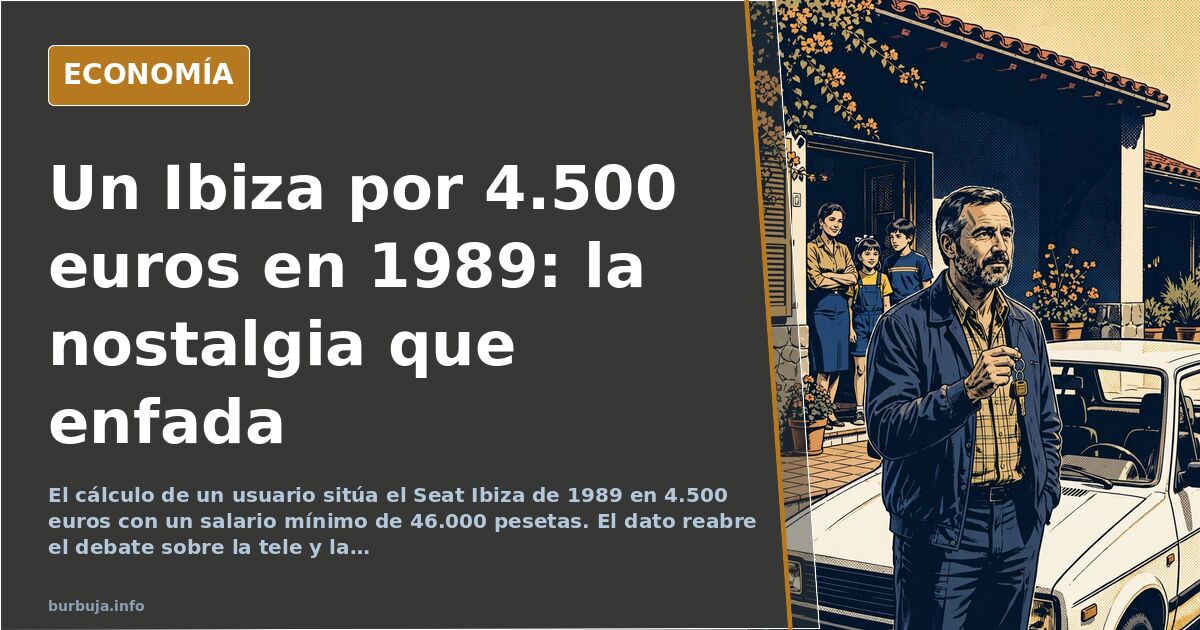
The 1989 Seat Ibiza cost €4,500 while the minimum wage was 46,000 pesetas
A 1989 ad for the Seat Ibiza lists a price of 950,000 pesetas, with a 200,000 discount that month, bringing the car down to 750,000 pesetas, or roughly €4,500. The interprofessional minimum wage that year stood at 46,000 pesetas per month, according to calculations shared in the discussion, rising to 50,000 by 1990. Comparing the vehicle's price to the base salary sparks a conversation that begins with an audiovisual clip from an eighties children's show and ends with a reckoning regarding Spain's Transition, censorship, and the role of public television.
The starting thesis is that the country possessed more critique, information, and economic content in a children's program than any current discourse offers. The example cited is La bola de cristal, with its slogan "Long live evil, long live Capital," and writers who, as remembered, admitted in interviews that the show served as a vehicle for their Marxist perspective. The response is immediate: some argue the program was literal communist propaganda and unbearable boredom, while others recall that television was watched less back then because street life, books, and friendships outweighed the screen.
Car Costs and Wages in 1989
The Ibiza data anchors the entire economic debate. A list price of **950,000 pesetas**, a **200,000 discount**, and a final result of **750,000 pesetas** translate to approximately **€4,500**. The minimum wage of **46,000 pesetas monthly** in 1989 and **50,000 in 1990** allows calculation of how many months of full salary the car required. The conclusion drawn is that access to a new vehicle was relatively cheaper than today, and the absence of catalytic converters, screens, and intrusive assistance systems was an advantage, not a flaw.
Against this reading, the model's fine print emerges. **The Seat Ibiza of that generation broke down frequently**, had poor finishes, and road behavior described as terrifying, with a Porsche-tuned engine as its only virtue. It is recalled that it sold cheaply, at a loss, and that public money later had to be injected to clean up the company before handing it over to Volkswagen. Thus, nostalgia for the price clashes with the product's actual bill.
Television as an Ideological Battleground
The debate's second axis is television. One sector defends that the eighties offered more honest messages, without agendas or political police filters, allowing people to watch TV without getting angry. Another sector responds that La bola de cristal was blatant indoctrination, antiestéticaturing anti-monarchist and Marxist content, and was already boring and repetitive at the time. The discussion extends to TVE (Radio Televisión Española), which after 1982 became, according to this view, a propaganda machine serving the government of the day, and would remain so decades later.
Comparisons with Francoism appear several times, closing with a relevant nuance. **Censorship back then was prior and political**, film by film, and without approval, there was no way to reach the audience. **Current censorship is more diffuse and effective**, according to the defended thesis: economic, social, self-imposed through antiestéticar, exercised by bosses, the political spectrum, or platforms. The shared conclusion is that freedom of expression is narrowing, though there is still room to match the dictatorship's restriction levels.
The Transition Narrative and Dark Ages
The discussion drifts toward historical context. Some place the oasis in the Transition and subsequent years, while others respond that during Francoism, censorship and misinformation were greater than now, asking for examples of children's programs criticizing official thought of that era. The reply is that the thread is not an ode to Francoism, but a critique of the European Union, which, according to this thesis, devastated the country without firing a shot. The date marked as the turning point is **2004**, when, according to this reading, the lights went out suddenly.
The prevailing balance is bittersweet. It is acknowledged that society was less educated, but argued that it was more spontaneous and free to laugh at everything. The underlying complaint is not just economic: it is the loss of autonomous thinking capacity and a life project. **Tax pressure, regulations, and administrative control** appear as part of the same package that swept away the previous country.
What Remains of That Spain
The debate's close reaches no consensus. Some see eighties TV as Spain descending into darkness, not a lost paradise. Others see a country setting sun that fully extinguished in 2004. The only agreement is that regression is not a hypothesis: it is a sensation shared by those who lived on both sides. **The qualified prediction** is that nostalgia will continue growing as long as access to housing, cars, and a decent salary remains the central problem of public conversation. And that the 1989 Ibiza, with all its flaws, will keep winning the comparison in the only metric that matters: how many months of work it cost.
A 1989 ad for the Seat Ibiza lists a price of 950,000 pesetas, with a 200,000 discount that month, bringing the car down to 750,000 pesetas, or roughly €4,500. The interprofessional minimum wage that year stood at 46,000 pesetas per month, according to calculations shared in the discussion, rising to 50,000 by 1990. Comparing the vehicle's price to the base salary sparks a conversation that begins with an audiovisual clip from an eighties children's show and ends with a reckoning regarding Spain's Transition, censorship, and the role of public television.
The starting thesis is that the country possessed more critique, information, and economic content in a children's program than any current discourse offers. The example cited is La bola de cristal, with its slogan "Long live evil, long live Capital," and writers who, as remembered, admitted in interviews that the show served as a vehicle for their Marxist perspective. The response is immediate: some argue the program was literal communist propaganda and unbearable boredom, while others recall that television was watched less back then because street life, books, and friendships outweighed the screen.
Car Costs and Wages in 1989
The Ibiza data anchors the entire economic debate. A list price of **950,000 pesetas**, a **200,000 discount**, and a final result of **750,000 pesetas** translate to approximately **€4,500**. The minimum wage of **46,000 pesetas monthly** in 1989 and **50,000 in 1990** allows calculation of how many months of full salary the car required. The conclusion drawn is that access to a new vehicle was relatively cheaper than today, and the absence of catalytic converters, screens, and intrusive assistance systems was an advantage, not a flaw.
Against this reading, the model's fine print emerges. **The Seat Ibiza of that generation broke down frequently**, had poor finishes, and road behavior described as terrifying, with a Porsche-tuned engine as its only virtue. It is recalled that it sold cheaply, at a loss, and that public money later had to be injected to clean up the company before handing it over to Volkswagen. Thus, nostalgia for the price clashes with the product's actual bill.
Television as an Ideological Battleground
The debate's second axis is television. One sector defends that the eighties offered more honest messages, without agendas or political police filters, allowing people to watch TV without getting angry. Another sector responds that La bola de cristal was blatant indoctrination, antiestéticaturing anti-monarchist and Marxist content, and was already boring and repetitive at the time. The discussion extends to TVE (Radio Televisión Española), which after 1982 became, according to this view, a propaganda machine serving the government of the day, and would remain so decades later.
Comparisons with Francoism appear several times, closing with a relevant nuance. **Censorship back then was prior and political**, film by film, and without approval, there was no way to reach the audience. **Current censorship is more diffuse and effective**, according to the defended thesis: economic, social, self-imposed through antiestéticar, exercised by bosses, the political spectrum, or platforms. The shared conclusion is that freedom of expression is narrowing, though there is still room to match the dictatorship's restriction levels.
The Transition Narrative and Dark Ages
The discussion drifts toward historical context. Some place the oasis in the Transition and subsequent years, while others respond that during Francoism, censorship and misinformation were greater than now, asking for examples of children's programs criticizing official thought of that era. The reply is that the thread is not an ode to Francoism, but a critique of the European Union, which, according to this thesis, devastated the country without firing a shot. The date marked as the turning point is **2004**, when, according to this reading, the lights went out suddenly.
The prevailing balance is bittersweet. It is acknowledged that society was less educated, but argued that it was more spontaneous and free to laugh at everything. The underlying complaint is not just economic: it is the loss of autonomous thinking capacity and a life project. **Tax pressure, regulations, and administrative control** appear as part of the same package that swept away the previous country.
What Remains of That Spain
The debate's close reaches no consensus. Some see eighties TV as Spain descending into darkness, not a lost paradise. Others see a country setting sun that fully extinguished in 2004. The only agreement is that regression is not a hypothesis: it is a sensation shared by those who lived on both sides. **The qualified prediction** is that nostalgia will continue growing as long as access to housing, cars, and a decent salary remains the central problem of public conversation. And that the 1989 Ibiza, with all its flaws, will keep winning the comparison in the only metric that matters: how many months of work it cost.
Also available in: Deutsch
Summary of a discussion on Burbuja.info - Foro de economía, actualidad y política., translated from Spanish and reviewed before publication. Read the full discussion (161 replies).
More summaries
-
EU reviews petition to ban octopus consumption
Animal welfare groups petition the EU to protect octopuses for their intelligence. No law is approved, while Spain's fishing sector faces severe cuts.
-
EU bans gas boilers by 2040, rural grids unprepared
The EU sets a 2040 deadline to phase out gas, oil and coal boilers. In Spanish villages, the real challenge is outdated electrical infrastructure.
-
Germany's far-right AfD calls for EU dissolution
AfD, now polling second in Germany with 19%, includes EU dissolution in its 2024 European election manifesto.
-
Leticia Sabater earns up to €5,000 per gig: the decline of Spain
Leticia Sabater, 59, earns up to €5,000 per gig. Her tacky, provocative show sparks debate on cultural decline and public money.
-
Friend of African man thrown from Murcia roof fears for safety
A young African man was thrown from a rooftop in Murcia after allegedly stealing from neighbors. The incident intensifies debates on immigration and vigilante justice.
-
Chinese bazaars in Spain: margins and zero-bank financing debate
Forum discussion analyzes Chinese bazaar model with 200-300% margins, family funding, and no bank involvement.