
Forum Debate: What Would Voters Do If Sánchez Wins Again?
A forum discusses citizens' options if the PSOE returns to power: emigrate, save, or resist. Many users doubt there is any room for maneuver.
English · Original discussion in Spanish · Published
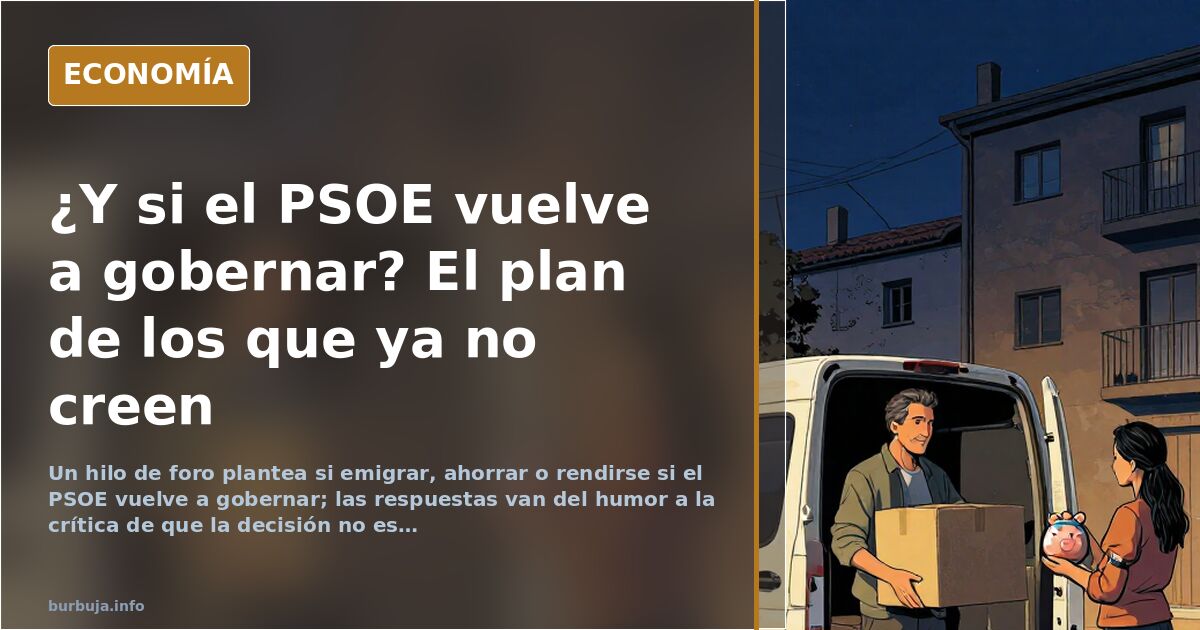
What would voters do if Sánchez wins the elections again?
The question isn't who will win, but what ordinary citizens will do if the PSOE returns to government. Amidst institutional wear and tear and economic uncertainty, responses range from "every man for himself" to stubborn resistance. The menu of options proposed in the original debate—saving, starting a business, emigrating, getting involved in politics, or simply stopping work—clashes with an uncomfortable reality: according to several participants, most people have no room for maneuver.
The mobility trap
Emigrating sounds good until you crunch the numbers. The initial suggestion is to find a country with better opportunities or lower cost of living, but the most repeated response is that without savings and with family responsibilities, borders are walls. "What do you leave behind for your elderly parents or children?" summarizes one intervention that dismantles the digital nomad fantasy. Criticism of individualism—"you assume you are an international company and not a person"—points to a real gap: freedom of movement is a privilege, not a plan.
The economic factor: from complaint to strategy
If anything unites the disparate views, it is distrust that a change in government will alter the root of the problem. Some argue that the PP and PSOE are 'the blue PP and the red PP', and that alternation does not touch the power structure. In this framework, personal strategies prevail: accumulating bonuses, buying canned goods and whiskey, accelerating retirement, or directly squating homes (illegal occupation). The option of starting a business or training appears, but with skepticism: "rowing harder every day to live slightly worse."
The scenario of rupture
The hypothesis of armed civil conflict is not marginal in the debate. It is suggested that if the PSOE bypasses laws, collective reaction could overflow. Against this, the "vaccine" thesis argues that a third Sánchez government would be such an evident disaster that it would force a cycle change. The problem, they admit, is that "probably none of us count on it."
The institutional path: fewer politicians and more control
Another current proposes attacking the problem at its root: reducing the number of public offices and requiring private sector experience to govern. The idea that no politician without ten years of management in a private company should become a minister gains trinc. Also, punishing budget diversion with disqualification and personal guarantees. It is the least emotional response and generates the fewest headlines.
In the end, the question "what would you do?" answers itself: most will continue working, paying taxes, and minding their own business while the country decays. Those who can, will leave. Those who cannot, will stay. And those who still believe in something, will vote. As someone else said about the rest: let them row their mother's ass.
Also available in: Deutsch
Summary of a discussion on Burbuja.info - Foro de economía, actualidad y política., translated from Spanish and reviewed before publication. Read the full discussion (43 replies).
More summaries
-
Spain Forum Debate: Did Sánchez Win or Lose?
46% of Spain's census relies on state funds. Polls give PP and Vox 212 seats, while PSOE resists amid forum debates.
-
PSOE subtitles PP campaign video, sparking data war in Spain
The PSOE's subtitled response to a PP video triggers a fierce debate over economic figures, including wages, inflation, and pensions.
-
Antonio Montero, Spanish tax inspector, dies in Urda train crash
Antonio Montero, a tax inspector with Spain's tax agency, died in the Urda train crash. The official minute of silence triggered a wave of backlash against the profession.
-
Tesla owners protest in Fuenlabrada, Spain, over faulty BYD batteries
Owners of 2023 Tesla Model Y cars with BYD LFP batteries protested in Fuenlabrada, Spain. Some replacement quotes exceed 16,000 euros.
-
Spain's budget stalemate leaves rail operator Adif with half its promised funding
The 2021-2025 agreement pledged 4,695 million euros for Adif; the Treasury has transferred 2,662. With no budgets since 2023, one in every three euros has gone unspent.
-
Mass voting against Spain's Government: anger that ignores ballot colours
Anger with Spain's Government clashes with distrust of the PP: from the VAT hike from 18 to 21 percent to migration figures nobody can reconcile. Mass voting, but for what?