
Mass voting against Spain's Government: anger that ignores ballot colours
Anger with Spain's Government clashes with distrust of the PP: from the VAT hike from 18 to 21 percent to migration figures nobody can reconcile. Mass voting, but for what?
English · Original discussion in Spanish · Published
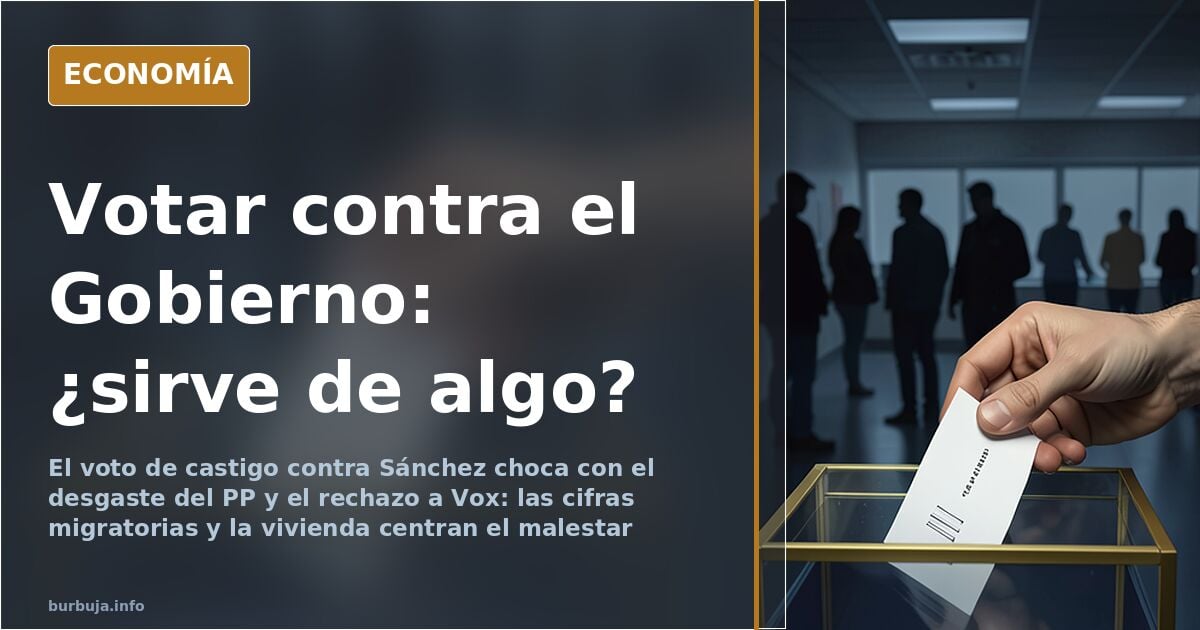
Voting against the Government: anger that ignores ballot colours
What is the point of switching ballots if the outcome is the same mess? That question runs through a current economic affairs discussion in which weariness with the Government blends with distrust of any alternative. The starting point is an explicit disappointment with Vox and the decision to vote for another party for the first time, with a bitter conclusion: "it makes no difference whether you drop in a blue or a green ballot." The underlying issue is less ideological than material: housing out of reach for young people, a sense of deteriorating infrastructure, and a migration debate fuelled by contradictory figures.
The PP raised VAT from 18 to 21 and other ghosts of the tactical vote
The first counterpoint comes on the tax front. Against the enthusiasm for a change of government, it is pointed out that the PP once promised not to raise taxes and ended up increasing VAT from 18 to 21 percent. It is no minor detail: that episode serves as a recurring argument against the idea that voting for the right automatically fixes the economic problem. The distrust is directed not only at the current Government but at the political class as a whole.
Added to this is criticism of infrastructure management. It is argued that the rail cuts of earlier governments explain part of today's deterioration, linked to the privatisation of RENFE (Spain's state railway operator) in 2013, when the company was split into four subsidiaries to make way for private capital. The implicit argument: the problem did not start with the last Government; it goes back a long way and affects whichever party holds power.
How many migrants entered under Sánchez and under Aznar: the clashing figures
The most tense core of the debate is migration. The figures being cited are incompatible with one another. Some speak of more than 12 million arrivals under Pedro Sánchez; others lower that to 5 million; a third claims that 8 million entered under Aznar; and a fourth corrects them: just over 2.5 million, mostly workers from Eastern Europe. There is no single source to settle the discrepancy.
The time frame is also disputed. It is claimed that in the late nineties most of the population was white and that part of that migratory flow returned during the crisis. The discussion drifts towards the distinction between labour migration and what some describe as a welfare burden, with accusations of crime unaccompanied by verifiable data. This is where the economic debate crosses into the cultural one, and where positions become most irreconcilable.
From "voting changes nothing" to "serves you right"
The conversation soon turns to the effectiveness of voting. Some argue that dropping a piece of paper into a plastic box solves no structural problems, while others reply that such resignation is precisely what perpetuates the system. Irony runs through the exchange: the PP is described as "the blue PSOE," and it is suggested that a change of party label does not alter the underlying economic policy.
The end of the debate offers no clear winner. Distrust of the Government coexists with distrust of the opposition, and the most repeated conclusion is that no ballot guarantees a solution. The opening question remains unanswered: if everyone votes massively against the Government, who exactly are they voting against?
Summary of a discussion on Burbuja.info - Foro de economía, actualidad y política., translated from Spanish and reviewed before publication. Read the full discussion (22 replies).
More summaries
-
Junts would back a PSOE government if Pedro Sánchez steps aside
Míriam Nogueras invokes the 'Starmer route' and opens the door to backing a PSOE government in Spain if Pedro Sánchez steps aside. What it means for stability.
-
Left-wing voters urging the ballot box to oust Spain's Sánchez
Self-described left-wing voters who say they backed progressive parties until two elections ago are calling for a return to the polls to remove Pedro Sánchez from power.
-
Sánchez and Tusk clash over immigration as Costa plays mediator
Sánchez defended regularising hundreds of thousands of undocumented migrants; Tusk called it the "wrong approach" and Costa had to mediate between the two.
-
Abascal and the viral cuts claim: the €44 billion left unexplained
A calculation circulating in the debate attributes cuts to Vox that add up to less than €1.2 billion, against €44 billion a year with no identified budget line.
-
Spain's economy slows to 0.6% growth as investment and consumption cool
Spain's economy grew 0.6%, a tenth of a point less than expected, as investment and consumption lost steam. Here's what it means and why it matters.
-
Lagarde resigns as ECB president, stepping down on 7 February 2027
Christine Lagarde resigns as president of the European Central Bank to run in France's 2027 presidential election. She will leave office on 7 February, before her term expires.