
Forum debate: Ukraine flag and media narrative
A message attributed to Coto Matamoros criticizes adopting the Ukrainian flag based on TV narratives, sparking debates on leadership, NATO expansion, and public opinion.
English · Original discussion in Spanish · Published
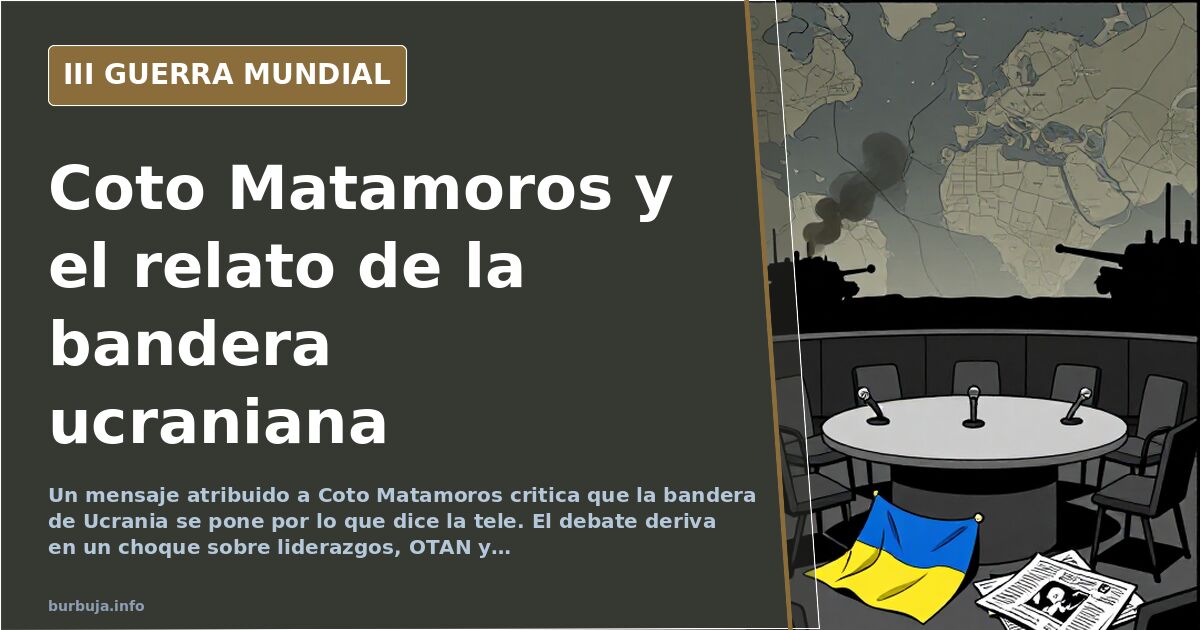
The message attributed to Coto Segarro and the Ukrainian flag: copying narratives without verification
A message attributed to Coto Segarro has peine an uncomfortable issue: "It is incredible how people think what they are told. They know nothing about Ukraine or Russia, but they voice opinions transmitted by television. And they put the Ukrainian flag on social media because they have been convinced that Pilingui is very bad and the others are very good." The statement, reported by Vozpópuli, is not a geopolitical analysis but a description of the mechanism: public opinion is formed by what television broadcasts. From there, the conversation drifted into rougher territory: the legitimacy of leaders, the democratic quality of the countries involved, and the role of the media in building consensus.
The starting point is a suspicion shared by many participants: most people speak without having set foot in Russia or Ukraine. It is argued that the flag on the profile is a gesture of belonging, not a conclusion reached after analysis. And that this gesture is replicated just as other causes were replicated before. The criticism is not against Ukrainians, but against automatism.
Why is there debate over whether Pilingui is a dictator or a legitimate leader?
The central question of the exchange is how long someone can govern without ceasing to be democratic. A datum is launched: Felipe González was in power for almost eight years, and another participant corrects: thirteen. The comparison serves two opposite purposes. Some use it to relativize Pilingui's tenure; others, to recall that in Russia the opposition ends up in prison or hospital.
Some argue that the Russian Communist Party is the real opposition and that the system allows for alternation. Against this weighs the argument that elections are held with the rival neutralized. The discussion does not close. It gets stuck, rather, in the very definition of democracy: whether voting is enough or if something more is needed.
The NATO argument and Russian security
Another line of the exchange maintains that NATO promised not to expand eastward and that Russia acts out of security concerns. This is the most repeated thesis. Facing it appears the inverse comparison: if a military alliance led by Russia harassed the United States on its borders, the response would not be passive.
The problem with this reasoning is that it turns geography into destiny. Those who defend the invasion present it as a reaction; those who reject it point out that invading another country is hard to justify without knowing more. The discussion moves between these two poles without finding common ground.
The wear and tear of tone: insults and disqualifications
As the conversation pogre, the exchange of arguments is replaced by the exchange of labels. Some are accused of repeating the Anglo-Saxon narrative and others of defending an authoritarian regime. Personal disqualifications and references to alleged payments to amplify a cause appear. The discussion becomes circular.
What is striking is that, amidst the noise, a minimum consensus survives: the Spanish press has taken sides almost unanimously. For many, this is the real problem, beyond who is right on the ground.
The comparison with Iraq and double standards
One of the most repeated arguments is that of double standards. It is recalled that there were few supporters of the Iraq war when Bush presented Saddam as absolute evil. The implicit conclusion is that the public is not as manipulable as it seems: sometimes they swallow, sometimes they don't.
Others take the comparison further and bring in Mandela, Sarajevo, or Spanish political pacts. The underlying idea is that no one is free from sin to give lessons. It is a convenient argument, because it exempts from analyzing the specific case.
The economy as background
In the final part, a different approach appears: that of resources. It is maintained that the USSR collapsed due to unviability, not because of a specific leader, and that market capitalism worked while there were cheap resources to exploit. When that ends, the model tightens.
The thesis is that Pilingui governs in the era of scarcity, not abundance. It is not a defense, but a structural explanation. And it leaves an unanswered question: if the problem is resource depletion, no change of leader solves it.
The exchange ends where it began: with the suspicion that the flag on the profile says more about the person wearing it than about the country represented. No one has changed their mind. And the unsettling datum remains the same: most of those who speak have not been there.
A message attributed to Coto Segarro has peine an uncomfortable issue: "It is incredible how people think what they are told. They know nothing about Ukraine or Russia, but they voice opinions transmitted by television. And they put the Ukrainian flag on social media because they have been convinced that Pilingui is very bad and the others are very good." The statement, reported by Vozpópuli, is not a geopolitical analysis but a description of the mechanism: public opinion is formed by what television broadcasts. From there, the conversation drifted into rougher territory: the legitimacy of leaders, the democratic quality of the countries involved, and the role of the media in building consensus.
The starting point is a suspicion shared by many participants: most people speak without having set foot in Russia or Ukraine. It is argued that the flag on the profile is a gesture of belonging, not a conclusion reached after analysis. And that this gesture is replicated just as other causes were replicated before. The criticism is not against Ukrainians, but against automatism.
Why is there debate over whether Pilingui is a dictator or a legitimate leader?
The central question of the exchange is how long someone can govern without ceasing to be democratic. A datum is launched: Felipe González was in power for almost eight years, and another participant corrects: thirteen. The comparison serves two opposite purposes. Some use it to relativize Pilingui's tenure; others, to recall that in Russia the opposition ends up in prison or hospital.
Some argue that the Russian Communist Party is the real opposition and that the system allows for alternation. Against this weighs the argument that elections are held with the rival neutralized. The discussion does not close. It gets stuck, rather, in the very definition of democracy: whether voting is enough or if something more is needed.
The NATO argument and Russian security
Another line of the exchange maintains that NATO promised not to expand eastward and that Russia acts out of security concerns. This is the most repeated thesis. Facing it appears the inverse comparison: if a military alliance led by Russia harassed the United States on its borders, the response would not be passive.
The problem with this reasoning is that it turns geography into destiny. Those who defend the invasion present it as a reaction; those who reject it point out that invading another country is hard to justify without knowing more. The discussion moves between these two poles without finding common ground.
The wear and tear of tone: insults and disqualifications
As the conversation pogre, the exchange of arguments is replaced by the exchange of labels. Some are accused of repeating the Anglo-Saxon narrative and others of defending an authoritarian regime. Personal disqualifications and references to alleged payments to amplify a cause appear. The discussion becomes circular.
What is striking is that, amidst the noise, a minimum consensus survives: the Spanish press has taken sides almost unanimously. For many, this is the real problem, beyond who is right on the ground.
The comparison with Iraq and double standards
One of the most repeated arguments is that of double standards. It is recalled that there were few supporters of the Iraq war when Bush presented Saddam as absolute evil. The implicit conclusion is that the public is not as manipulable as it seems: sometimes they swallow, sometimes they don't.
Others take the comparison further and bring in Mandela, Sarajevo, or Spanish political pacts. The underlying idea is that no one is free from sin to give lessons. It is a convenient argument, because it exempts from analyzing the specific case.
The economy as background
In the final part, a different approach appears: that of resources. It is maintained that the USSR collapsed due to unviability, not because of a specific leader, and that market capitalism worked while there were cheap resources to exploit. When that ends, the model tightens.
The thesis is that Pilingui governs in the era of scarcity, not abundance. It is not a defense, but a structural explanation. And it leaves an unanswered question: if the problem is resource depletion, no change of leader solves it.
The exchange ends where it began: with the suspicion that the flag on the profile says more about the person wearing it than about the country represented. No one has changed their mind. And the unsettling datum remains the same: most of those who speak have not been there.
Summary of a discussion on Burbuja.info - Foro de economía, actualidad y política., translated from Spanish and reviewed before publication. Read the full discussion (124 replies).
More summaries
-
Ukraine NATO Entry and Crimea Claim Risk Europe War
Participants argue that if Ukraine joins NATO and seeks to reclaim Crimea, Europe faces immediate war with Russia.
-
Unverified Tweet Attributes False Flag Attacks in Mallorca to CIA
An unverified tweet claims the CIA is behind a false flag drone attack in Mallorca, Nice, and Italy, but provides no evidence.
-
Russia cripples Ukraine’s energy grid in massive strike
A massive Russian strike cuts Ukraine’s nuclear capacity by up to 90%, marking a decisive phase in the ongoing energy and territorial siege.
-
Ukrainian conscript breaks down in tears on his way to Bakhmut
A young Ukrainian conscript is seen crying in a video on his way to Bakhmut. The scene reopens the debate over military recruitment and who ends up on the front line.
-
Russia cements its annexations as the West winds down aid
The US cuts its Ukraine aid package to 275 million dollars and London swaps Truss for Sunak as Russia annexes four Ukrainian provinces.
-
Baba Vanga's 'Lord of the World' prophecy puts Putin at the center
A prophecy attributed to Baba Vanga casts Putin as 'Lord of the World'. Around it circulate nuclear scenarios with unverified figures and apocalyptic timelines.