
Forum debate: Spain leads in dogs per capita
A user claims Spain has 9 million dogs for 45 million people and more uncollected waste than other European countries.
English · Original discussion in Spanish · Published
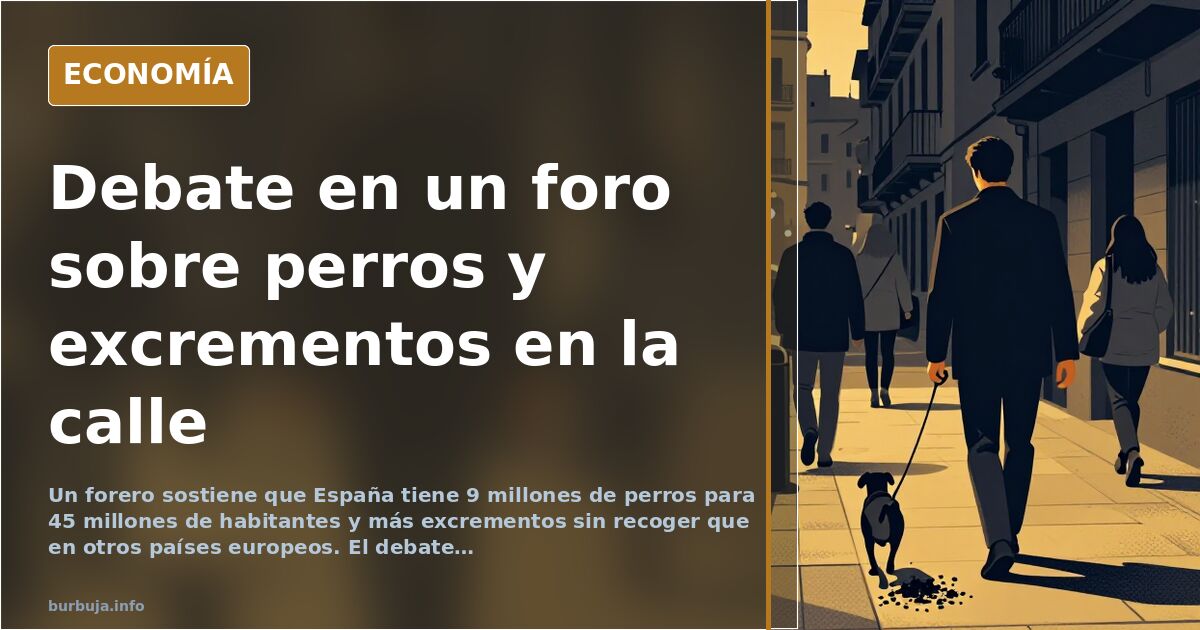
Why Spain smells of dog urine while France doesn't
Is the issue of dog waste a purely Spanish phenomenon? Anyone returning from France, Italy, Germany or Switzerland recently and landing in any Spanish city argues that here you dodge feces, but not there. The observation, repeated across various areas over many days, points to a proportion of dogs on the street up to twenty times higher than in neighboring countries, and an presence of excrement on sidewalks and parks unmatched by any other nearby European nation. Some claim Spain ranks among the world leaders in dogs per inhabitant, alongside the United Kingdom.
How many dogs are in Spain and why they multiply
A striking figure circulating in the debate is: nine million dogs in a country of 45 million inhabitants. The ratio per person would be among the highest on the planet. The question is why.
Some attribute it to a shift in roles: the dog fills the gap once occupied by children or partners, becoming the new emotional axis of a society with fewer births, more divorces, and more people living alone. This thesis repeats with variations: fewer children, more dogs. It is not just about young people without offspring; retirees and families with several children also bring animals into their homes.
The other pillar of the argument is material, not sentimental. According to one forum user, in countries where buying a dog costs an average of around €2,000 and adoption fees range from €600-800 to cover veterinary expenses, the economic barrier filters access. In Spain, access is cheap and quick, multiplying the number of owners, including those who perhaps should not have an animal.
It's not just Spain: the phenomenon spreads
The thesis of Spanish exceptionalism has a counterargument. Those who have traveled the Côte d'Azur describe dogs in ultra-luxury hotels costing over €500 a night, in restaurants walking under tables, and in supermarkets. In Germany, Austria, and Italy, presence is also growing, according to accounts. The difference, they argue, is not the existence of the phenomenon but its management: there, owners keep only the dogs they can handle and keep them indoors; here, large animals accumulate in small apartments within blocks lacking green spaces.
The urban planning argument carries weight. Spain concentrates population in dense cities with narrow sidewalks and few green zones, while 90% of the territory remains virtually empty. In northern countries, dogs live in detached houses with plots; here, they share two-by-two-meter elevators.
The problem isn't the dog: it's the uncollected waste
The broadest consensus in the debate is that the animal is not the problem, but the uncivil owner. Descriptions include urination on balconies dripping onto lower terraces, loose dogs with two-meter leashes, animals in bar patios, and a growing sense that those without dogs are the odd ones out. A recurring complaint is impunity: lack of effective fines for owners who leave excrement behind.
Calculating the full ratio of dogs per inhabitant and comparing it with other European countries yields a surprising differential, according to proponents, which anyone wishing to verify could find broken down in detail.
The health hypothesis and animal humanization
One line of analysis links the rise in dogs with indicators of distress: loneliness, depression, antidepressant use. Humanizing the animal—treating it like a child—is read as a symptom, not a cause. Meanwhile, the impact on coexistence is noted: those asking that a dog not touch them or enter the elevator are treated as psychopaths who don't love animals.
The final irony comes from the material itself: if dogs didn't pee or poop on the street, so-called "dog phobia" wouldn't exist. And apparently, that is asking too much.
Also available in: Deutsch
Summary of a discussion on Burbuja.info - Foro de economía, actualidad y política., translated from Spanish and reviewed before publication. Read the full discussion (158 replies).
More summaries
-
Trump imposes 25% tariffs on UK, Germany, and France over Greenland
Trump imposes tariffs between 10% and 25% on the UK, Germany, and France following their refusal to cede Greenland. Analysis of economic impact and Eurozone reactions.
-
Europe Fires: Coordinated Attack or Rural Neglect?
Simultaneous wildfires in Spain, France, Germany, and the UK. Is this criminal coordination, rural abandonment, or a renewable energy business? Data analysis reveals the truth behind the blazes.
-
Storm Ciarán hits UK and France with hurricane warnings
Storm Ciarán brings hurricane-level winds to the UK and France, while a second low pressure system dumps moisture on the Alpine arc.
-
Italian youth's anti-migrant rant goes viral amid work permit row
A video of a young Italian railing against migrants lands as debate rages over the 500,000 work permits Meloni reportedly plans to issue by 2028.
-
Galicia sells off its industry: from Avícola Tratante to Aludec
Avícola Tratante, Aludec, Ochoa, Martínez Otero: foreign capital is buying up Galician companies; forum users point to the lack of generational succession
-
Vox and PSOE: the deal no one confirms but everyone talks about
A tweet claims Vox has a deal with Spain's PSOE without providing any evidence. The claim is stirring up a campaign in which, some say, Vox is rising and the PP fears being overtaken.