
Forum debate: Should Spain's capital move to Zaragoza?
A forum thread proposes Zaragoza as Spain's capital, sparking debates on history, economy, immigration and regional grievances.
English · Original discussion in Spanish · Published
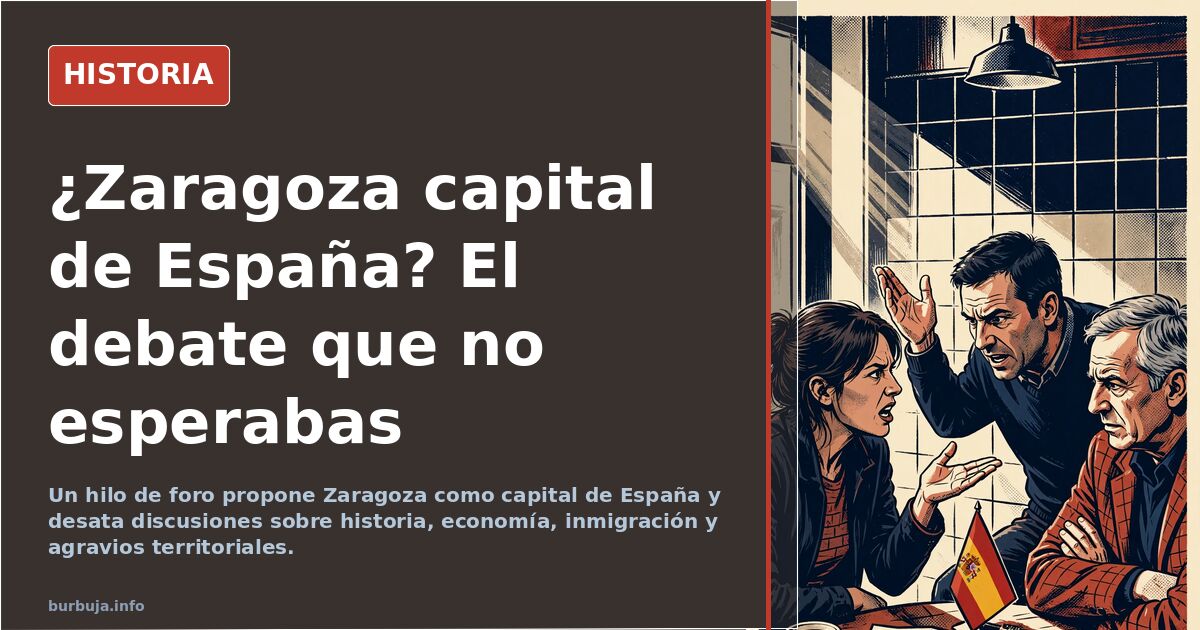
Zaragoza as capital: the tug-of-war between centralism and empty Spain
The proposal to move Spain's capital to Zaragoza is not new, but it is back in the spotlight with force. Supporters argue that Madrid is a "dump" and that the old Crown of Aragon deserves to regain its historical weight. Critics, however, point out that Zaragoza is a declining industrial city with an ageing population and transport problems. The debate, far from being a simple provocation, touches sensitive nerves: the territorial distribution of power, public investment and the role of the autonomous communities.
The historical argument: from the Crown of Aragon to Castilian centralism
Defenders of Zaragoza's capital status claim that Madrid was a "defeca corral" in the 16th century and that it was the Habsburg dynasty that turned it into a centre of power. "Zaragoza has suffered the consequences of Castilian dominance," they say, calling for the "restoration of the history" of the Crown of Aragon. However, detractors recall that Aragon was never an entity with real power: it first depended on Navarre and then on Barcelona, and after the conquest from the Jovenlandeses it fell under the orbit of the Counts of Barcelona. The discussion drifts into a clash of narratives over which Spain should prevail.
The economic reality: industry, logistics and dependence on Madrid
Beyond history, economic analysis carries the most weight. Zaragoza is today a key logistics hub, with industrial estates like Plaza that attract distribution giants. But its economy depends on proximity to Madrid, Barcelona and Bilbao. "It is an industrial city that aspires to be the fifth in its country," critics say. The population, ageing, is around half a million, and public transport is "absurd and chaotic": no metro and only one tram line. The lack of rain and extreme climate (blizzards in winter, stifling heat in summer) complete a less than flattering picture for a capital.
The social factor: immigration, crime and citizen unrest
The debate also exposes social tensions. Some messages warn of increased immigration in certain areas, with references to the avenue from the Central Market to the Aljafería. There is mention of "arguments, trouble, bad vibes" and an atmosphere of "madness" in the city. These opinions, although minority, reflect a discontent that goes beyond economics. The discussion about capital status thus becomes a thermometer of dissatisfaction with today's Spain.
What would happen to Madrid? The antiestéticar of losing centralism
Those who reject the move argue that Madrid, despite its problems, remains the country's economic engine. "Madrid is not advisable for a family if you don't go with loads of cash," admits one participant, but others reply that Zaragoza does not offer better opportunities either. The capital status proposal is seen as a symbolic gesture with no real basis: "Zaragoza is fine as it is," they conclude. The discussion, at bottom, reveals the gap between centre and periphery, and the difficulty of agreeing on a common national project.
With these ingredients, it is foreseeable that the debate will flare up whenever the territorial distribution of power is touched. Zaragoza will not be Spain's capital in the short term, but its claim will continue to feed the imagination of a more balanced Spain. Or not.
The proposal to move Spain's capital to Zaragoza is not new, but it is back in the spotlight with force. Supporters argue that Madrid is a "dump" and that the old Crown of Aragon deserves to regain its historical weight. Critics, however, point out that Zaragoza is a declining industrial city with an ageing population and transport problems. The debate, far from being a simple provocation, touches sensitive nerves: the territorial distribution of power, public investment and the role of the autonomous communities.
The historical argument: from the Crown of Aragon to Castilian centralism
Defenders of Zaragoza's capital status claim that Madrid was a "defeca corral" in the 16th century and that it was the Habsburg dynasty that turned it into a centre of power. "Zaragoza has suffered the consequences of Castilian dominance," they say, calling for the "restoration of the history" of the Crown of Aragon. However, detractors recall that Aragon was never an entity with real power: it first depended on Navarre and then on Barcelona, and after the conquest from the Jovenlandeses it fell under the orbit of the Counts of Barcelona. The discussion drifts into a clash of narratives over which Spain should prevail.
The economic reality: industry, logistics and dependence on Madrid
Beyond history, economic analysis carries the most weight. Zaragoza is today a key logistics hub, with industrial estates like Plaza that attract distribution giants. But its economy depends on proximity to Madrid, Barcelona and Bilbao. "It is an industrial city that aspires to be the fifth in its country," critics say. The population, ageing, is around half a million, and public transport is "absurd and chaotic": no metro and only one tram line. The lack of rain and extreme climate (blizzards in winter, stifling heat in summer) complete a less than flattering picture for a capital.
The social factor: immigration, crime and citizen unrest
The debate also exposes social tensions. Some messages warn of increased immigration in certain areas, with references to the avenue from the Central Market to the Aljafería. There is mention of "arguments, trouble, bad vibes" and an atmosphere of "madness" in the city. These opinions, although minority, reflect a discontent that goes beyond economics. The discussion about capital status thus becomes a thermometer of dissatisfaction with today's Spain.
What would happen to Madrid? The antiestéticar of losing centralism
Those who reject the move argue that Madrid, despite its problems, remains the country's economic engine. "Madrid is not advisable for a family if you don't go with loads of cash," admits one participant, but others reply that Zaragoza does not offer better opportunities either. The capital status proposal is seen as a symbolic gesture with no real basis: "Zaragoza is fine as it is," they conclude. The discussion, at bottom, reveals the gap between centre and periphery, and the difficulty of agreeing on a common national project.
With these ingredients, it is foreseeable that the debate will flare up whenever the territorial distribution of power is touched. Zaragoza will not be Spain's capital in the short term, but its claim will continue to feed the imagination of a more balanced Spain. Or not.
Also available in: Deutsch
Summary of a discussion on Burbuja.info - Foro de economía, actualidad y política., translated from Spanish and reviewed before publication. Read the full discussion (131 replies).
More summaries
-
Why the Crown of Aragon Was Never Called Catalan
The 1150 marriage united Barcelona and Aragon, yet the name 'Crown of Aragon' persists. This article explores why the dynasty is named after Aragon despite its Catalan origins.
-
Columbus Didn't Write in Italian, and His Origins Remain Unresolved
According to the Galician thesis, Columbus left no writings in Italian, and a genetic map points to the Crown of Aragon. His origins remain unresolved.
-
ETA and GAL: two arms of the same Gladio network in Spain
Investigation linking ETA and GAL as arms of the same NATO Gladio network, with drug trafficking funding and CIA control.
-
Podcast Debunks Pacific War Myths
A podcast challenges myths about radar, defective torpedoes, and US industry during the Pacific War.
-
Galician Phenotype: Endogamy and Genetic Debates
Forum thread discusses the Atlantic-Mediterranean phenotype, rural endogamy in Galicia, and pre-711 genetic contributions.
-
Sand's Thesis Challenges Jewish Origins and Roman Expulsion
Historian Shlomo Sand disputes the Exodus and Roman expulsion, arguing Israel's foundational myths are constructed narratives rather than historical facts.