
Forum debate over tactical voting for Abascal in Spain
A forum debates voting for Abascal as the lesser evil, abstaining, or simply giving up: "If you don't pick a side, they'll govern you anyway."
English · Original discussion in Spanish · Published
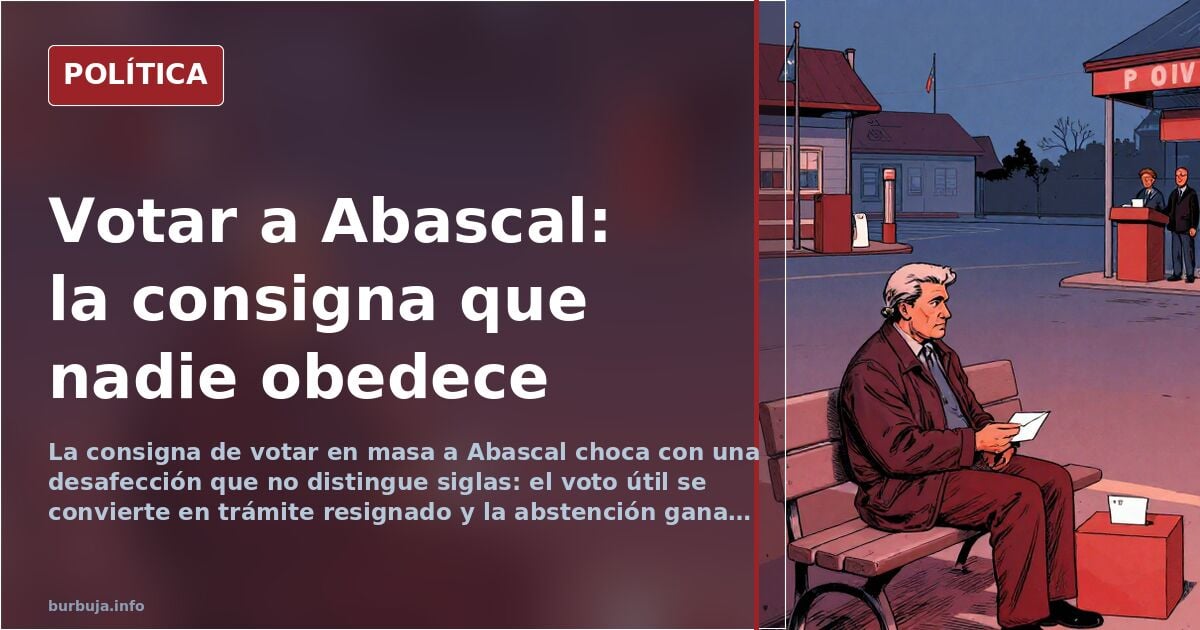
Forum debate over tactical voting for Abascal in Spain
In a forum thread, one participant sums up the mood of part of the right-wing electorate that treats voting as the lesser evil. The underlying argument is simple: facing the prospect of another four years of socialist government — or of a coalition executive with disparate partners — part of the conservative electorate considers concentrating their vote on Vox even if it doesn't convince them. The discussion isn't about the candidate, it's about the arithmetic.
Tactical voting and resignation as a strategy
The dominant argument among those who back that option rests on a repeated idea: "If you don't pick a side, they'll govern you anyway." Abstention, they claim, punishes no one; it simply leaves the field clear. Under that logic, voting for Vox "holding your nose and gagging" — as one post describes it — would be preferable to another four or eight years of what they call the PPSOE bloc. It's an uncomfortable, almost defensive position, one that assumes there is no "minimally decent" alternative and that voting becomes an exercise in containment rather than conviction.
Against that, another strand of the analysis rejects the whole framework. "It's not about voting for ideologies and narratives, we need solutions to the wrecking of a country," sums up one comment that avoids taking sides with any party. The criticism isn't aimed at Vox in particular, but at the idea that the party system can solve anything. Some outright propose mass abstention and the resignation of all officeholders en masse, with a list of grievances that hits Sánchez, Abascal and Feijóo alike.
Cross-party disillusionment that doesn't pick sides
What's striking about this is that the discontent isn't organized along ideological lines. A single message dismisses the Prime Minister as a "psychopath" and the Vox leader as a "slacker," and finishes off the PP candidate with a reference to drug trafficking. There's no clean side. The disaffection is cross-cutting, and that complicates any call for tactical voting: if every candidate generates rejection, the rallying cry of concentrating the vote loses force.
The argument of internal exile also appears. "All that's left for us now is scorched earth and exile to eastern lands where you can still live with dignity by working like a mule," writes someone who takes for granted that the current occupant of La Moncloa (the Spanish PM's residence) will try to entrench himself "irreversibly and definitively." It's the most pessimistic version of the diagnosis: it's not about winning an election, but about the fact that the framework no longer allows winning them.
Fraud suspicions and the ghost of a coalition government
In the realm of predictions, the most repeated hypothesis is that the outcome won't depend on the ballot box. "Get ready for another 4 years of blue PSOE. That is, unless we end up with another PSOE rigged vote or a frankenstein government," sums up one comment that takes for granted that the PP will govern in the same style as the PSOE or will need heterogeneous partners. Distrust of the electoral process appears without elaboration, as an assumed commonplace.
The general tone isn't one of a campaign, it's one of fatigue. The discussion about voting en masse for Abascal rests on a premise nobody disputes: that the right-wing electorate has no candidate it feels enthusiastic about. The headline's rallying cry doesn't ask for faith, it asks for voting discipline. And that's where the analysis gets stuck: there's no way to know whether that discipline exists or whether disillusionment outweighs the arithmetic.
Also available in: Deutsch
Summary of a discussion on Burbuja.info - Foro de economía, actualidad y política., translated from Spanish and reviewed before publication. Read the full discussion (20 replies).
More summaries
-
Catalan party Alianza Catalana weighs a leap into Spain's general election
Silvia Orriols's party denies it will run in the general election, but internal pressure and buzz on social media keep the debate alive. Will it change strategy?
-
Spain’s November 29 election: ballots ready, budgets frozen
The Spanish government has issued tenders for election materials despite no scheduled vote, while Puigdemont challenges Sánchez to call early elections amid frozen budgets.
-
Madrid PP gives 48 hours to clear Sol camp
Madrid's PP gives 48 hours to clear the Sol encampment, citing cobblestones, stoves and knives; banners against Ayuso appear.
-
Spain's immigration and wages debate: labour or pressure?
A youth post by Spain's PP has sparked the debate: is immigration about integration or about driving down wages? The underlying suspicion that makes everyone uneasy.
-
Pedro Sánchez's brother David Sánchez banned from office for nine years
The Provincial Court of Badajoz, Spain, has convicted David Sánchez, brother of Prime Minister Pedro Sánchez, of misconduct and banned him from public office for nine years. The court found that…
-
Zapatero's hand on his chest: warning sign or political meme
From fear of his own colleagues to an alleged encrypted message: theories about Zapatero's repetitive gesture are spreading fast through Spain's political corridors