
Spain's immigration and wages debate: labour or pressure?
A youth post by Spain's PP has sparked the debate: is immigration about integration or about driving down wages? The underlying suspicion that makes everyone uneasy.
English · Original discussion in Spanish · Published
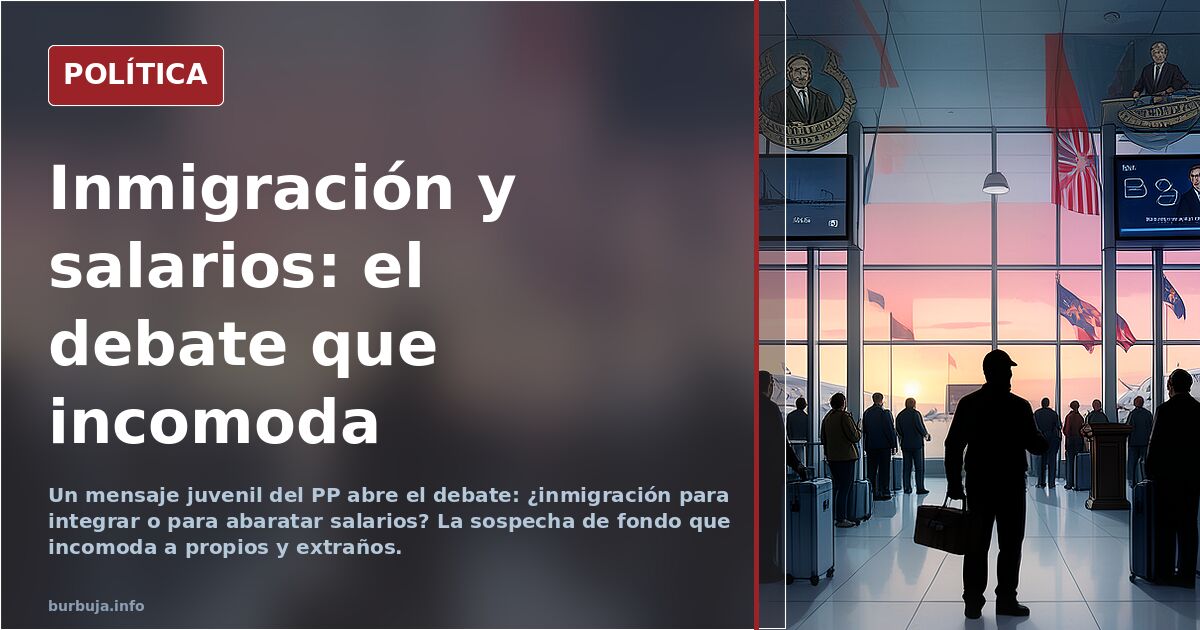
The right that wants immigrants so it doesn't have to raise wages
A short message, a plane and a blunt sentence are enough to light the fuse: "Anyone who comes here to work and integrate is welcome in Spain. If not, you're on the first flight out." The quote, posted by a youth account linked to the PP (Spain's main conservative party), has triggered a discussion that goes far beyond the gesture itself. The core criticism is not the harshness of the tone, but the underlying suspicion: that behind the friendly rhetoric on labour migration lies a very specific economic interest. Cheapening labour. And, along the way, keeping the wage bill down in a labour market that never quite tightens.
The accusation circulates with a recurring formula: those who wrap themselves in the flag would be the first to open the door if it suits the employers' association. The thesis, stated without nuance, is that the PP acts as a transmission belt for business interests and that mass immigration, far from being an integration problem, is above all a mechanism of wage restraint. An argument that, deep down, is shared by voices of very different stripes, each in its own way.
From "welcome" to "zero immigration"
The range of responses is wide and reveals just how divisive the issue is. Some outright propose turning off the tap: cutting immigration to zero and reducing welfare benefits so that half of the arrivals return to their countries of origin. This is the harshest stance, put bluntly and with the conviction that anything else is a waste of time. Opposite them, a more pragmatic current accepts the arrival of workers but demands conditions: stricter requirements, a commitment to integration and, in some cases, filters that have nothing to do with work.
In between comes a criticism that makes both sides uncomfortable. From those who argue that neither will stop anything, because the problem is not the rhetoric but the structure. And a question that hangs over the whole conversation: are more workers needed, or more jobs for those workers to do? The doubt is not a minor one. If the problem is demand rather than supply, bringing in labour only serves to divide the same pie into more slices.
The employers' lobby, the local bosses and the story that doesn't add up
The sharpest blow comes from within the field itself. The surprise, it is said, is discovering that the right works for the employers' association and for the local power brokers. It is nothing new historically, but it clashes with the identity-hardline narrative sold on the campaign trail. There lies the knot: if the tough talk on immigration coexists with a practice favourable to the arrival of workers, something doesn't add up. Either one side is lying, or the other is.
The pointed irony appears when the defenders of this path are compared to the proge. The charge of cowardice is thrown at a right that, in this reading, bends to the very interests it claims to fight. And with the PP in government, the prediction goes, there will be more immigration and more conflict. The phrase is exaggerated, but it sums up the disillusionment of those who expected something else.
The detail that throws everything off
While the debate revolves around wages and borders, a note appears that changes everything: many of those arriving already come with an organised religion and proselytise on public transport. Integration, then, is not just a matter of paperwork or contracts. It is cultural, and that is not fixed with a return flight or an entry quota.
In the end, the question left hanging is not how many should come, but who benefits from their coming. And the answer, apparently, is not the one shouted at the rallies.
Also available in: Deutsch
Summary of a discussion on Burbuja.info - Foro de economía, actualidad y política., translated from Spanish and reviewed before publication. Read the full discussion (21 replies).
More summaries
-
Spain’s Human Capital Degrades: Rising Unemployment, Falling Education
Spain loses human capital as ideological education, youth emigration, and unskilled immigration lower productivity and worsen the skills gap.
-
Tweet Places Pablo Fernández in Luxury Housing Development
A tweet places Pablo Fernández living in a luxury development from the Mahou-Calderón operation, the same one Podemos tried to halt.
-
Víctor de Aldama holds photo with Spain's Pedro Sánchez as bargaining chip
Is the photo of Víctor de Aldama and Pedro Sánchez a real bargaining chip or just smoke? Forum users debate whether this evidence will mark a turning point in Spain's legislative term.
-
Explainer video: how did so many zainichi end up in Japan today?
Foreigners make up just 3% of Japan's population, and Africans are only 1% of that group. Why is the perception of an orchestrated invasion growing?
-
What Spaniards will do if Sánchez wins again: between leaving and fighting back
From emigrating to the Philippines to banging pots or waiting for a coup: reactions to a hypothetical new Sánchez victory in Spain reveal a deeply divided society.
-
P.S. is Pedro Sánchez: the newspaper archive confirms it
Newly unearthed archive documents identify P.S. as Pedro Sánchez, Spain's prime minister. The parallel with the M. Rajoy case fuels political scepticism.