
Forum debate on women's role in economy
A forum thread argues women's workforce entry destroys families, citing historical data and mythology.
English · Original discussion in Spanish · Published
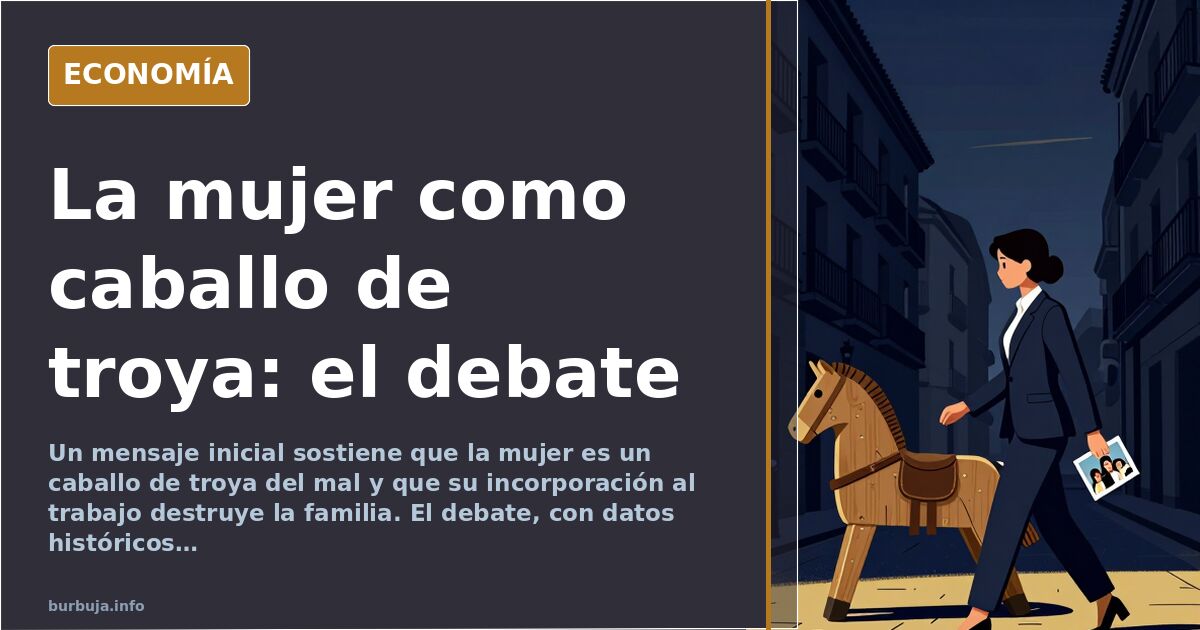
Women as Trojan Horses: The Unending Debate
An initial post claims most women make decisions based on emotions rather than reason, arguing that their mass entry into the labor market aims to destroy the family. This thesis, supported by a tweet about legal rights for women in Europe until the 1970s, has generated 111 replies in an Economics subforum. The discussion mixes historical data, Greek mythology, and opinions on birth rates and consumption.
The Origin of the Debate: A Tweet on Legal Rights
The original post cites a tweet claiming that in the US, a woman could not open a bank account without her husband's permission until 1974, in Belgium until 1976, in France until 1965, and in Germany she could not work without permission until 1977. The author uses this data to argue that the situation for women in Sarracinic societies is not so different from what occurred in the West until recently. However, a participant corrects this: the information is false; accurately, it means that at those dates, a married woman under community property laws could not transfer joint funds to an exclusive personal account. The nuance is important: it was not a general prohibition but a specific asset restriction.
Greek Mythology as Argument
One of the most cited messages refers to Hesiod’s Works and Days, recalling that Zeus created woman as punishment for men after the theft of fire. The direct quote: "I will give them an evil with which they will all rejoice, fondly embracing their own misfortune." Another participant adds that Adam’s first mistake was not eating the forbidden fruit, but listening to his vvife. These mythological arguments reinforce the idea that women are a biological trap, as another message citing Schopenhauer states: "Woman is the trap biology sets for man, the true human being, to perpetuate the species."
Consumption and Birth Rates as Alleged Proof
Several posts link women’s labor market entry to increased consumption and declining birth rates. One participant asserts women were put to work to increase the number of consumers and spend more due to impulsivity. Another shares experience as a security guard in a boutique: women spending €12,000 or €2,000 on Chanel clothes that "do not even keep you warm like a Ternua or North Face garment." It is argued women no longer have children to keep 100% of their money for spending. In contrast, one post notes low birth rates also affect homogeneous Asian nations lacking these cultural factors, suggesting the phenomenon is more complex.
Evolution of the Debate: From Economic Analysis to Disqualification
As the discussion pogre, the tone becomes more aggressive. Some posts openly disparage women: "they are 50% of the reproductive factor, but otherwise they are THE PLAGUE," or "a woman cannot even drive a car without causing problems." These views mix with attempts at nuanced analysis. One participant argues women are more realistic than men and their alleged emotionality is a mirror game to achieve goals, citing fibromyalgia: "their goal: not working, achieved by appealing to the myth that their emotional world is much more uncontrollable than men's." Another defends the opposite: women are the system’s target because they are the solution, not the problem.
Parallels with the 2030 Agenda and Capitalism
Some posts try to connect the thesis with macroeconomic trends. The 2030 Agenda is mentioned, arguing its apparent goal is raising Third World living standards at the expense of rich countries, generating poverty and less consumption. Another participant claims capitalism is exhausted and will fail in about 20 years. The discussion shifts to immigration and population replacement: asserting areas like Catalonia will have Muslim-origin mayors within 20 years. These arguments are presented as speculation without supporting data.
Dissenting Voices and the End of the Debate
Not all posts share the initial thesis. One highly voted message states: "Women are the only ones who give LIFE... everything else is a herd of Homo Sapiens fighting over who rules." Another defends women as more realistic, viewing irrationality as manipulation strategy. Others note the problem is the system, not women. The debate ends without consensus, with mutual disqualifications and an implicit conclusion: the conversation on women’s role in economy and society remains as polarized as ever.
Lasting 674 days, the discussion reflects tensions beyond economics: the clash between traditional family models and individual autonomy. Historical data on legal rights mixes with opinions on consumption and birth rates, yet no conclusive figures are provided. With reservations, while birth rates fall and consumption drives the economy, the debate on women’s societal role will likely intensify.
An initial post claims most women make decisions based on emotions rather than reason, arguing that their mass entry into the labor market aims to destroy the family. This thesis, supported by a tweet about legal rights for women in Europe until the 1970s, has generated 111 replies in an Economics subforum. The discussion mixes historical data, Greek mythology, and opinions on birth rates and consumption.
The Origin of the Debate: A Tweet on Legal Rights
The original post cites a tweet claiming that in the US, a woman could not open a bank account without her husband's permission until 1974, in Belgium until 1976, in France until 1965, and in Germany she could not work without permission until 1977. The author uses this data to argue that the situation for women in Sarracinic societies is not so different from what occurred in the West until recently. However, a participant corrects this: the information is false; accurately, it means that at those dates, a married woman under community property laws could not transfer joint funds to an exclusive personal account. The nuance is important: it was not a general prohibition but a specific asset restriction.
Greek Mythology as Argument
One of the most cited messages refers to Hesiod’s Works and Days, recalling that Zeus created woman as punishment for men after the theft of fire. The direct quote: "I will give them an evil with which they will all rejoice, fondly embracing their own misfortune." Another participant adds that Adam’s first mistake was not eating the forbidden fruit, but listening to his vvife. These mythological arguments reinforce the idea that women are a biological trap, as another message citing Schopenhauer states: "Woman is the trap biology sets for man, the true human being, to perpetuate the species."
Consumption and Birth Rates as Alleged Proof
Several posts link women’s labor market entry to increased consumption and declining birth rates. One participant asserts women were put to work to increase the number of consumers and spend more due to impulsivity. Another shares experience as a security guard in a boutique: women spending €12,000 or €2,000 on Chanel clothes that "do not even keep you warm like a Ternua or North Face garment." It is argued women no longer have children to keep 100% of their money for spending. In contrast, one post notes low birth rates also affect homogeneous Asian nations lacking these cultural factors, suggesting the phenomenon is more complex.
Evolution of the Debate: From Economic Analysis to Disqualification
As the discussion pogre, the tone becomes more aggressive. Some posts openly disparage women: "they are 50% of the reproductive factor, but otherwise they are THE PLAGUE," or "a woman cannot even drive a car without causing problems." These views mix with attempts at nuanced analysis. One participant argues women are more realistic than men and their alleged emotionality is a mirror game to achieve goals, citing fibromyalgia: "their goal: not working, achieved by appealing to the myth that their emotional world is much more uncontrollable than men's." Another defends the opposite: women are the system’s target because they are the solution, not the problem.
Parallels with the 2030 Agenda and Capitalism
Some posts try to connect the thesis with macroeconomic trends. The 2030 Agenda is mentioned, arguing its apparent goal is raising Third World living standards at the expense of rich countries, generating poverty and less consumption. Another participant claims capitalism is exhausted and will fail in about 20 years. The discussion shifts to immigration and population replacement: asserting areas like Catalonia will have Muslim-origin mayors within 20 years. These arguments are presented as speculation without supporting data.
Dissenting Voices and the End of the Debate
Not all posts share the initial thesis. One highly voted message states: "Women are the only ones who give LIFE... everything else is a herd of Homo Sapiens fighting over who rules." Another defends women as more realistic, viewing irrationality as manipulation strategy. Others note the problem is the system, not women. The debate ends without consensus, with mutual disqualifications and an implicit conclusion: the conversation on women’s role in economy and society remains as polarized as ever.
Lasting 674 days, the discussion reflects tensions beyond economics: the clash between traditional family models and individual autonomy. Historical data on legal rights mixes with opinions on consumption and birth rates, yet no conclusive figures are provided. With reservations, while birth rates fall and consumption drives the economy, the debate on women’s societal role will likely intensify.
Also available in: Deutsch
Summary of a discussion on Burbuja.info - Foro de economía, actualidad y política., translated from Spanish and reviewed before publication. Read the full discussion (111 replies).
More summaries
-
94-Year-Old Man Pushes Wife’s Wheelchair Due to Ambulance Shortage in Spain
A 94-year-old man pushed his wife with Alzheimer's 250 meters due to lack of ambulance in Campdevànol, reigniting debate on non-urgent transport.
-
PP and Vox Reverse Decision to Cut Equality Office in Ciudad Real
In Spain, PP and Vox withdrew plans to eliminate Gender Equality and Sustainability offices in Ciudad Real shortly after announcing them.
-
California fires: conspiracy theories vs. real infrastructure failures
California wildfires worsened by drought, Santa Ana winds, and dry hydrants fuel conspiracy claims about Agenda 2030 lacking evidence.
-
Spain's Equality Ministry: 114,576 Prostitution Ads in 2023
Spain's Equality Ministry estimated 114,576 women advertised on prostitution sites in 2023. This represents roughly 1% of the fertile-age population, though data reflects ads, not unique individuals.
-
Half of Spain's Unemployment Benefit Recipients Rely on Non-Contributory Aid
In October, half of the 1.73 million unemployment benefit recipients in Spain relied on non-contributory aid, blurring the line between insurance and welfare.
-
Spain's SER Radio Leak Reveals Government Panic Over UCO Report
An open microphone on Cadena SER captured a tense exchange between Deputy PM Montero and a journalist regarding the UCO report implicating Santos Cerdán.