
94-Year-Old Man Pushes Wife’s Wheelchair Due to Ambulance Shortage in Spain
A 94-year-old man pushed his wife with Alzheimer's 250 meters due to lack of ambulance in Campdevànol, reigniting debate on non-urgent transport.
English · Original discussion in Spanish · Published
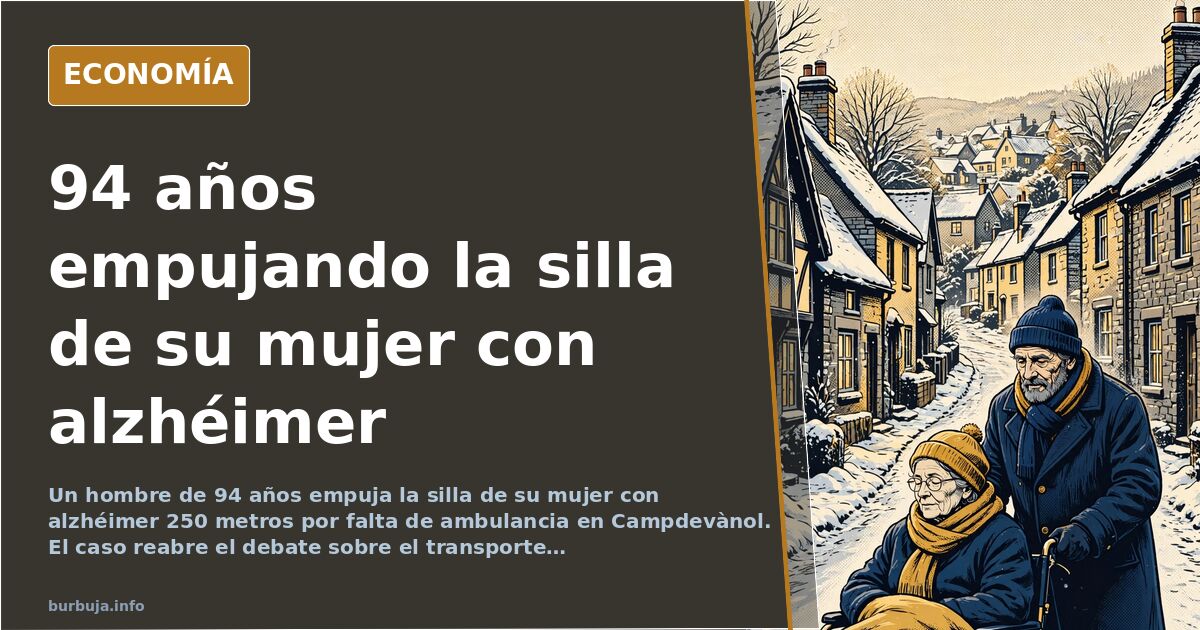
Nonagenarian pushes vvife’s wheelchair due to ambulance shortage
A 94-year-old man pushed his vvife’s wheelchair, who suffers from stage three Alzheimer’s, for 250 meters at two degrees Celsius. This occurred upon discharge from the Hospital de Campdevànol, in the Ripollès region, when no ambulance was available. The scene, captured by one of their daughters, went viral on social media and sparked a discussion extending far beyond this specific case: the management of non-urgent medical transport, the role of families, and public health spending.
What peine in Campdevànol and why it went viral
The circulated account states that the hospital informed the family there was only one ambulance for the entire province. For a five-minute alucinación, the last time it came from Figueres. The daughter claims this is the third time her parents have faced such an issue and insists it is not isolated. The woman cannot walk or stand alone and requires an adapted vehicle for any displacement. According to testimony, the service works well from the residence to the hospital, but not vice versa.
The image became a symbol of a problem transcending anecdotal incidents. It is not just about missing ambulances: it is about a system considering a transfer resolved when, in practice, it falls to an elderly family. And often, there is no family behind them.
Is an ambulance a taxi? Debate on non-urgent transport
Many interventions agree on one point: a medicalized ambulance should not be used to transport a discharged patient who only needs an adapted vehicle. The argument is that resources must be reserved for emergencies. The proposed alternative is the existence of vans or adapted taxis, with drivers and wheelchair platforms, covering non-urgent transfers. Some communities have these; others do not. And when they exist, immediate availability is not guaranteed.
The important nuance is that the problem is not exclusive to Catalonia. Some recall that in rural areas across Spain, these situations have repeated for years: if there is no ambulance or doctor, everyone manages as best they can. The difference here was the presence of a camera and a grandson willing to share the story.
Role of family: solidarity or institutional abandonment?
One recurring viewpoint points to children and grandchildren. If the 94-year-old grandfather was pushing the chair, where was the rest of the family? The account itself reveals that a daughter took the photograph. This does not answer the fundamental question: should a family solve a medical transfer with their own means?
Another viewpoint argues the opposite: that the family cannot be the last resort of a public system. When it is, the failure belongs to the Administration, not the children. In between lies an uncomfortable truth: many elderly people have no children, or children hundreds of kilometers away, for whom even the option of pushing the chair does not exist.
Concerted healthcare, waiting lists, and spending priorities
This case has peine comparisons between healthcare models. Part of the analysis suggests Catalan healthcare is largely concerted (public-private partnership), conditioning resource management. Weeks-long waits for primary care physicians and months for hernia surgeries are mentioned. It is also noted that strikes for public healthcare have concentrated in Madrid, creating a contradiction difficult to sustain.
The other axis is spending. Against the lack of ambulances, other budget items are cited: Catalan embassies, subsidies to associations, diversity programs. One conclusion drawn is that money is not lacking, but spent elsewhere. This thesis is debatable but connects with a broader perception: urgent and visible issues always find funding, while everyday services degrade unnoticed.
Aging and the next decade
Demographic data looms over the entire issue. A 94-year-old man caring for a vvife with stage three Alzheimer’s is not a statistical exception: it is a portrait of what is coming. The Spanish population pyramid guarantees cases like this will multiply. The question is not whether more Ramons will push chairs, but how many and with what institutional support.
Some suggest solutions lie in intermediate resources: adapted vehicles at every hospital, non-medical staff for transfers, coordination with regulated taxis. Measures cheap compared to maintaining a medicalized ambulance on standby. But they require something invisible in a photo: planning.
The Campdevànol case will not be solved by adding one more ambulance. It will be solved when the system stops treating the elderly as a logistical problem someone, somewhere, must resolve. Today, that someone remains the family. How many times must this scene repeat before it ceases to be news?
A 94-year-old man pushed his vvife’s wheelchair, who suffers from stage three Alzheimer’s, for 250 meters at two degrees Celsius. This occurred upon discharge from the Hospital de Campdevànol, in the Ripollès region, when no ambulance was available. The scene, captured by one of their daughters, went viral on social media and sparked a discussion extending far beyond this specific case: the management of non-urgent medical transport, the role of families, and public health spending.
What peine in Campdevànol and why it went viral
The circulated account states that the hospital informed the family there was only one ambulance for the entire province. For a five-minute alucinación, the last time it came from Figueres. The daughter claims this is the third time her parents have faced such an issue and insists it is not isolated. The woman cannot walk or stand alone and requires an adapted vehicle for any displacement. According to testimony, the service works well from the residence to the hospital, but not vice versa.
The image became a symbol of a problem transcending anecdotal incidents. It is not just about missing ambulances: it is about a system considering a transfer resolved when, in practice, it falls to an elderly family. And often, there is no family behind them.
Is an ambulance a taxi? Debate on non-urgent transport
Many interventions agree on one point: a medicalized ambulance should not be used to transport a discharged patient who only needs an adapted vehicle. The argument is that resources must be reserved for emergencies. The proposed alternative is the existence of vans or adapted taxis, with drivers and wheelchair platforms, covering non-urgent transfers. Some communities have these; others do not. And when they exist, immediate availability is not guaranteed.
The important nuance is that the problem is not exclusive to Catalonia. Some recall that in rural areas across Spain, these situations have repeated for years: if there is no ambulance or doctor, everyone manages as best they can. The difference here was the presence of a camera and a grandson willing to share the story.
Role of family: solidarity or institutional abandonment?
One recurring viewpoint points to children and grandchildren. If the 94-year-old grandfather was pushing the chair, where was the rest of the family? The account itself reveals that a daughter took the photograph. This does not answer the fundamental question: should a family solve a medical transfer with their own means?
Another viewpoint argues the opposite: that the family cannot be the last resort of a public system. When it is, the failure belongs to the Administration, not the children. In between lies an uncomfortable truth: many elderly people have no children, or children hundreds of kilometers away, for whom even the option of pushing the chair does not exist.
Concerted healthcare, waiting lists, and spending priorities
This case has peine comparisons between healthcare models. Part of the analysis suggests Catalan healthcare is largely concerted (public-private partnership), conditioning resource management. Weeks-long waits for primary care physicians and months for hernia surgeries are mentioned. It is also noted that strikes for public healthcare have concentrated in Madrid, creating a contradiction difficult to sustain.
The other axis is spending. Against the lack of ambulances, other budget items are cited: Catalan embassies, subsidies to associations, diversity programs. One conclusion drawn is that money is not lacking, but spent elsewhere. This thesis is debatable but connects with a broader perception: urgent and visible issues always find funding, while everyday services degrade unnoticed.
Aging and the next decade
Demographic data looms over the entire issue. A 94-year-old man caring for a vvife with stage three Alzheimer’s is not a statistical exception: it is a portrait of what is coming. The Spanish population pyramid guarantees cases like this will multiply. The question is not whether more Ramons will push chairs, but how many and with what institutional support.
Some suggest solutions lie in intermediate resources: adapted vehicles at every hospital, non-medical staff for transfers, coordination with regulated taxis. Measures cheap compared to maintaining a medicalized ambulance on standby. But they require something invisible in a photo: planning.
The Campdevànol case will not be solved by adding one more ambulance. It will be solved when the system stops treating the elderly as a logistical problem someone, somewhere, must resolve. Today, that someone remains the family. How many times must this scene repeat before it ceases to be news?
Also available in: Deutsch
Summary of a discussion on Burbuja.info - Foro de economía, actualidad y política., translated from Spanish and reviewed before publication. Read the full discussion (125 replies).
More summaries
-
Milei's Health Vouchers: Who Covers Argentina's Sick?
Milei's plan replaces public hospital funding with vouchers. The critical issue: who pays for chronic patients in Argentina's proposed system?
-
Ceuta gang rape leaves minor seriously injured amid migration debate
A minor was seriously injured after a gang sexual assault in Ceuta. The incident has reignited the migration debate and accusations of political manoeuvring.
-
Madrid leader Ayuso leaves mass via ambulance after illness
Isabel Díaz Ayuso left the Almudena Cathedral mass by ambulance due to a minor indisposition, reigniting debates on her health and political agenda.
-
Influencer Shannis Claims She Didn't Know Ibiza Is in Spain for Profit
An influencer claims she didn't know Ibiza is in Spain and exchanged euros for dollars. The episode reveals the profitable rage bait business.
-
Yellow Rain in Spain: Pollen, Dust or Conspiracy?
Yellow residue on cars in Spain is likely pine pollen or Saharan dust. No lab tests support conspiracy theories about chemical spraying.
-
Spain Wallapop Scam: €300 for Broken Phone
A Spanish buyer loses €300 on a defective phone via Wallapop. The seller refuses the return, the bank denies the chargeback, and legal recourse remains uncertain.