
Forum Debate Compares Spain's Situation to Colonization
A forum thread compares Spain's current situation to the colonization of the Americas, citing mestizaje, extermination claims, and internal division as tools of control.
English · Original discussion in Spanish · Published
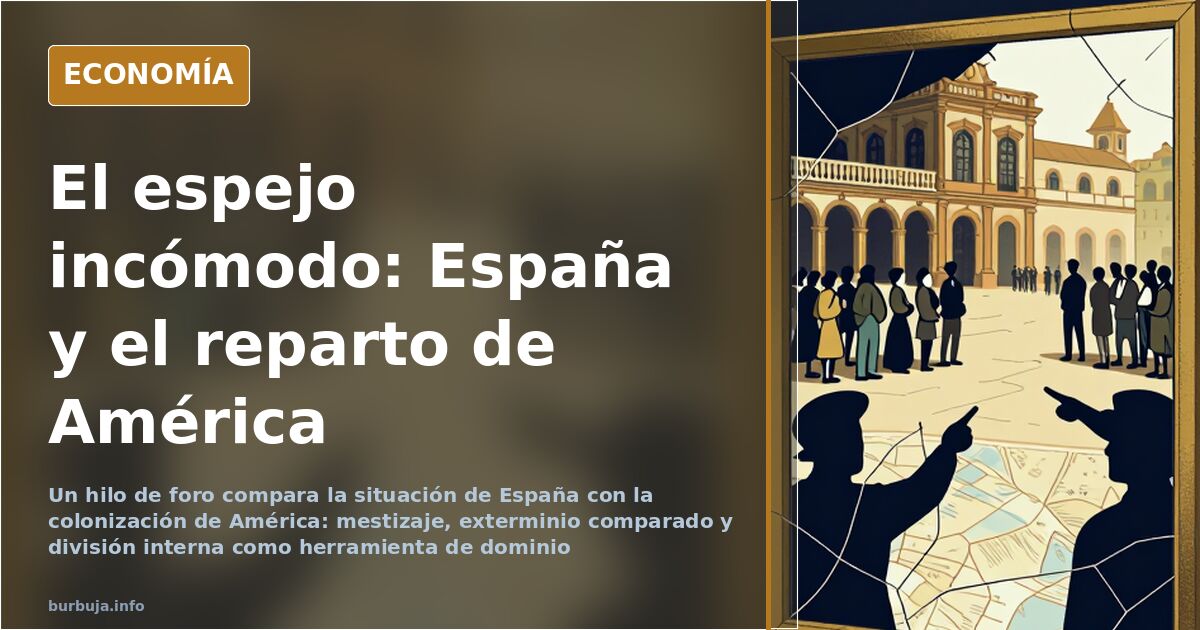
Forum Debate Compares Spain's Situation to Colonization
Is the same recipe applied to Spaniards today that they once applied to the peoples of the Americas? This question, which sounds like a barroom slogan, has filled hundreds of replies and evolved into a clash between two narratives: one arguing there is a plan to divide and replace the Spanish population, and the other responding with demographics, DNA, and archives. The trigger is a simple thesis: just as a handful of conquistadors imposed themselves on empires that had been fighting each other for millennia, an organized minority is now using internal division to dominate the majority. Far from remaining anecdotal, the discussion shifts toward verifiable data on mestizaje, extermination, and comparative colonization.
What Is Debated When People Say "They Are Doing the Same to Us"
The starting point is a warning against internal confrontation: anyone threatening another Spaniard for their ideas, the initial argument holds, is doing the work of those who want to weaken the country. It then jumps to everyday politics and the suspicion that elites, "all of them," have always used division as a tool of dominance. The most repeated rebuttal does not deny the diagnosis, but rather the mirror: Spaniards did not exterminate anyone, and the proof lies in the American continent itself.
Percentages become the battlefield. It is claimed that Hispanic America retains indigenous populations with proportions up to 98% in some countries, while in the Anglo-Saxon sphere it does not even reach 2%. The comparison extends to the Caribbean: Taíno maternal DNA would be prominent in former Spanish colonies, between 61.3% and 22.0%, and virtually nonexistent in Haiti (0.0%) and Jamaica (0.5%). These figures are attributed to a scientific publication, not a casual after-dinner remark.
The Demographic Argument vs. The Black Legend
The current rejecting the parallelism does not limit itself to denial; it reconstructs. It argues that the Spanish Empire was multiethnic, that it mixed where others exterminated, and that the divisions it found were not created by them but exploited. Pre-Hispanic empires had subjugated other peoples, and the newcomers relied on this prior discontent. The conclusion they draw is uncomfortable for the original headline: if someone divided, it was those already divided.
Against this, the opposing version insists that domination was real and that a insignificant group ended up controlling entire tribes and empires. The discussion gets tangled with the Black Legend and its origins: some place its organized dissemination in rival England and among propagandists of American independence, while others respond that speaking of extermination is a self-serving exaggeration. No one yields, but the exchange leaves a useful datum: the comparison between Spanish and Anglo-Saxon colonization is not the same movie with different actors.
From Pre-Hispanic Empires to Reggaeton: How the Tone Degrades
As the exchange pogre, analysis gives way to cultural clash. References appear to reggaeton as supposed historical revenge, to colonial gold as a pending debt, and to the idea that Europe is currently experiencing a demographic replacement process similar to what indigenous peoples suffered. It is the least rigorous and noisiest part, but also the one that best portrays the climate: the discussion about the past is used to talk about the present, and the present is read as a repetition of the past.
In this stretch emerges a more uncomfortable thesis: that historical Spanish individualism, far from the myth of the "spirit of Fuenteovejuna," explains why the country has beaten itself so easily. If that were true, the problem would not be an external plan, but the raw material available to execute it.
Who Wins the Narrative and Why It Matters
The block rejecting the parallelism has one advantage: the numbers. Against suspicion, it opposes censuses, genetic studies, and comparisons between empires. The block defending it has another: politics. Its strength lies not in data, but in denouncing an elite that, according to their version, uses division to stay on top. They are two languages that do not listen to each other.
And in the middle remains what no one disputes: that the conversation about America has become a way of talking about Spain. The colonial past functions as a mirror where each side sees what it wants to see. For some, proof that there was no extermination here. For others, a warning that what was done returns. Neither has moved the other a millimeter, and the exchange continues to add replies.
Also available in: Deutsch
Summary of a discussion on Burbuja.info - Foro de economía, actualidad y política., translated from Spanish and reviewed before publication. Read the full discussion (148 replies).
More summaries
-
VOX tweet on Tenochtitlan reignites the Black Legend
A VOX tweet about the surrender of Tenochtitlan goes viral, reopening the clash between the Black Legend and imperial pride 500 years later.
-
Disney's Black Legend Push Angers Spanish Speakers
Disney releases a series with Mexican leads as a voice actor calls Spanish the language of conquerors, sparking debate over the Black Legend narrative.
-
Maduro claims Jesus was Palestinian, condemned by Spanish Empire
Venezuelan President Maduro states Jesus was a 'Palestinian child' condemned by the 'Spanish Empire,' despite earlier citing the Roman Empire.
-
Vox targets PSOE with viral videos on TVE and rail accident
Vox amplifies critical content about TVE and the government to erode PSOE support, mixing real events with speculation in three viral videos.
-
Spain isn't starving, but middle class feels poor despite iPhones
Relative impoverishment in Spain: why €2,000 salaries no longer suffice and normal homes are mistaken for privilege.
-
Goalkeeper Michael Owono faces racist hate after mistaken identity
CF Can Vidalet goalkeeper receives racist insults and threats after being confused with an FC Andorra player involved in Jesús de Miguel's death.