
Forum Claim: Spain Ranks Third Globally in Fentanyl Use
A forum user claims Spain is third worldwide for fentanyl and first for benzodiazepines, citing a jump from 1.9% to 14% between 2018 and 2022.
English · Original discussion in Spanish · Published
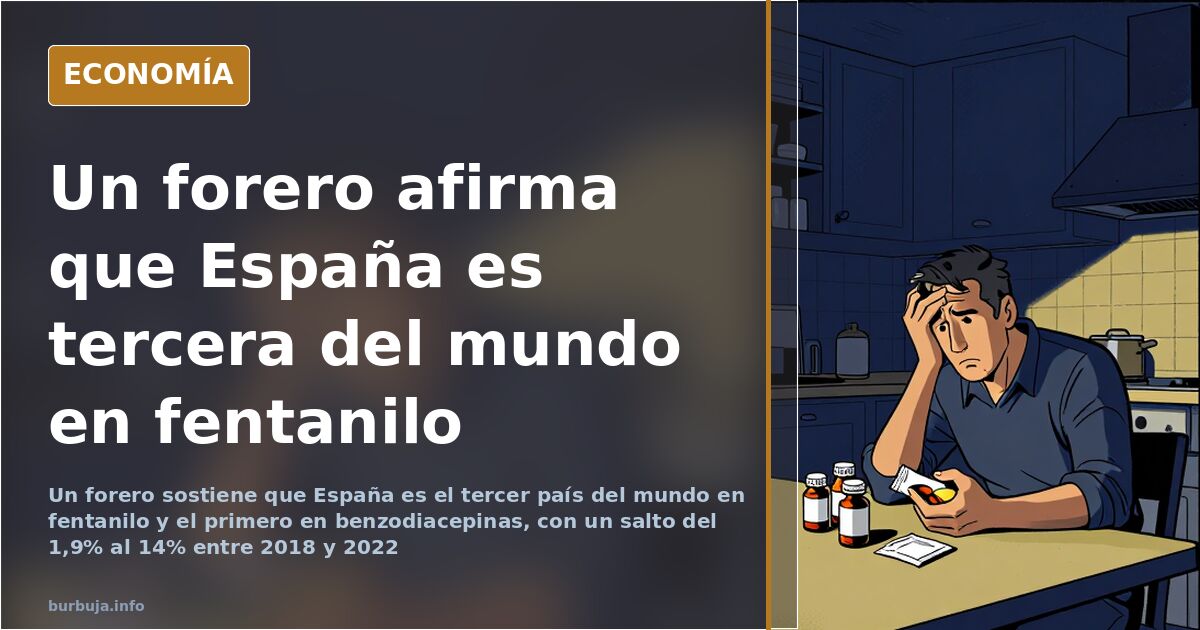
Forum User Claims Spain Is Now Third Worldwide in Fentanyl Consumption
The debate asserts that Spain has become the world's third-largest consumer of fentanyl and the leader in benzodiazepine use. This data, circulating in economic and health circles, clashes with public perception; many claim they have never seen a user. The answer is simple yet uncomfortable: invisibility does not miccionan non-existence. Fentanyl is not smoked on street corners or injected in abandoned lots. It arrives via transdermal patches, prescribed by doctors, and changed every three days.
The conversation begins with a recurring figure: in 2018, 1.9% of the population admitted using fentanyl, while in 2022, that percentage skyrocketed to 14%. If confirmed, this leap places Spain in a league previously thought exclusive to the United States, where the drug causes approximately 100,000 deaths annually.
From 80s Heroin to Today’s Patches
The parallel with the heroin crisis is inevitable but misleading. In the 1980s, anyone could encounter a user at their building entrance, suffering withdrawal with shared syringes. That was visible. This is not. Testimonies recall that back then, one only needed to avoid touching needles found on the ground; today, consumption enters through the primary care physician’s office.
This is the core issue. Fentanyl is a potent opioid analgesic, indicated primarily for cancer pain, administered via skin-absorbed patches. An inhaled version also exists, highly addictive. The suspicion pervading the debate is that some prescriptions end up in hands that do not need them, making the healthcare system the most silent entry point imaginable.
Benzodiazepines: The Other Unwanted Ranking
Spain leads not only in opioids. It is also the top country for benzodiazepine consumption, where criticism targets primary care directly. The accusation, repeated sarcastically, is that family doctors prescribe anxiolytics to dismiss patients with anxiety disorders who require different approaches. The result is a chronically medicated population for problems pills do not solve.
Context does not help. A country is described where anxiety, depression, and other mental health diagnoses have normalized to extremes that surprise distant observers. Living here, the chorus suggests, is counterproductive for mental health. When distress is structural, the pharmacological exit is always the cheapest.
Why Isn’t Fentanyl Visible Like Heroin?
Because its main entry route is not street dealing, but medical prescription. Fentanyl patches, sold under known brands, are placed on the skin and release the active ingredient continuously. This explains why many users do not identify as such: they do not inject, buy from dealers, or commit crimes to fund habits—at least initially.
The other side is addiction. The same potency that makes it useful for pain turns it into a rapid dependency trap. Here appears the most repeated argument: if the drug comes via prescription, the patient does not perceive risk until already inside. Legal and illegal circuits overlap, and this blurred boundary makes measuring the phenomenon difficult.
Conspiracy Narrative vs. Business Narrative
Interpretations vary widely. One current holds that increased consumption responds to a deliberate strategy of social weakening, benefiting pharmaceutical industry and specific interests. Another, more pragmatic view points simply to business: if the substance is cheap to produce and the health system funds it, expansion is guaranteed. Both readings coexist without reconciliation.
Some look to the immediate future with bitter sarcasm. The most repeated warning is that nitazenes, synthetic opioids even more potent than fentanyl, are already knocking on Europe’s door. A cited study calls for investigating how they entered. The sequence, they say, has been seen before: first the substance arrives, then the explanation trinc.
What the Data Leaves Open
One question remains unanswered: if Spain is third globally in consumption, where is the visible trace? In the US, fentanyl has devastated entire neighborhoods and changed the overdose mortality map. Here, the phenomenon is intuited in statistics and pharmacies, not in squares. This asymmetry between data and scene is likely the key to everything.
With these figures on the table, one would expect a deep health debate on prescription, control, and alternatives for chronic pain. What exists now is a conversation oscillating between astonishment and suspicion. If percentages continue rising as suggested, the question will no longer be whether it is seen, but what comes next.
The debate asserts that Spain has become the world's third-largest consumer of fentanyl and the leader in benzodiazepine use. This data, circulating in economic and health circles, clashes with public perception; many claim they have never seen a user. The answer is simple yet uncomfortable: invisibility does not miccionan non-existence. Fentanyl is not smoked on street corners or injected in abandoned lots. It arrives via transdermal patches, prescribed by doctors, and changed every three days.
The conversation begins with a recurring figure: in 2018, 1.9% of the population admitted using fentanyl, while in 2022, that percentage skyrocketed to 14%. If confirmed, this leap places Spain in a league previously thought exclusive to the United States, where the drug causes approximately 100,000 deaths annually.
From 80s Heroin to Today’s Patches
The parallel with the heroin crisis is inevitable but misleading. In the 1980s, anyone could encounter a user at their building entrance, suffering withdrawal with shared syringes. That was visible. This is not. Testimonies recall that back then, one only needed to avoid touching needles found on the ground; today, consumption enters through the primary care physician’s office.
This is the core issue. Fentanyl is a potent opioid analgesic, indicated primarily for cancer pain, administered via skin-absorbed patches. An inhaled version also exists, highly addictive. The suspicion pervading the debate is that some prescriptions end up in hands that do not need them, making the healthcare system the most silent entry point imaginable.
Benzodiazepines: The Other Unwanted Ranking
Spain leads not only in opioids. It is also the top country for benzodiazepine consumption, where criticism targets primary care directly. The accusation, repeated sarcastically, is that family doctors prescribe anxiolytics to dismiss patients with anxiety disorders who require different approaches. The result is a chronically medicated population for problems pills do not solve.
Context does not help. A country is described where anxiety, depression, and other mental health diagnoses have normalized to extremes that surprise distant observers. Living here, the chorus suggests, is counterproductive for mental health. When distress is structural, the pharmacological exit is always the cheapest.
Why Isn’t Fentanyl Visible Like Heroin?
Because its main entry route is not street dealing, but medical prescription. Fentanyl patches, sold under known brands, are placed on the skin and release the active ingredient continuously. This explains why many users do not identify as such: they do not inject, buy from dealers, or commit crimes to fund habits—at least initially.
The other side is addiction. The same potency that makes it useful for pain turns it into a rapid dependency trap. Here appears the most repeated argument: if the drug comes via prescription, the patient does not perceive risk until already inside. Legal and illegal circuits overlap, and this blurred boundary makes measuring the phenomenon difficult.
Conspiracy Narrative vs. Business Narrative
Interpretations vary widely. One current holds that increased consumption responds to a deliberate strategy of social weakening, benefiting pharmaceutical industry and specific interests. Another, more pragmatic view points simply to business: if the substance is cheap to produce and the health system funds it, expansion is guaranteed. Both readings coexist without reconciliation.
Some look to the immediate future with bitter sarcasm. The most repeated warning is that nitazenes, synthetic opioids even more potent than fentanyl, are already knocking on Europe’s door. A cited study calls for investigating how they entered. The sequence, they say, has been seen before: first the substance arrives, then the explanation trinc.
What the Data Leaves Open
One question remains unanswered: if Spain is third globally in consumption, where is the visible trace? In the US, fentanyl has devastated entire neighborhoods and changed the overdose mortality map. Here, the phenomenon is intuited in statistics and pharmacies, not in squares. This asymmetry between data and scene is likely the key to everything.
With these figures on the table, one would expect a deep health debate on prescription, control, and alternatives for chronic pain. What exists now is a conversation oscillating between astonishment and suspicion. If percentages continue rising as suggested, the question will no longer be whether it is seen, but what comes next.
Summary of a discussion on Burbuja.info - Foro de economía, actualidad y política., translated from Spanish and reviewed before publication. Read the full discussion (124 replies).
More summaries
-
Fentanyl and opioid crisis: lethal potency reaches Europe
Fentanyl has changed the rules of the drug crisis. We analyze this synthetic opioid's lethal potency and its arrival in Madrid.
-
Man sentenced to 4.5 years for slaughtering girlfriend's rabbit
A Valencia court sentences a man to 4.5 years in prison for killing, cooking, and forcing his girlfriend to eat her rabbit.
-
40 Bodies in a Garage: Unverified Claim
The claim of 40 bodies in a garage lacks specific location details, photos, or official confirmation.
-
Haley Calls for Identity Verification on Social Media
Former US Ambassador Nikki Haley proposes mandatory real-name verification on social media, citing national security concerns.
-
Teacher marks 103 minus 28 as 70, rejecting exact answer
A primary school exercise asks if 75 is reasonable for 103 - 28. The teacher marks the estimate of 70 correct, despite the exact calculation being 75.
-
Stellantis Faces Bankruptcy Risk Amid €2.3B Losses
Forum debate on Stellantis' crisis: heavy losses, faulty engines, and EU regulations drive user concerns.