
Former King reportedly facilitates €300,000 Ibex 35 advisory role for Urdangarin
Iñaki Urdangarin has reportedly been hired as a legal advisor for an Ibex 35 company with a €300,000 annual salary, allegedly backed by the former King.
English · Original discussion in Spanish · Published
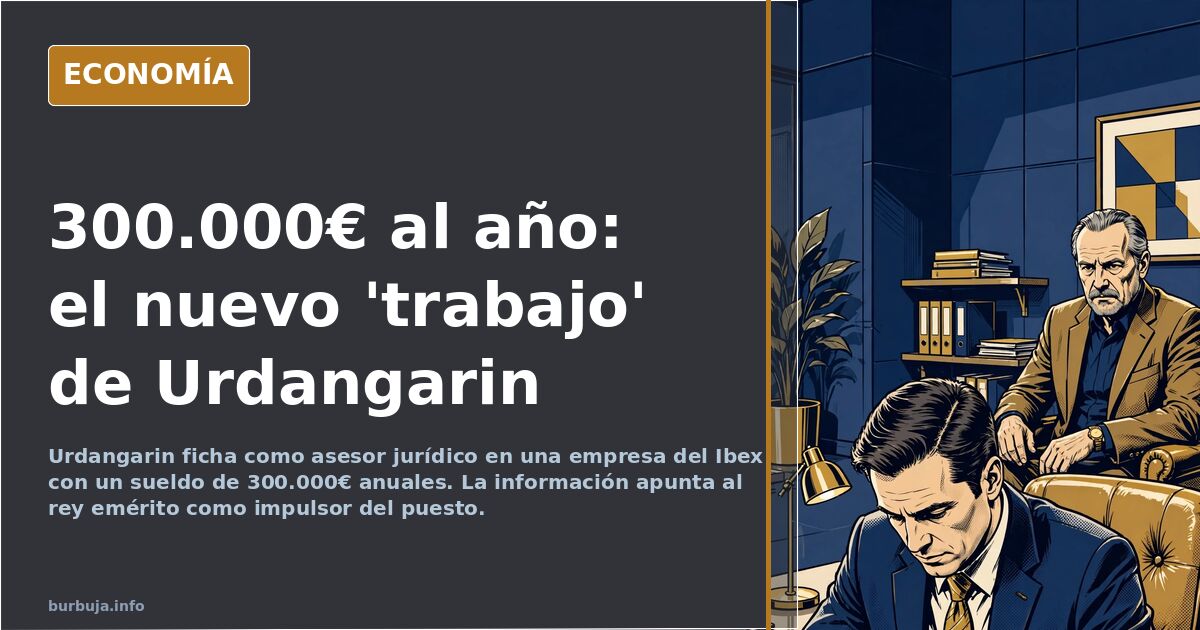
Urdangarin reportedly to earn €300,000 as legal advisor for Ibex 35 firm
A former convict for corruption has been hired as a legal advisor for an Ibex 35 company with an annual salary of €300,000. The detail that makes this story more than just an anecdote is who is allegedly behind the hiring: according to leaked information, the King emérito (the former King of Spain). Iñaki Urdangarin, the ex-husband of Infanta Cristina, reappears in the public eye not due to professional merit, but because of the shadow cast by the Noos case (a corruption scandal involving the Spanish royal family).
The figure is significant. Three hundred thousand euros a year places the position far above the average salary of a legal advisor in any Spanish law firm. Furthermore, the profile of the hire—convicted of crimes related to the embezzlement of public funds—raises the obvious question: it is not about his knowledge of commercial law, but rather whom he protects and from whom he receives protection.
Details regarding Urdangarin's new employment
Information released by journalist Juan Luis Galiacho places Urdangarin as an advisor to the legal department of a major Ibex 35 company. The specific company has not been named. It is also unclear whether the role involves actual duties or if it is a 'ghost position' with a salary but no real workload. This ambiguity is precisely what fuels public distrust.
The parallel with other 'revolving door' cases is unavoidable. The difference here is that the beneficiary is not a high-ranking official leaving the government, but someone who served a sentence and who, according to various reports, protected the secrets of the King emérito's inner circle during the judicial process. In certain circles, loyalty is paid for.
Job reintegration or covert influence peddling?
Some argue that anyone who has served their sentence has the right to reintegrate into the workforce. This argument is sound in the abstract. The problem arises when reintegration consists of a management position in a company operating in regulated sectors that likely has interests before the administration. The reintegration of a plumber is one thing; that of a former Duke convicted of corruption is quite another.
The most common irony in the analysis is that while Urdangarin has legal experience, it is primarily in incivil law. His time in prison may have given him a practical understanding of the justice system that few advisors can claim. "Don't do what I did, or you'll get caught," would be his most valuable advice.
The €300,000 salary and the gap with average earners
To put the figure in context: €300,000 per year equates to more than €20,000 per month across fourteen payments. This is more than a specialist doctor earns in an entire decade in some sectors. Above all, it is an amount that is not paid for a conventional CV.
Comparisons with other multimillion-euro appointments are frequent. Similar salaries are mentioned in the circles of large corporations and international organizations, always linked to well-known surnames or pending favors. The conclusion drawn is that the elite labor market operates under different rules: they do not hire the best; they hire the most useful.
Who pays and why: the shadow of the King emérito
Information suggests that the King emérito is behind the hiring. In other words, the salary would not come from Urdangarin's own pocket for his services, but would be a way to keep him in orbit, controlled and grateful. The expression that summarizes this dynamic is the "purchase of silence": those who remained quiet during the trial are now being paid via a monthly salary.
A parallel with the end of Alfonso XIII also appears in the analysis. When the monarchy runs out of arguments, it resorts to fleeing with full coffers. The difference is that there is no exile now, only Ibex companies willing to act as intermediaries.
How long can a system survive where merit is loyalty and punishment is transparency? The answer, as is almost always the case, is not found in the courts.
Also available in: Deutsch
Summary of a discussion on Burbuja.info - Foro de economía, actualidad y política., translated from Spanish and reviewed before publication. Read the full discussion (103 replies).
More summaries
-
Ceuta and the Army at 20%: Alfonso Rojo's controversy reveals a real problem
Alfonso Rojo reopens the debate on Ceuta: the Army at 20% of personnel, Vox's initiative rejected by PP and 25 years of Vivas in power. The data...
-
Cristina Pardo corners Óscar Puente on Antena 3
Cristina Pardo puts Óscar Puente on the spot on Antena 3, using corruption as a weapon and sparking talk of a changing cycle in the press and its…
-
Alfonso Ussía, Spanish writer and TV pundit, dies
Alfonso Ussía, author of Tratado de las buenas maneras, has died. Some call him a master of irony; others fault him for a drawing-room, bourgeois brand of humour.
-
Norwegian IQ Test: The Flaw in Measuring Cognitive Ability
Analysis of Norwegian IQ test results: Is intelligence measurable with patterns or is it a statistical fallacy?
-
LZB debate: "It fails half the days," says a forum user
A forum user claims the LZB fails half the days and another puts it at 170 outages a year; the minister reportedly called it routine, according to the thread. Staffing is at…
-
Spain appears in viral list of fatal train crashes since 2020
A list circulating on social media places Spain alongside Pakistan or Tanzania in fatal train accidents since 2020. The minister says the LZB system has failed 170…