
Foreign degree holders stuck in Spain's elder care jobs
Colombian graduates report only finding elder care work in Spain. A 30% wage gap between immigrants and natives is highlighted.
English · Original discussion in Spanish · Published
Migrant degree holders end up caring for the elderly in Spain
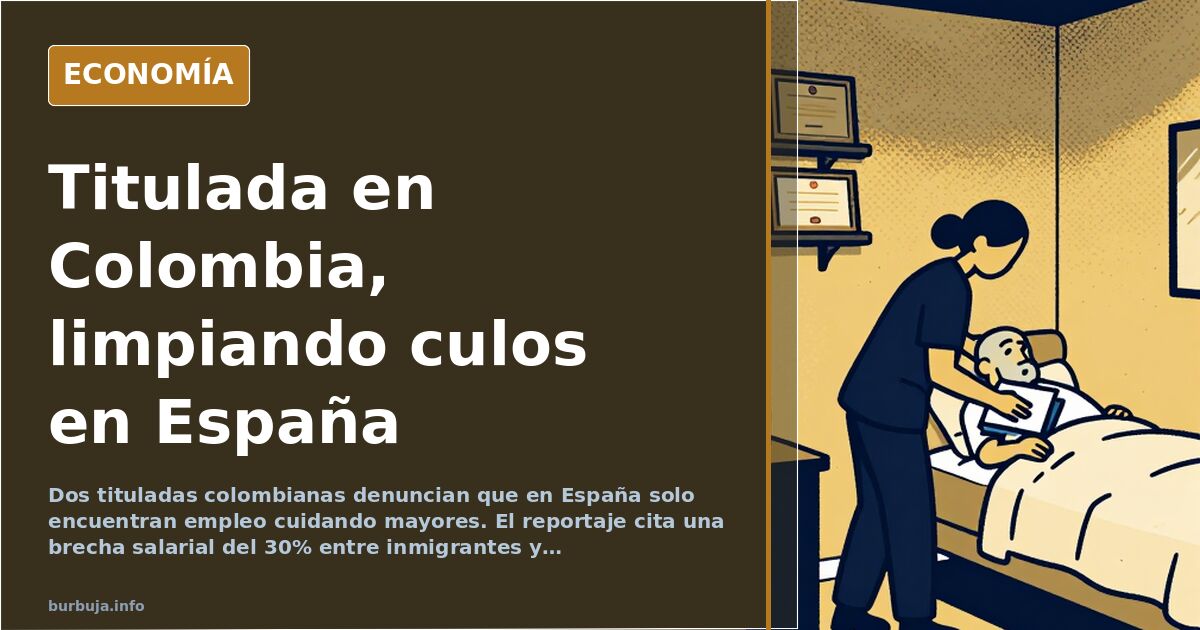
A Colombian professional with a university degree reports that in Spain, she can only find work caring for older people. The case, reported by a digital outlet, has peine the debate on foreign degree recognition and language as a barrier to qualified roles. The paradox is uncomfortable: Spain exports young talent while importing labor that ends up in the informal economy.
What the report says about graduates unable to find work in their field
The starting point is a specific complaint: two Colombian women with university degrees in their home country are forced into domestic and elder care jobs upon arriving in Spain. The report notes that lack of language proficiency is among the reasons they do not access qualified positions, alongside the absence of automatic degree validation. The text also states that immigrants earn 30% less than nationals, a gap the outlet presents without breaking it down.
Public reaction was immediate. Much of the commentary pointed to a basic contradiction: if the degree is not validated and the language is not mastered, the Spanish labor market will not hand out an air-conditioned office simply because someone was born elsewhere. The most repeated criticism recalled that Spain lacks qualified jobs for locals too: with a quarter of youth unemployed and housing costs soaring, competition for any position is fierce.
Why foreign degree recognition is not automatic
Recognizing a foreign university degree in Spain is not a simple counter service. It requires verifying academic level, curriculum content, and often passing exams or completing additional training. Those arriving with a bachelor’s degree from another country discover that the certificate does not hold the same value here, and the process can take months or years. Meanwhile, the need to eat presses hard.
That gap between expectation and reality is the core issue. Those who emigrate with a degree assume their education will open doors; instead, the market offers what is left over: care, cleaning, hospitality. The result is structural overqualification pushing many migrant graduates into the informal economy, where lack of papers and urgency to earn eliminate any wage bargaining power.
Language as a real barrier and a convenient excuse
The report mentions language as one obstacle. In practice, Colombian and Spanish share grammar but differ in professional registers, sector jargon, and workplace communication codes. A medical or engineering degree requires technical vocabulary not acquired on the street. Those claiming language is not a problem oversimplify; those using it as an excuse to pay less do so too.
The discussion moved to rougher ground. Some argue that part of irregular immigration feeds on networks teaching others how to arrive without papers, and that this should be prosecuted. This accusation appears in the material without evidence, launched in the heat of indignation. It should be treated as what it is: an unverified suspicion, not a fact.
The elder care paradox: no replacement without migrants
Spain’s care sector relies heavily on migrant workers, many in irregular status. Care homes and home assistance face accelerated population aging and a chronic shortage of professionals willing to accept sector conditions. The paradox is that the work locals refuse to do is ultimately done by those who arrived yesterday.
This dependency raises an uncomfortable question: what happens when these workers retire? The answer is not in the material. What does appear is the realization that the system rests on precarious labor whose regularization no one resolves. Meanwhile, the complaint of the Colombian graduates becomes the visible symptom of a labor market that does not absorb the talent it claims to need.
The calculation no one breaks down: 30% lower wages
The figure of a 30% wage gap between immigrants and nationals appears in the report without visible methodology. Does it refer to gross hourly wage, annual income, or specific sectors? Without that breakdown, the data is a headline, not an analysis. Those wanting to understand the real magnitude of the differential must dive into original sources, where the calculation is detailed line by line.
What can be stated is that the combination of overqualification, administrative irregularity, and economic urgency creates a wage floor that drags down conditions across the entire sector. It is not exclusively a Spanish phenomenon, but here it worsens due to lack of border control and slow recognition and regularization processes.
How many Colombian graduates are trapped in jobs unrelated to their training? How many will retire without having contributed enough? The report leaves questions open and answers hanging in the air.
A Colombian professional with a university degree reports that in Spain, she can only find work caring for older people. The case, reported by a digital outlet, has peine the debate on foreign degree recognition and language as a barrier to qualified roles. The paradox is uncomfortable: Spain exports young talent while importing labor that ends up in the informal economy.
What the report says about graduates unable to find work in their field
The starting point is a specific complaint: two Colombian women with university degrees in their home country are forced into domestic and elder care jobs upon arriving in Spain. The report notes that lack of language proficiency is among the reasons they do not access qualified positions, alongside the absence of automatic degree validation. The text also states that immigrants earn 30% less than nationals, a gap the outlet presents without breaking it down.
Public reaction was immediate. Much of the commentary pointed to a basic contradiction: if the degree is not validated and the language is not mastered, the Spanish labor market will not hand out an air-conditioned office simply because someone was born elsewhere. The most repeated criticism recalled that Spain lacks qualified jobs for locals too: with a quarter of youth unemployed and housing costs soaring, competition for any position is fierce.
Why foreign degree recognition is not automatic
Recognizing a foreign university degree in Spain is not a simple counter service. It requires verifying academic level, curriculum content, and often passing exams or completing additional training. Those arriving with a bachelor’s degree from another country discover that the certificate does not hold the same value here, and the process can take months or years. Meanwhile, the need to eat presses hard.
That gap between expectation and reality is the core issue. Those who emigrate with a degree assume their education will open doors; instead, the market offers what is left over: care, cleaning, hospitality. The result is structural overqualification pushing many migrant graduates into the informal economy, where lack of papers and urgency to earn eliminate any wage bargaining power.
Language as a real barrier and a convenient excuse
The report mentions language as one obstacle. In practice, Colombian and Spanish share grammar but differ in professional registers, sector jargon, and workplace communication codes. A medical or engineering degree requires technical vocabulary not acquired on the street. Those claiming language is not a problem oversimplify; those using it as an excuse to pay less do so too.
The discussion moved to rougher ground. Some argue that part of irregular immigration feeds on networks teaching others how to arrive without papers, and that this should be prosecuted. This accusation appears in the material without evidence, launched in the heat of indignation. It should be treated as what it is: an unverified suspicion, not a fact.
The elder care paradox: no replacement without migrants
Spain’s care sector relies heavily on migrant workers, many in irregular status. Care homes and home assistance face accelerated population aging and a chronic shortage of professionals willing to accept sector conditions. The paradox is that the work locals refuse to do is ultimately done by those who arrived yesterday.
This dependency raises an uncomfortable question: what happens when these workers retire? The answer is not in the material. What does appear is the realization that the system rests on precarious labor whose regularization no one resolves. Meanwhile, the complaint of the Colombian graduates becomes the visible symptom of a labor market that does not absorb the talent it claims to need.
The calculation no one breaks down: 30% lower wages
The figure of a 30% wage gap between immigrants and nationals appears in the report without visible methodology. Does it refer to gross hourly wage, annual income, or specific sectors? Without that breakdown, the data is a headline, not an analysis. Those wanting to understand the real magnitude of the differential must dive into original sources, where the calculation is detailed line by line.
What can be stated is that the combination of overqualification, administrative irregularity, and economic urgency creates a wage floor that drags down conditions across the entire sector. It is not exclusively a Spanish phenomenon, but here it worsens due to lack of border control and slow recognition and regularization processes.
How many Colombian graduates are trapped in jobs unrelated to their training? How many will retire without having contributed enough? The report leaves questions open and answers hanging in the air.
Also available in: Deutsch
Summary of a discussion on Burbuja.info - Foro de economía, actualidad y política., translated from Spanish and reviewed before publication. Read the full discussion (190 replies).
More summaries
-
Foreign Degree Recognition: The Talent Paradox
Spain's foreign degree recognition process clashes with bureaucratic delays, exams, and wage pressures, challenging the narrative of wasted talent.
-
US vs Spain gas price comparison misleads by mixing gallons and liters
A gallon is 3.78 liters: comparing $4 per gallon in the US with €1.99 per liter in Spain omits the conversion.
-
Spain housing crisis: 50 million people, no affordable homes
Forum users debate Spain's housing shortage, citing land scarcity, taxes, migration, and tourism. One notes the population grows by 500,000 annually.
-
Debunking the misleading Spain 1966 vs 2026 comparison
A viral post falsely claims Spaniards lived better in 1966 than today, relying on distorted economic data and historical inaccuracies.
-
Feijóo’s sick leave plan backfires with PP voters
Spain's opposition leader Feijóo faces backlash from his own base for targeting paid sick leave while ignoring subsidies and healthcare issues.
-
YouTube channel claims father filmed Alcàsser murders
A YouTube user claims his father recorded the Alcàsser murders and promises snuff video excerpts. No evidence provided, only narrative and technical analysis.