
Foreign Contributors Double, Sustaining Spain's GDP
Immigration sustains the GDP: foreign contributors jumped from 2 to 3.1 million in six years. Per capita income and housing affordability are not keeping pace.
English · Original discussion in Spanish · Published
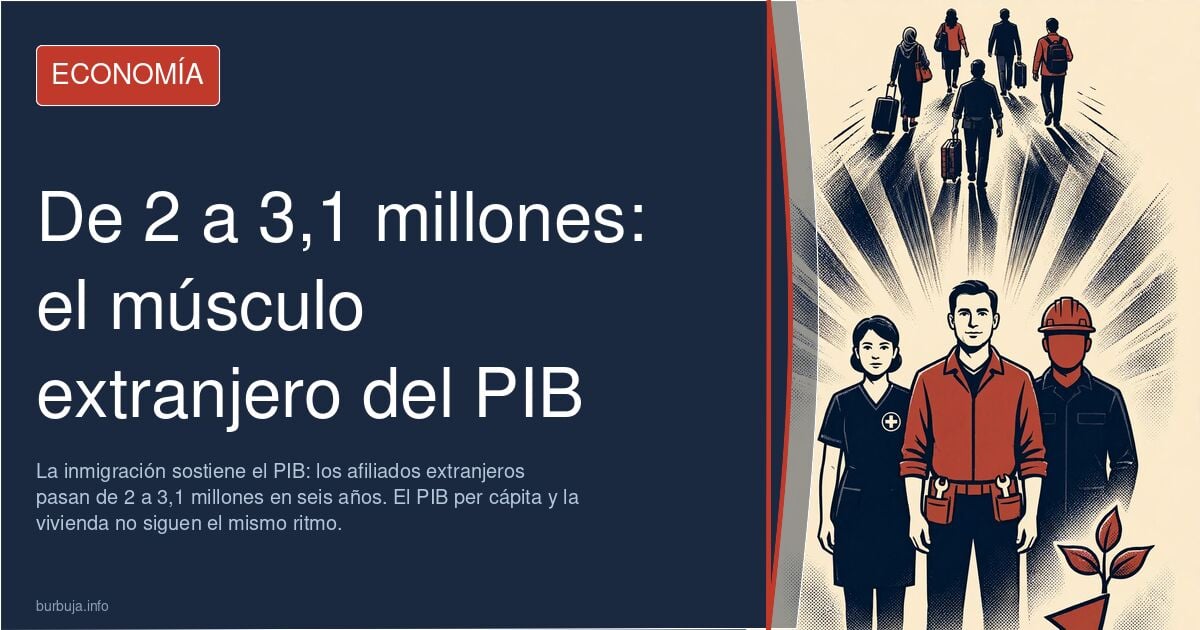
Foreign contributions rise from 2 to 3.1 million, propping up the GDP
How much of Spain's growth is due to immigration, and how much of that GDP ends up in the pockets of those who were already here? It is useful to start with the raw data. Over six years, foreign contributors to the Social Security system have risen from about two million to nearly 3.1 million, according to figures from last September. In August 2019, they accounted for 11% of total contributors; now they exceed 14%. The absolute record was set in June.
The demographic leap supporting the engine
Spain now receives more immigrants than France and Germany combined. It alone accounted for 65% of all population increase in the European Union and absorbed 28% of immigration arriving in the bloc. The pattern repeated in analyses is uncomfortable for triumphalist narratives: the Spanish economy grows supported by demographic increase, with GDP growth far exceeding that of other major economies on the continent, but without a corresponding jump in productivity.
GDP rises, but per capita income does not
This is where the disagreement begins. Some argue that a GDP growing by adding limbs is a statistical mirage. The example often cited: a four-person family in 60 square meters earning €4,000 and bringing in four cousins—two unemployed, two with one thousand euros—now earns €6,000. The family's "GDP" increases by 50%. But per person, it falls from €1,000 to €750, and the square meters per person are halved. Applied to a country, the aggregate grows, but the per capita GDP lags behind, and pressure on housing skyrockets. The average age of legal immigrants arriving is around 32 years old, a profile that boosts consumption and contributions but also the demand for rentals.
Who benefits from the flow: employers, landlords, and public coffers
The flow benefits more than one party, and not everyone is accounted for. Businesses in hospitality, agriculture, or construction without labor; the property owner with a rental flat; those living off subsidies. On the other side, there are those who call for data broken down by nationality because it mixes very different professional profiles. And in the middle, the low-wage worker competing for the same salary and the same flat.
The debate is not whether foreign workers boost the GDP—they do—but rather who pays the bill.
So yes: immigration boosts the GDP. The minor detail, as always, is who receives the rental bill increase.
How much of Spain's growth is due to immigration, and how much of that GDP ends up in the pockets of those who were already here? It is useful to start with the raw data. Over six years, foreign contributors to the Social Security system have risen from about two million to nearly 3.1 million, according to figures from last September. In August 2019, they accounted for 11% of total contributors; now they exceed 14%. The absolute record was set in June.
The demographic leap supporting the engine
Spain now receives more immigrants than France and Germany combined. It alone accounted for 65% of all population increase in the European Union and absorbed 28% of immigration arriving in the bloc. The pattern repeated in analyses is uncomfortable for triumphalist narratives: the Spanish economy grows supported by demographic increase, with GDP growth far exceeding that of other major economies on the continent, but without a corresponding jump in productivity.
GDP rises, but per capita income does not
This is where the disagreement begins. Some argue that a GDP growing by adding limbs is a statistical mirage. The example often cited: a four-person family in 60 square meters earning €4,000 and bringing in four cousins—two unemployed, two with one thousand euros—now earns €6,000. The family's "GDP" increases by 50%. But per person, it falls from €1,000 to €750, and the square meters per person are halved. Applied to a country, the aggregate grows, but the per capita GDP lags behind, and pressure on housing skyrockets. The average age of legal immigrants arriving is around 32 years old, a profile that boosts consumption and contributions but also the demand for rentals.
Who benefits from the flow: employers, landlords, and public coffers
The flow benefits more than one party, and not everyone is accounted for. Businesses in hospitality, agriculture, or construction without labor; the property owner with a rental flat; those living off subsidies. On the other side, there are those who call for data broken down by nationality because it mixes very different professional profiles. And in the middle, the low-wage worker competing for the same salary and the same flat.
The debate is not whether foreign workers boost the GDP—they do—but rather who pays the bill.
So yes: immigration boosts the GDP. The minor detail, as always, is who receives the rental bill increase.
Summary of a discussion on Burbuja.info - Foro de economía, actualidad y política., translated from Spanish and reviewed before publication. Read the full discussion (32 replies).
More summaries
-
Housing prices continue to climb: limited supply meets unstoppable demand
Prices rise despite high interest rates. Immigration and lack of new construction are fueling demand. Will the trend break?
-
Euthanasia in Old Age: Autonomy vs. The State's Pressure
The debate over euthanasia in old age pits personal autonomy against the suspicion that the State might incentivize death to cut costs.
-
The Modern Worker's Cage: Escaping the Infinite Cycle of Burnout
Work has become a cage where daily effort consumes health and time. Discover why we push ourselves so hard and how to break the cycle.
-
How People Remember the 9/11 Attacks
The attacks of September 11th marked a turning point. Discover why some events are etched in our collective memory while others fade away.
-
Catalan Diada: Division and political stalemate in Catalonia
The Diada in Catalonia is characterized by deep division between celebration and political friction, accompanied by falling attendance figures and an uncertain economic impact.
-
Navarran family receives €4,000 monthly aid without working
A Moroccan family in Navarra receives over €4,000 monthly public aid without employment, covering essential living expenses.