
Ford patents a system that would drive your car to the scrapyard
Ford has patented a system that would send your car to the scrapyard or the police station if you stop paying the financing, an idea that clashes with both technology and the law.
English · Original discussion in Spanish · Published
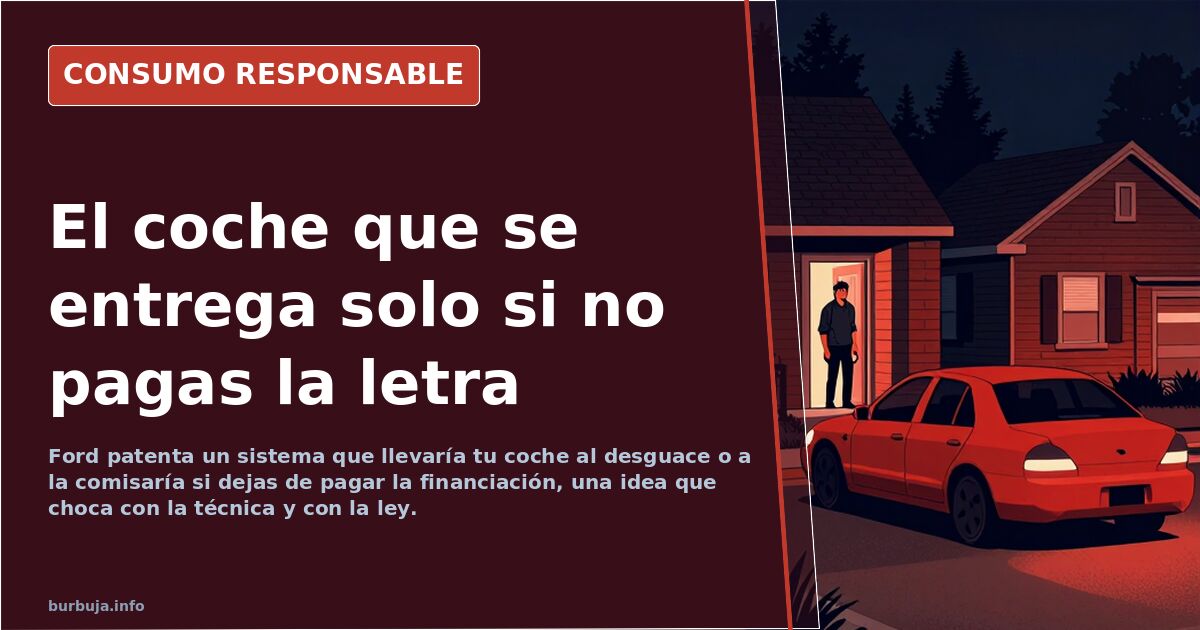
Ford patents a car that drives itself to the impound if you stop paying
Stop paying your car loan and, instead of a tow truck, your own Ford starts up by itself and drives off to a scrapyard or the nearest police station. That is what the automaker has reportedly patented to chase down missed payments, and it has raised an uncomfortable question: can a manufacturer take control of your vehicle over a missed bill? Put simply, the anti-deadbeat system is straightforward: pay up, or the car leaves on its own.
What Ford's patent actually says
The mechanism would go one step beyond the traditional tow truck. If the buyer stops paying the financing, the vehicle would drive itself to an agreed collection point, whether a scrapyard or a police station, without the owner lifting a finger. The proposal has sparked immediate backlash because it mixes two things that until now were kept separate: debt and physical control of the asset.
The most common comparison is that Ford turns non-payment into an automatic repossession, with the car acting as its own tow truck. And that is where the problem begins, because claiming the money is one thing, but unilaterally deciding what to do with an asset already in your garage is quite another.
Is it technically possible for the car to drive itself to the scrapyard?
The first line of doubt is technical, and skepticism here is nearly unanimous. Several voices argue that no vehicle today is capable of moving in a 100% autonomous way through the dense traffic of a major city: the variables are endless —traffic, distance, the number of cars around— and all of them require a supervising driver. A car can assist you, not replace you. Full autonomous driving, enough to send a vehicle from one point to another across a city, is not yet a reality.
That is why many view the patent with a smirk. The question is not whether Ford registered it, but whether it describes something workable or is just a deterrent gesture with more marketing value than substance.
Disabling it by hand: steering lock, battery and aluminum foil
If the technology is shaky, the public's answer is even more basic. Neighborhood-garage tricks are listed: a steering wheel lock, disconnecting the battery, pulling the right fuse or wrapping the specific antenna in aluminum foil to cut off its communications. With that, the argument goes, the car is not going anywhere.
The list dismantles the brand's futuristic narrative, but it opens another question. If you have to tamper with your own car to keep it from running away, something has gone wrong in the relationship between owner and manufacturer.
The legal problem: the car cannot take its owner away
Even if the vehicle could drive itself, a second wall appears: the legal one. If the car travels with the owner inside to a police station, it is argued that the owner could sue the manufacturer for kidnapping. Detaining a person against their will is not enforcing a debt, it is something else entirely.
That is the line separating a legitimate recovery system from an unlawful deprivation of liberty. That is why some outright call the patent a hoax by the manufacturer itself.
Financing a car, with or without a watchful brand
Beyond the patent, the conversation has drifted to the real-world context: buying a new car today is viewed with suspicion, and some rule out American or European brands in favor of Asian ones. People are starting to eye any installment financing warily.
And then there is the background noise: the case of Tesla is recalled, which reportedly disables vehicles over unpaid repairs, a claim attributed to commentator Ángel Gaitán and unconfirmed. A reminder that software now calls more of the shots than the key.
One contrast remains unresolved. The authorities take months to process any paperwork, it is said, but at three in the morning, in fog and at 130 km/h, a estimulante ilegal camera pulls all your data and mails you the certified letter the next day. Technology always arrives sooner to collect than to protect.
Also available in: Deutsch
Summary of a discussion on Burbuja.info - Foro de economía, actualidad y política., translated from Spanish and reviewed before publication. Read the full discussion (14 replies).
More summaries
-
Tesla's Autonomous Car Threatens Taxis and Driving Schools
Tesla's Cybercab promises to end taxis and driving schools, but licenses remain priced at €160k while FSD costs €99/month. Revolution or smoke?
-
Ford adds EGR valve to EcoBoost petrol engines
Ford integrates the EGR valve into its 1.5 EcoBoost petrol engine, cutting fuel consumption by 7% but introducing a component prone to clogging and requiring workshop maintenance.
-
Changing mobile OS doesn't eliminate tracking in Spain
Blocking Google on Android requires editing the hosts file and using F-Droid apps. Even LineageOS without GApps fails to stop connections to Qualcomm or Amazon.
-
Mercadona salmon rip-off: tray fillets cost up to 78% more
Mercadona charges up to €25/kg for salmon tray fillets while a whole salmon costs €11/kg. Data and tips to save.
-
Forgotten Argentine desserts: industrialization sweeps away 15 classics
Fifteen classic Argentine desserts, such as homemade dulce de leche, floating islands or bread pudding, are fading into oblivion due to industrialization. A look at the losses.
-
RPCS3 and Gran Turismo 5: why buying a PS3 makes more sense
Emulating Gran Turismo 5 on PC with RPCS3 causes crashes with many cars on track. A Ryzen 5 5600GT isn't enough. The alternative: buying a second-hand PS3 for under 100 euros.